




Import Cargo Volume to See Year-Over-Year Gain Again in June, Then Remain Below 2025 Levels Into Fall
After July, the report predicts a weakening in import volume as consumer uncertainty remains high and the impact of increasing inflation takes its toll.

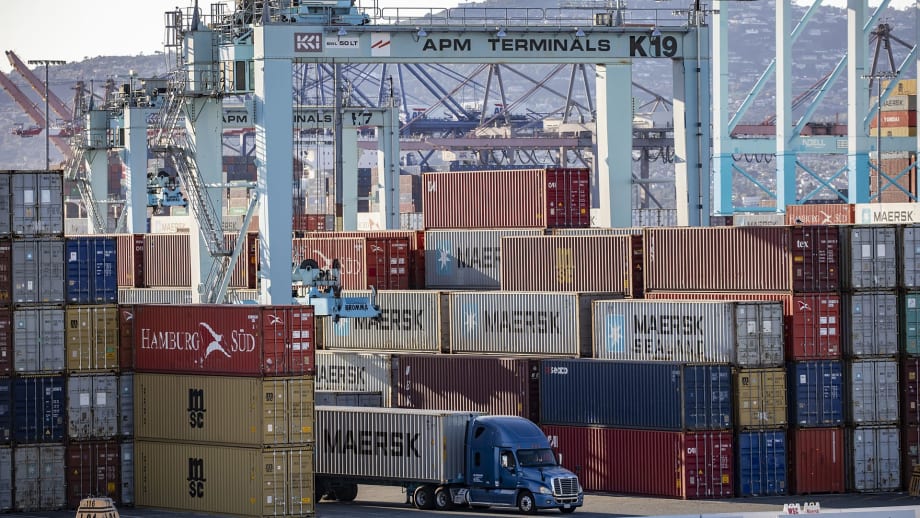
The Global Port Tracker report raised its outlook for June cargo volume, projecting an early peak season to get ahead of higher shipping costs driven by rising fuel prices and tariff concerns.
Port of Los Angeles
- Import cargo volumes at U.S. ports are projected to rise year-over-year in June due to early merchandise arrivals prompted by anticipated tariffs and rising fuel costs.
- The increase in June is expected to be temporary, with import volumes remaining below 2025 levels into the fall as economic uncertainties persist.
- The ongoing conflict in Iran exacerbates inflation and global economic uncertainty, which may contribute to a potential decline in import volumes.
*Summarized by AI
Import volumes at major U.S. container ports are expected to see a skewed year-over-year bump in June in anticipation of more tariffs and rising fuel prices, but then remain below last year’s levels into the fall, according to a new report.
The conflict in Iran continues to cause higher inflation and economic uncertainty, according to the Global Port Tracker report from the National Retail Federation and Hackett Associates, which is expected to lead to lower imports.
“We expect to see a year-over-year increase this month that’s partly driven by retailers bringing in merchandise early because of higher costs from tariffs or fuel prices that could come starting in August,” NRF Vice President for Supply Chain and Customs Policy Jonathan Gold said.
The year-over-year gain expected in June is partly due to comparisons with import levels that dropped sharply after President Donald Trump announced “Liberation Day” tariffs in April 2025.
But higher shipping costs and worries about additional tariffs imposed after those tariffs were ruled illegal by the Supreme Court are also a concern.
Importers Try to Get Ahead of Higher Costs
“We have increased our outlook for June cargo volume as retailers bring forward their peak season cargo to mitigate increasing shipping costs as carriers pass along the sharply rising cost of fuel and because of concerns about punitive replacement tariffs,” said Hackett Associates Founder Ben Hackett.
The current import surge will likely last into July, with an early peak season that resembles the more recent pattern of raised volume rather than a sharp peak, he added.
U.S. ports covered by Global Port Tracker handled 2.05 million Twenty-Foot Equivalent Units — one 20-foot container or its equivalent — in April, although the Port of New York and New Jersey has not yet reported its numbers.
Those April numbers were down 5.1% from March and down 7.3% year over year.
Ports have not yet reported May numbers, but Global Port Tracker projected the month at 2.14 million TEU. That's up 9.7% from a year earlier, when imports were down sharply because of last year’s “Liberation Day” tariffs.
What the Cargo Import Forecast Looks Like
June is forecast at 2.25 million TEU, up 14.3%, with the increase also because of low imports a year earlier.
Forecasts through the summer into the fall:
- July: 2.19 million TEU, down 8.4% year over year
- August: 2.12 million TEU, down 8.6% year over year
- September: 2.06 million TEU, down 2.2% year over year.
- October: 2.08 million TEU, up 0.1% year over year.
Those numbers would bring the first half of 2026 to 12.6 million TEU, up 0.6% from the same period in 2025, thanks in part to the May-June increases.
What is the Global Port Tracker?
Global Port Tracker, which is produced for the National Retail Federation by Hackett Associates, provides historical data and forecasts for the U.S. ports of Los Angeles/Long Beach, Oakland, Seattle and Tacoma on the West Coast; New York/New Jersey, Port of Virginia, Charleston, Savannah, Port Everglades, Miami and Jacksonville on the East Coast, and Houston on the Gulf Coast.
More Fleet Management

How Telematics Improves Visibility, Control, and Performance in Refrigerated Fleets
Explore how telematics help refrigerated fleets improve visibility, uptime, efficiency, compliance, and cargo protection across connected cold chain operations.
Read More →
What the U.S.-Canada Trade War Means for Trucking
Escalating U.S.-Canada tariffs could disrupt cross-border freight, reduce truck volumes, raise costs, and create new uncertainty for carriers on both sides of the border.
Read More →
What Are Trucking’s Top Concerns for 2026?
The American Transportation Research Institute wants to know what's worrying trucking fleet managers, drivers, and other stakeholders in its annual Industry Issues survey.
Read More →

American Trucking Associations Looks for a New Leader
ATA President and CEO Chris Spear abruptly left his job at the association on August 21, at a pivotal time for the trucking industry.
Read More →
Public Wi-Fi Cybersecurity Risks: How Truck Drivers and Fleets Can Protect Their Data
Public Wi-Fi can expose truck drivers and fleets to credential theft, malware, and other cyber threats. Here’s how to reduce the risk on the road.
Read More →
For Nicky Cupp, Fleet Innovation Starts With Frustration
HDT Truck Fleet Innovator Nicky Cupp turns everyday pain points at Fraley & Schilling into opportunities for better technology and smarter processes.
Read More →
Adam Buttgenbach’s Approach to Electric Trucks: Start With Where They Fit
HDT Truck Fleet Innovator Adam Buttgenbach helped PepsiCo build one of North America’s largest EV fleets by focusing on where electric trucks make operational sense.
Read More →
Deen Albert: Let Automation Do the Math, People Make the Decisions
HDT Truck Fleet Innovator Deen Albert makes sure people are still at the heart of operations at Grand Island Express, even while adopting artificial intelligence tools. AI-assisted dispatch helped boost revenue 25% with the same number of trucks.
Read More →
Trimble’s New AI Agent Takes Aim at Fleet Back-Office Busywork
Arc Agent works across Trimble TMS products to automate repetitive tasks such as freight orders, maintenance, invoices, fuel costs and more.
Read More →
How HDT’s 2026 Truck Fleet Innovators Are Rethinking Fleet Operations
Meet five trucking leaders who are challenging assumptions, solving operational problems, and putting innovative ideas to work.
Read More →