





Keep Up With Latest Tariff News: How Latest Trump Tariffs Could Affect Trucking
Port of Los Angeles: Tariffs Slowing Container Volume
May marked the lowest monthly cargo output in over two years at the Port of Los Angeles, thanks to trade policy uncertainty.
June 17, 2025
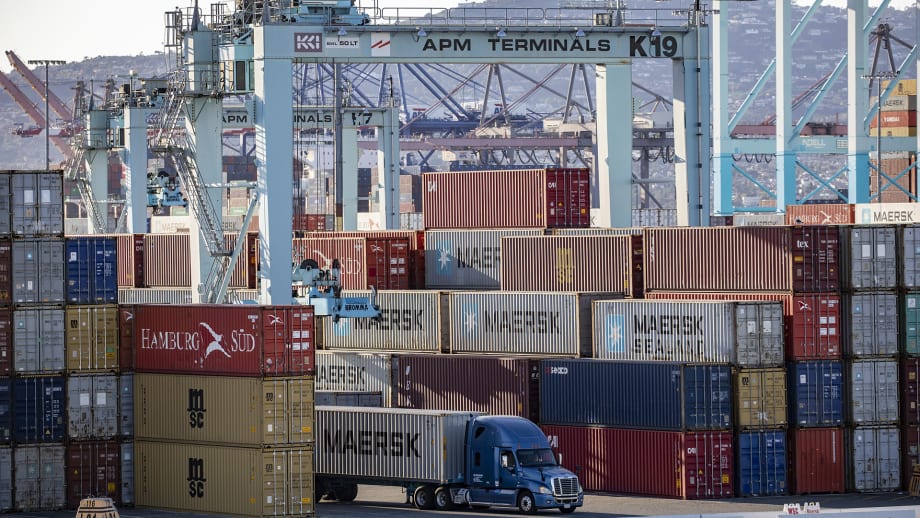
May 2025 imports at the Port of Los Angeles were 9% less than last year, and 17% less than the port’s five-year running average for the month of May.
File photo: Port of Los Angeles
2 min to read
After 10 straight months of year-over-year growth, overall cargo volume at the Port of Los Angeles slowed in May due to the impact of tariffs on both imports and exports.
The Port of Los Angeles processed 716,619 Twenty-Foot Equivalent Units (TEUs) in May, 5% less than last year.
“May marked our lowest monthly cargo output in over two years,” Port of Los Angeles Executive Director Gene Seroka said at a media briefing, although he did say it was a little better than port officials expected.
“To give you some perspective, the last six months of 2024 here at the Port of Los Angeles, we averaged 927,000 container units each month.”
Imports, Exports Both Down
Inbound cargo totaled 356,000 TEUs, which was 25% less than the port had forecasted on April 1 before the tariffs were announced.
May 2025 loaded imports came in at 355,950 TEUs, 9% less than the previous year. And compared to the port’s five-year running average for the month of May, imports were down 17%.
“While May volume is typically stronger than April as we approach our traditional peak season, our imports dropped 19% compared to last month,” Seroka said.
Loaded exports landed at 120,196 TEUs, a 5% drop from 2024.
“That lands us at six straight months of declining exports,” Seroka said.
The port processed 240,472 empty container units, 2% more than last year.
What Will Port of LA Container Traffic Look Like in 2025?
For the first five months in 2025, the Port of Los Angeles handled 4.06 million TEUs. That was 4% more than the same period in 2024, likely driven by the surge in imports as companies tried to bring in cargo ahead of expected tariffs.
Seroka said he expects overall cargo flow to remain modest for the balance of 2025.
He said the National Retail Federation’s Port Tracker predicts a decline in imports for June, July, and August.
Fast-Changing Tariff Policies
Seroka noted that more than 60 announcements on trade and tariffs have come from Washington since January, and the uncertainty created by these fast-changing tariff policies is affecting business decisions among those whose imports and exports move through the ports.
“What I continue to hear [from businesses] is we want clarity, longer range planning capability, and much lower tariffs,” he said.
“Unless long-term, comprehensive trade agreements are reached soon, we’ll likely see higher prices and less selection during the year-end holiday season,” Seroka added.
More Fleet Management

Sponsored•September 16, 2026
Color Match Smarter: Tools That Restore & Perform
For fleet managers and collision repair professionals keeping heavy-duty trucks on the road, getting the color right the first time isn't just about appearance — it's about efficiency, turnaround time, and bottom-line results. Discover how today's digital color tools are transforming the repair process from guesswork to precision.
Read More →
FMCSA Pauses Biennial-Update Enforcement Amid Motus Transition
Carriers whose updates were due on or after June 1 have more time, while FMCSA works to stabilize its new registration system and warns of phishing sites impersonating its new carrier registration system, Motus.
Read More →
Sponsored•September 14, 2026
2026 Blueprint for Countering Smarter Supply Chain Theft
Cargo theft is no longer just the cost of doing business. It's a multi-billion-dollar criminal enterprise exploiting vulnerabilities across your fleet, drivers, and supply chain.
Read More →


Sponsored•September 1, 2026
How Telematics Improves Visibility, Control, and Performance in Refrigerated Fleets
Explore how telematics help refrigerated fleets improve visibility, uptime, efficiency, compliance, and cargo protection across connected cold chain operations.
Read More →
What the U.S.-Canada Trade War Means for Trucking
Escalating U.S.-Canada tariffs could disrupt cross-border freight, reduce truck volumes, raise costs, and create new uncertainty for carriers on both sides of the border.
Read More →
What Are Trucking’s Top Concerns for 2026?
The American Transportation Research Institute wants to know what's worrying trucking fleet managers, drivers, and other stakeholders in its annual Industry Issues survey.
Read More →
American Trucking Associations Looks for a New Leader
ATA President and CEO Chris Spear abruptly left his job at the association on August 21, at a pivotal time for the trucking industry.
Read More →
Public Wi-Fi Cybersecurity Risks: How Truck Drivers and Fleets Can Protect Their Data
Public Wi-Fi can expose truck drivers and fleets to credential theft, malware, and other cyber threats. Here’s how to reduce the risk on the road.
Read More →
For Nicky Cupp, Fleet Innovation Starts With Frustration
HDT Truck Fleet Innovator Nicky Cupp turns everyday pain points at Fraley & Schilling into opportunities for better technology and smarter processes.
Read More →
Adam Buttgenbach’s Approach to Electric Trucks: Start With Where They Fit
HDT Truck Fleet Innovator Adam Buttgenbach helped PepsiCo build one of North America’s largest EV fleets by focusing on where electric trucks make operational sense.
Read More →