





Truck Maintenance Costs Ease Slightly, but Long-Term Trend Still Rising
Trucking Fleets Faced Record Operating Costs During Third Year of Freight Recession
ATRI's annual operational cost report shows carriers trimmed fleets, delayed equipment purchases, and ran older trucks as expenses continued to outpace freight rates.
July 15, 2026
Faced with rising costs and stagnant freight rates, motor carriers in the survey cut the number of trucks on the road. ATRI said it was the largest reduction in freight capacity since the start of the freight recession in 2022.
Credit:
HDT Graphic
6 min to read
As trucking fleets dealt with recessionary conditions in the freight markets for the third year in a row in 2025, they saw their average costs to operate a truck rise by 3.4% from the previous year.
That’s according to the American Transportation Research Institute’s 2026 Analysis of the Operational Costs of Trucking.
Record Truck Operating Costs in 2025
The average operating cost of $2.336 per mile was the highest per-mile cost in the report’s history.
Excluding fuel, costs rose by 4.2% to $1.854 per mile.
There was no single contributor to cost increases in 2025. Every line item
except permits and licenses increased year-over-year. The largest percentage gains were seen in:
- Tolls (13.2%)
- Repair and maintenance (8.6%)
- Driver benefits (6.6%)
- Tires (6.4%)
Only two line items rose at rates below the inflation rate: fuel and, for the second year in a row, driver pay.
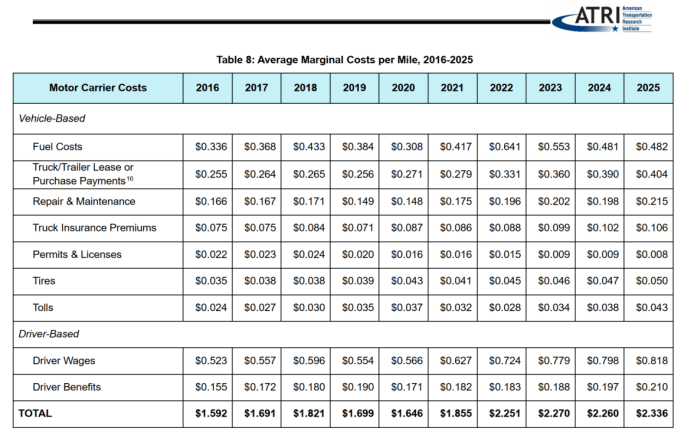
There was no single contributor to operational cost increases in 2025.
Source:
ATRI
Cutting Freight Capacity and Staff
Faced with rising costs and stagnant freight rates, motor carriers in the survey cut the number of trucks on the road. ATRI said it was the largest reduction in freight capacity since the start of the freight recession in 2022.
Carriers in the survey on average reduced truck counts by 2.4% and left another 10% of trucks unseated, according to ATRI.
The prolonged downturn also led to higher average truck age and annual mileage, more deadhead miles, and a cut in non-driver staffing levels by an average of 7.8%.
Most Trucking Fleets Still Struggled to Make Money
The industry’s austerity efforts did achieve some success, ATRI said.
The truckload, refrigerated, and tanker sectors made modest gains in profitability, with the truckload sector recovering from a negative average operating margin in 2024.
But of these, only the tanker sector had an operating margin of 1% or higher. The flatbed sector averaged an operating loss of 0.5%.
Only less-than-truckload carriers and fleets with more than 1,000 trucks had healthy margins in 2025, ATRI said. Compared to the previous year, they still were stagnant.
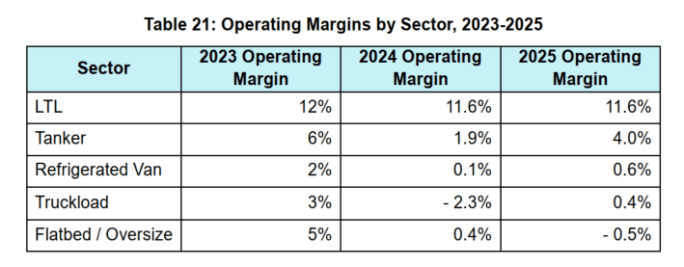
Only the tanker sector had an operating margin of 1% or higher in 2025
Source:
ATRI
Smaller Fleets, Older Trucks
In 2025, the average truck age rose for the first time since 2022, to 3.6 years. ATRI said this age is still low compared to historical averages, especially for a soft freight market, due to delayed delivery of trucks purchased during the post-pandemic freight boom.
Truck and trailer procurement costs varied by fleet size amid high prices and low freight volumes. Small fleets spent less on trucks and trailers in 2025 than in 2024, while truckload fleets with more than 1,000 trucks spent 16.1% more.
Older equipment typically means more maintenance and repair costs.
Truck Repair Costs Jump 8.6%
After falling by 2% from 2023 to 2024, repair and maintenance costs rose by 8.6% from 2024 to 2025 to an industry average of 21.5 cents per mile. (This includes parts, labor, and roadside service, but excludes tires and towing or recovery.)
Truckload carriers’ repair and maintenance costs tended to be lower as fleet size increased.
Not surprisingly, ATRI found that fleets with fewer than 5 trucks had the highest repair and maintenance costs in the truckload sector because they spent less on truck and trailer procurement. Older trucks typically need more maintenance.
Tariffs Push Up Tire Costs
Industry-average tire costs per mile (parts and labor) increased 6.4% to 5 cents per mile in 2025, after rising by just 0.1 cents per mile in each of the previous two years. Tire prices were affected by tariffs on natural rubber and by synthetic rubber costs associated with rising petroleum prices.
Tire costs were higher in the specialized sectors than in the truckload sector, except for the very smallest and largest fleets. This was especially the case for specialized fleets with 5 to 100 trucks, whose operations tend to be more specialized and thus incur greater tire wear or require more expensive tires.
Driver Compensation Tops $1 Per Mile
In 2025, the industry spent a per-mile average of 81.8 cents on driver wages and 21 cents on driver benefits, for a total of $1.028, 3.3% higher than in 2024. This was the first year in which combined compensation costs averaged above one dollar.
For a second straight year, industry-wide driver wages grew at a pace below the inflation rate. In 2025, driver wages rose by 2.5% while inflation rose by 2.7%. That’s similar to 2024, when wages rose by 2.4% while inflation rose by 2.9%.
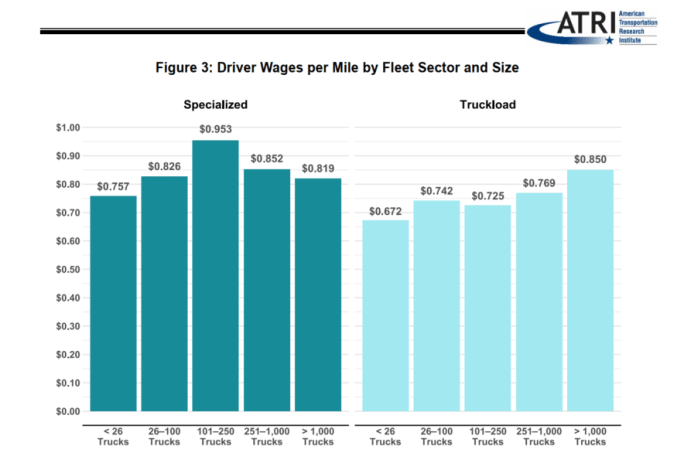
For a second straight year, industry-wide driver wages grew at a pace below the inflation rate.
Source:
ATRI
While nearly 100% of fleets offered health insurance, there were big differences between small and large fleets in other benefit offerings.
For example, there was a 22-point difference in the percentages of small and large fleets that offered 401(k) benefits, the second-most common benefit offered overall, with 74% of smaller fleets (100 or fewer trucks) and 96% of larger fleets (over 100 trucks)
The industry-average truck driver turnover rate improved to 44.2% in 2025 from 48% in 2024, as drivers were less inclined to switch jobs during a soft freight market with fewer open positions.
Fifty-four percent of respondents used owner-operators in some capacity in 2025, whether as a core component of operations or to accommodate unique freight needs. The specialized sectors had a higher rate of owner-operator use than the truckload sector.
ATRI Expects More Cost Pressure in 2026
First-quarter 2026 data show a continuation of most 2025 cost trends, according to ATRI.
Financial data for the first quarter of 2026 show that insurance, driver benefits, and toll costs continued to rise at an elevated rate.
- Insurance premiums were up 6.4%, driver benefits by 4.5%, and tolls by 2.7%.
- They were joined by fuel costs, which increased by 5.9% in the first quarter after remaining flat through 2025.
- Truck and trailer costs decelerated further, as did driver wages.
Repair and maintenance costs are likely to continue rising at elevated rates, ATRI said, thanks to tariffs on imported parts and on steel, aluminum, and copper used to make parts in the U.S.
The rising cost of parts has been partly masked by the slipping cost of technician labor, ATRI said, down 0.4% year-over-year in Q4 2025. With the labor market expected to stay flat through the end of 2026, ATRI said, lower labor costs will likely continue softening the blow of high parts costs.
“Freight rates are finally turning a corner in 2026, but the acceleration of industry-wide costs means that fleets must continue with aggressive cost discipline,” said PGT Trucking Chief Operating Officer Chad Marsilio.
How ATRI Calculated Trucking Costs
The data in the report reflects operational costs for the year 2025, as well as leading cost indicators for the first quarter of 2026.
The percentage of truckload respondents was lower than the trucking industry as a whole, and the percentage of LTL respondents and other/specialized were higher than the industry overall.
Fleets with 251 to 1,000 trucks made up the largest share of respondents, 25.3%, while 22.4% were fleets with 25 trucks or less.
Three new questions were added to the data collection form in 2026:
- Hours-of-service (HOS) utilization
- In-cab technology spend per truck
- Total litigation expense (verdicts, settlements, and/or legal costs)
In addition, truck and trailer costs, which previously had been reported as a single category, were collected as two separate categories.
The full report is available on ATRI’s website.
Participating carriers receive a customized report directly comparing their operations to an anonymized peer group of the same sector and size.
More Fleet Management
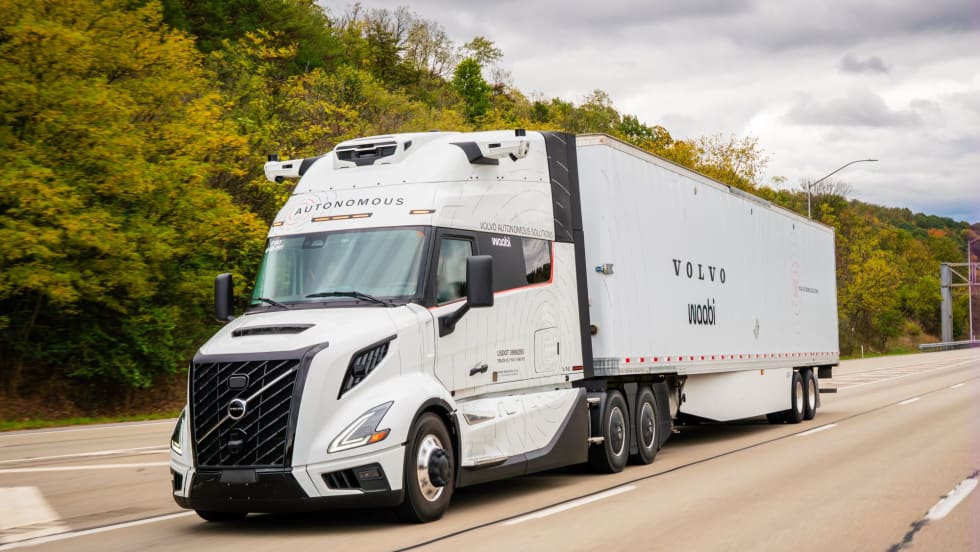
Volvo, Waabi Start Commercial Autonomous Operations in Texas
Volvo VNL Autonomous trucks, powered by the Waabi Driver, are hauling freight directly to third-party facilities for a customer in Texas.
Read More →
Samsara Launches Custom AI Agent Builder
Agent Studio lets fleets create AI tools for hours-of-service monitoring, reporting and driver support, including agents that communicate by phone.
Read More →
Geotab Links Fleet Card to Vehicle Data
The new card combines fuel discounts with telematics-based purchase controls. Geotab’s analysis also points to potential savings from choosing lower-priced fuel stops.
Read More →

How MFA Helps Protect Trucking Fleets
Multi-factor authentication adds protection when passwords are stolen. Here’s how it works and where fleets should start.
Read More →
How Better Freight Data Helps Trucking Teams Get Ahead of Disruption
Trucking and logistics teams have plenty of data. The problem is getting the right information in front of the right people soon enough to act. Better-connected data can help teams spot trouble earlier and make smarter decisions before small problems become big ones.
Read More →
Trimble: Taking Artificial Intelligence in Trucking Beyond Faster Tasks
At Insight 2026, Trimble executives argued that fleets may need to redesign workflows to get more from AI as it introduced new products and enhancements. AI’s value will depend on how fleets combine automation with their people's knowledge.
Read More →
Sponsored•September 28, 2026
Build a bulletproof fleet: Uniting ELDs and dash cams for total compliance
An ELD can prove compliance, but it cannot always prove what happened on the road. Discover how uniting accurate ELD data with AI-powered dash cam video can help your fleet strengthen compliance, defend against liability, protect drivers and reduce operational costs.
Read More →
Nominations Open for HDT Emerging Leaders
Heavy Duty Trucking is looking for accomplished trucking fleet professionals under 40 who are making an impact and helping lead the industry forward.
Read More →
Why Private Fleets Are Taking More Freight
Private fleets are putting their own trucks on demanding customers and high-cost lanes as companies seek greater control over service, costs, and capacity.
Read More →
Sponsored•September 16, 2026
Color Match Smarter: Tools That Restore & Perform
For fleet managers and collision repair professionals keeping heavy-duty trucks on the road, getting the color right the first time isn't just about appearance — it's about efficiency, turnaround time, and bottom-line results. Discover how today's digital color tools are transforming the repair process from guesswork to precision.
Read More →