What are motor carriers missing by sticking to their tried-and-true computer tech?
HDT Graphic
4 min to read
Even at a time when artificial intelligence is working its way into everything we do, many trucking fleets still use transportation management software with outdated load-planning tools.
Ad Loading...
These often force users to toggle between screens and may not offer the visibility that trucking fleets need today for efficient load planning.
Magnus Technologies has developed a tool that uses artificial intelligence to give fleets a more efficient and effective way of managing the intricacies of truckload planning.
Ad Loading...
I talked to Jay Delaney, director of product development for Magnus, about how technology is changing load planning for truckload carriers.
This interview has been lightly edited for clarity.
Magnus Technologies TMS
In 2021, Magnus Technologies launched a software-as-a-service-based TMS to simplify and streamline truckload carrier operations.
This year, it added AI-powered enhancements to “transform” load planning, order management, and freight visibility for truckload carriers, including a new load planning screen added in September.
Deborah Lockridge:It seems like technology is all over the map when it comes to how trucking companies use computers to manage their businesses. I’ve been surprised by the number of carriers still using mainframe computers and green screens.
Jay Delaney: In many ways, it’s very archaic still today. Many very large trucking companies still use green screens.
If you ask why, they’ll say it’s because it works and it’s fast. They don’t have outages, downtime, or hacks. And people know it — they can rifle through screens quickly. To this day, they believe it’s a competitive advantage.
Ad Loading...
But it’s interesting that, after 35 years of using the same software, we haven’t developed something better.
Lockridge: There’s lots of new technology out there to help trucking fleets. How bad is the problem, and what opportunities are they missing?
Delaney: They’re missing out on significant opportunities with the advancements being made.
However, their reasons — performance and reliability — are legitimate. Until they feel comfortable with high-performance, reliable software, they won’t change.
But we’re seeing some shifting mentalities.
Ad Loading...
Lockridge: So tell me about what you’ve been working on at Magnus Technologies.
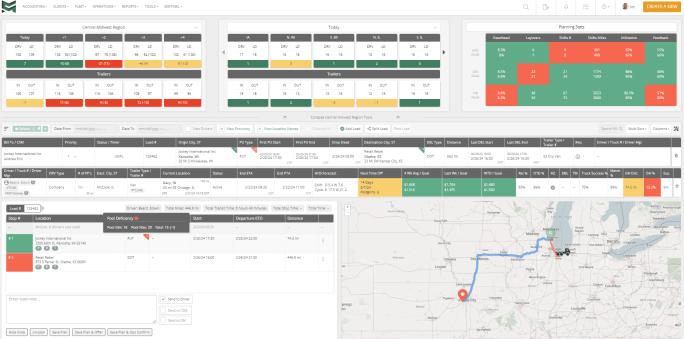
At Magnus, we’ve focused on making load planning better. We’ve identified four key areas to improve.
First, planners don’t need a flood of data; they need relevant information. Many systems inundate them with massive grids of data, which is overwhelming. We’ve designed our system to condense and present only pertinent information.
Second, visualization is key. A picture is worth a thousand words, so we’re integrating maps and visual dispatch applications to provide context that raw data can’t.
Third, we’re using KPIs directly within the planning screen. Most planners don’t know how their decisions affect utilization, deadhead, or costs. Showing them this data drives better behavior.
Finally, we’re focusing on network management and planning. With AI, we can forecast oversold or undersold markets five days in advance. This allows fleets to address imbalances early, turning potential costs into revenue-generating opportunities.
An example of network balance metrics, which are based on forecasting the demand and capacity in a load planner’s territory up to five days in advance.
Source: Magnus Technologies
Lockridge: Tell me a little more about Magnus and its background.
Delaney: Magnus has been around for 15 years as a TMS provider. We started in the finished vehicle market, working with auto haulers. Recently, we’ve expanded into truckload and other transportation markets. My role is to help drive this transition.
Ad Loading...
We’ve identified planning as the most pressing need, as it’s central to everything else. If planning isn’t right, the rest of the operation suffers.
Deborah Lockridge: How do you approach predicting oversold or undersold markets?
Delaney: Using AI is like predicting the weather — the further out, the less accurate. We found five days to be the sweet spot for balancing accuracy and time to act.
For significant imbalances (over or under by more than 5%), this timeframe allows for meaningful corrective actions.
It uses historical data, economic forecasts, and customer trends. Over time, the AI learns from its accuracy and self-corrects to improve predictions.
Ad Loading...
An example of network balance metrics, which are based on forecasting the demand and capacity in a load planner’s territory up to five days in advance.
Source: Magnus Technologies
Lockridge: What challenges and advances exist in using all this data?
Delaney: The challenge is collecting and ensuring the data is accurate. The advantage is leveraging data not previously used, like economic factors.
AI’s ability to self-manage and adapt reduces the burden on users, unlike traditional systems that require constant tweaking.
Lockridge: What opportunities and challenges do fleets face with advances in AI and software?
Delaney: The industry is overloaded with data, but much of it is noise. AI helps filter this noise, presenting only relevant information. Simplicity and ease of use will also be critical, as intuitive systems reduce the knowledge loss when employees leave.
For fleet managers and collision repair professionals keeping heavy-duty trucks on the road, getting the color right the first time isn't just about appearance — it's about efficiency, turnaround time, and bottom-line results. Discover how today's digital color tools are transforming the repair process from guesswork to precision.
Carriers whose updates were due on or after June 1 have more time, while FMCSA works to stabilize its new registration system and warns of phishing sites impersonating its new carrier registration system, Motus.
Cargo theft is no longer just the cost of doing business. It's a multi-billion-dollar criminal enterprise exploiting vulnerabilities across your fleet, drivers, and supply chain.
Explore how telematics help refrigerated fleets improve visibility, uptime, efficiency, compliance, and cargo protection across connected cold chain operations.
Escalating U.S.-Canada tariffs could disrupt cross-border freight, reduce truck volumes, raise costs, and create new uncertainty for carriers on both sides of the border.
The American Transportation Research Institute wants to know what's worrying trucking fleet managers, drivers, and other stakeholders in its annual Industry Issues survey.
HDT Truck Fleet Innovator Adam Buttgenbach helped PepsiCo build one of North America’s largest EV fleets by focusing on where electric trucks make operational sense.