





Read Vise's Previous Column: When Consumer Spending on Goods Produces No Freight
Why Strong Chemicals Output Isn’t Leading to Strong Truck Freight
Why do pharmaceutical and chemicals indicators matter to the health of trucking?
October 1, 2024
FTR's Avery Vise shares his insights each month for Heavy Duty Trucking.
Image: HDT Graphic
3 min to read
If you watch TV, you know that there’s big money in pharmaceuticals. Every other commercial seems to hawk some drug that will cure or treat one thing or another.
(I enjoy hearing the extensive – and sometimes odd – side effects, especially one recently where one of the side effects is the very condition that the medication is intended to treat.)
Pharmaceutical companies can afford to run a plethora of commercials because they are selling lots of drugs. Adjusted for inflation, sales are up about 40% since 2017 — and the commercials help them sell even more. To sell more drugs, you must make more drugs.
Why does this matter?
The Link Between Chemicals Production and Manufacturing
We traditionally think of chemicals production as a bellwether for the overall manufacturing industry, and manufacturing is a huge engine of truck freight volume — far more than retail sales, for example.
Monsanto once had an ad slogan, “Without chemicals, life itself would be impossible.” To put a finer point on it, we might declare, “Without chemicals, manufacturing itself would be impossible.”
Chemicals are an important component in some manufactured goods, but they are especially key to the manufacturing process. As manufacturers order more of the chemicals they need to produce stuff, we expect more stuff to be produced.
However, the strength in manufacturing of pharmaceuticals and other medicines is distorting the data on the broader chemicals manufacturing sector.
What Are Chemicals Production Numbers Saying?
Preliminary figures from the latest months show pharmaceutical and medicine production at its highest level since late 2009, when output was in a prolonged slide.
While pharmaceuticals output itself has some freight value, it’s nothing compared to the wide range of manufactured goods that depend on other chemicals.
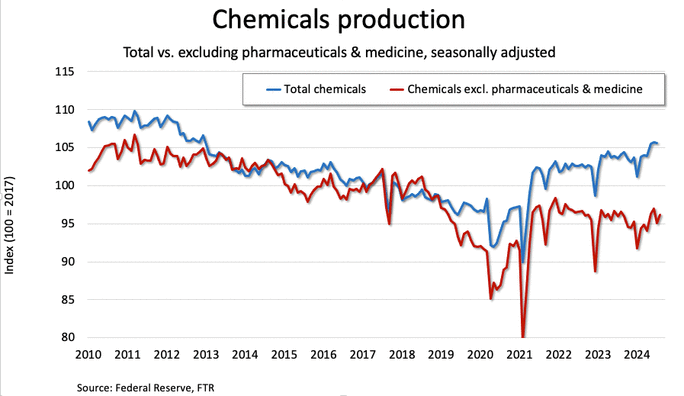
Pharmaceutical and medicine production has been at its highest level since late 2009, when output was in a prolonged slide.
Source: FTR
Total chemicals production recently has been the strongest since 2012. But total manufacturing output in August was barely any stronger than it was a year ago and below levels seen at various periods between 2012 and today.
Manufacturing production is not declining; it’s just sluggish, much like it was in 2016.
The Changing U.S. Economy
Excluding pharmaceuticals and medicine, chemicals manufacturing is, like overall manufacturing, not bad but also not great. The data is volatile, but a few outliers aside, recent data shows the production of chemicals excluding pharmaceuticals at around the strongest levels since the beginning of 2019.
Before then, however, you must go back to the Great Recession to find consistent production levels lower than they are now.
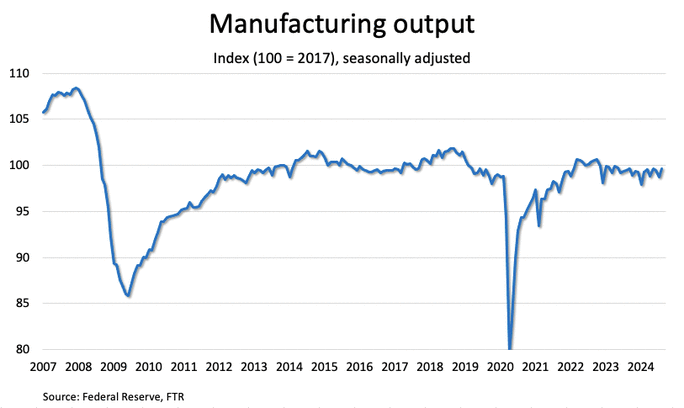
Previously, chemicals production was seen as a bellwether for the overall manufacturing industry, and manufacturing is a huge engine of truck freight volume.
Source: FTR
Drilling down another layer, it’s a mixed bag.
Industrial gas production is running at close to its highest level since 2008, and agricultural chemicals — pesticides, fertilizers, etc. — are close to their highest output in a decade. On the other hand, the key group of basic chemicals looks more like the broader category of chemicals excluding pharmaceuticals.
As we have seen with computer-related manufacturing and the construction of facilities to support it, the pharmaceuticals industry is reshaping parts of the U.S. economy in ways that require us to dig a little deeper when trying to analyze the ramifications for freight.
Subscribe to Our Newsletter
More Fleet Management

Sponsored•September 16, 2026
Color Match Smarter: Tools That Restore & Perform
For fleet managers and collision repair professionals keeping heavy-duty trucks on the road, getting the color right the first time isn't just about appearance — it's about efficiency, turnaround time, and bottom-line results. Discover how today's digital color tools are transforming the repair process from guesswork to precision.
Read More →
FMCSA Pauses Biennial-Update Enforcement Amid Motus Transition
Carriers whose updates were due on or after June 1 have more time, while FMCSA works to stabilize its new registration system and warns of phishing sites impersonating its new carrier registration system, Motus.
Read More →
Sponsored•September 14, 2026
2026 Blueprint for Countering Smarter Supply Chain Theft
Cargo theft is no longer just the cost of doing business. It's a multi-billion-dollar criminal enterprise exploiting vulnerabilities across your fleet, drivers, and supply chain.
Read More →


Sponsored•September 1, 2026
How Telematics Improves Visibility, Control, and Performance in Refrigerated Fleets
Explore how telematics help refrigerated fleets improve visibility, uptime, efficiency, compliance, and cargo protection across connected cold chain operations.
Read More →
What the U.S.-Canada Trade War Means for Trucking
Escalating U.S.-Canada tariffs could disrupt cross-border freight, reduce truck volumes, raise costs, and create new uncertainty for carriers on both sides of the border.
Read More →
What Are Trucking’s Top Concerns for 2026?
The American Transportation Research Institute wants to know what's worrying trucking fleet managers, drivers, and other stakeholders in its annual Industry Issues survey.
Read More →
American Trucking Associations Looks for a New Leader
ATA President and CEO Chris Spear abruptly left his job at the association on August 21, at a pivotal time for the trucking industry.
Read More →
Public Wi-Fi Cybersecurity Risks: How Truck Drivers and Fleets Can Protect Their Data
Public Wi-Fi can expose truck drivers and fleets to credential theft, malware, and other cyber threats. Here’s how to reduce the risk on the road.
Read More →
For Nicky Cupp, Fleet Innovation Starts With Frustration
HDT Truck Fleet Innovator Nicky Cupp turns everyday pain points at Fraley & Schilling into opportunities for better technology and smarter processes.
Read More →
Adam Buttgenbach’s Approach to Electric Trucks: Start With Where They Fit
HDT Truck Fleet Innovator Adam Buttgenbach helped PepsiCo build one of North America’s largest EV fleets by focusing on where electric trucks make operational sense.
Read More →