Adam Buttgenbach’s Approach to Electric Trucks: Start With Where They Fit
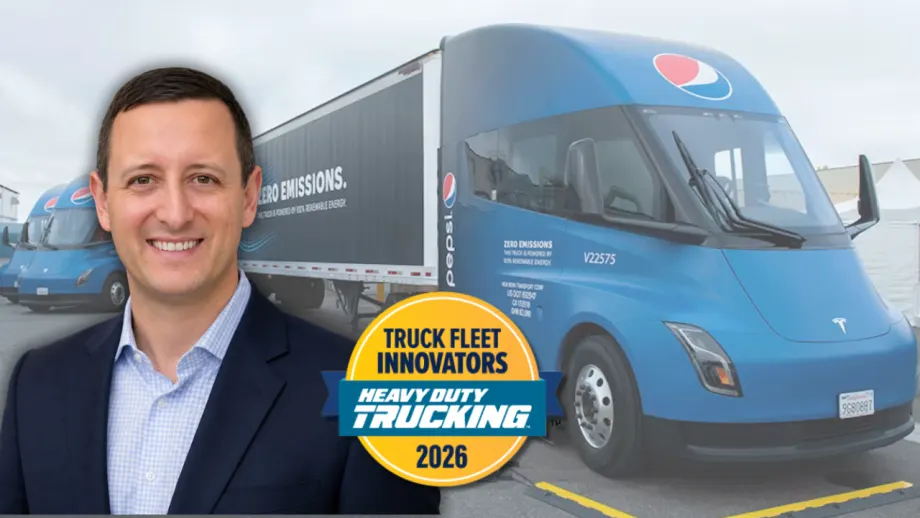
HDT Truck Fleet Innovator Adam Buttgenbach helped PepsiCo build one of North America’s largest EV fleets by focusing on where electric trucks make operational sense.
Adam Buttgenbach has partnered with manufacturers such as Volvo, Einride, and Tesla on the development and deployment of electric trucks, ranging from vans to yard tractors to over-the-road Class 8 tractors.
Credit:
HDT/PepsiCo
4 min to read
Adam Buttgenbach got his start driving trucks while in college and has spent the past two decades helping fleets tackle new technology. Most recently, he helped PepsiCo deploy one of North America's largest electric-vehicle fleets, from Ford E-Transit vans to Class 8 tractors, as the global procurement director – fleet transformation.
Ad Loading...
His career took an unexpected turn when a friend from graduate school joined a startup that needed someone to help launch its trucking operation.
"I think they thought, 'Well, you have a CDL and you've driven a truck, so you must know how to start up a trucking company,'" he recalls with a laugh.
Ad Loading...
Buttgenbach was game and left grad school early to join that company.
His interest in electric trucks also began in graduate school, when a friend introduced him to electric cars.
Then several years later, while working at Brinks, he says, “We were looking at what the future of fleet might look like. We ended up designing and purchasing the first two electric trucks for their fleet.”
Learning From Mistakes
When he joined PepsiCo eight years ago, he inherited responsibility for hundreds of Smith Electric trucks in California after the manufacturer went out of business.
"So there were a lot of these trucks with not a whole lot of support structure," Buttgenbach says. "So being in the field hands-on, running the operations, giving that firsthand experience of being able to figure out what suppliers can help support us, keep the trucks alive, keep them running."
Ad Loading...
Later, leading PepsiCo's fleet center of excellence, Buttgenbach partnered with manufacturers such as Volvo, Einride, and Tesla on development and deployment of everything from yard tractors to over-the-road Class 8 tractors.
Before making major investments, Buttgenbach's team evaluates everything from charging infrastructure and maintenance requirements to supplier stability and total cost of ownership.
His team looked at Nikola battery-electric and hydrogen-fuel cell trucks. Digging into their business model, however, they couldn't see a clear pathway to profitability.
"If they don't have a pathway to ever become profitable, it's a repeat of Smith Electric and EVI all over again, to where they eventually run out of money," he says. "So that was a huge deciding factor for us: Do they have a pathway to profitability? We want our suppliers to be successful so we can continue to purchase vehicles from them."
Experience has taught him that buying the trucks is only one piece of the puzzle. Drivers, technicians, charging infrastructure, and supplier support all have to be ready, too.
Ad Loading...
While going from a gas-powered Ford Transit van to the electric E-Transit, Buttgenbach notes, the cab is pretty much the same. "So when the driver gets in, it's very familiar." That made change management simpler.
The Tesla Semi, however, was a totally different design from the legacy heavy-duty truck cab drivers were used to.
"We always look for hand raisers. There's always a lot of very excited people who want to be a part of this transformation."
"There's a lot of positive feedback on the way that it's designed, but it was a big change management shift," he says. "So we always look for hand raisers. There's always a lot of very excited people who want to be a part of this transformation."
When those hand-raisers share the experiences they have with the new trucks, it makes the new-technology adoption faster and easier.
Matching Electric Trucks to the Operation
One thing he’s learned about adapting electric trucks and other new technology? The importance of starting with the fleet's operations and applications, rather than with the trucks.
Ad Loading...
Rather than trying to prove electric trucks could do everything, the company started by matching them to routes where they made the most sense.
For some applications, that meant initially limiting routes to about half the truck's available range. The extra cushion reduced driver anxiety, accounted for traffic and weather, and gave the fleet time to learn the technology before expanding its use.
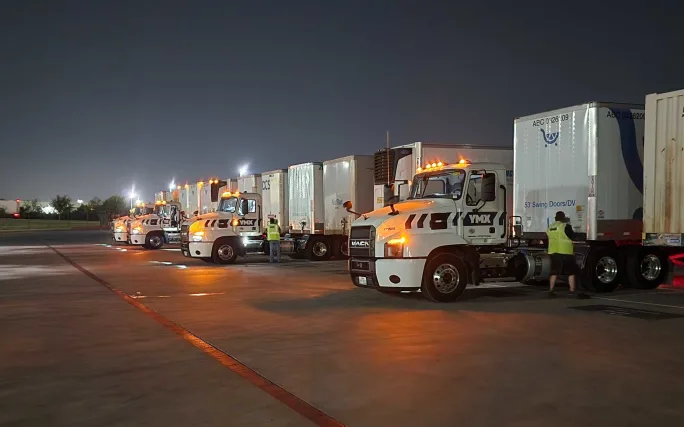
Buttgenbach's latest project is with YMX Logistics.
Credit:
Courtesy Adam Buttgenbach/YMX
"We really tried to look at the technology and then focus on where it fits operationally and not put it somewhere that it's not going to work."
Buttgenbach frequently shares those experiences with other fleets. Whether they're evaluating electric trucks or the next emerging technology, he encourages them to begin with a simple question:
"Where does this technology actually fit?"
Ad Loading...
Editor’s Note: Buttgenbach has since joined YMX Logistics as vice president of fleet strategy and loss prevention.
Trucking and logistics teams have plenty of data. The problem is getting the right information in front of the right people soon enough to act. Better-connected data can help teams spot trouble earlier and make smarter decisions before small problems become big ones.
At Insight 2026, Trimble executives argued that fleets may need to redesign workflows to get more from AI as it introduced new products and enhancements. AI’s value will depend on how fleets combine automation with their people's knowledge.
Private fleets are putting their own trucks on demanding customers and high-cost lanes as companies seek greater control over service, costs, and capacity.
For fleet managers and collision repair professionals keeping heavy-duty trucks on the road, getting the color right the first time isn't just about appearance — it's about efficiency, turnaround time, and bottom-line results. Discover how today's digital color tools are transforming the repair process from guesswork to precision.
Carriers whose updates were due on or after June 1 have more time, while FMCSA works to stabilize its new registration system and warns of phishing sites impersonating its new carrier registration system, Motus.
Cargo theft is no longer just the cost of doing business. It's a multi-billion-dollar criminal enterprise exploiting vulnerabilities across your fleet, drivers, and supply chain.
Explore how telematics help refrigerated fleets improve visibility, uptime, efficiency, compliance, and cargo protection across connected cold chain operations.
Escalating U.S.-Canada tariffs could disrupt cross-border freight, reduce truck volumes, raise costs, and create new uncertainty for carriers on both sides of the border.
The American Transportation Research Institute wants to know what's worrying trucking fleet managers, drivers, and other stakeholders in its annual Industry Issues survey.