




PepsiCo Looks to Scale Tesla Semi EV Operations Beyond California
Tesla's Dan Priestley and PepsiCo's Dejan Antunovic gave IAA 2024 attendees an update on the Tesla Semi and PepsiCo's experiences with the battery-electric truck, including what Tesla is doing to drive down total cost of ownership.

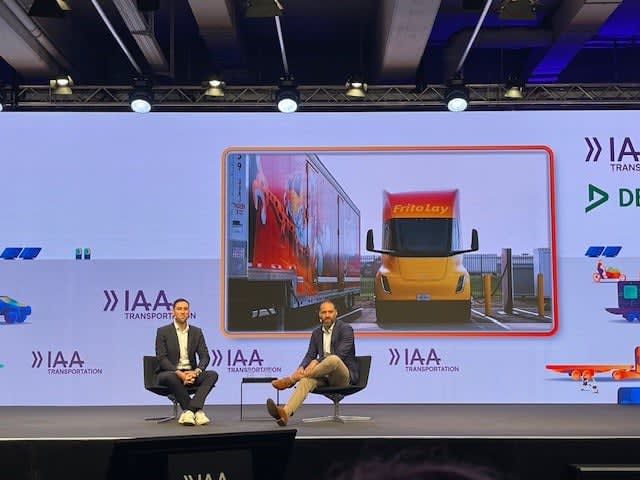
Dejan Antunovic (left) with PepsiCo and Dan Priestley of Tesla give IAA 2024 attendees an update on Semi truck operations in California.
Photo: Jack Roberts
Pepsico and Tesla took advantage of the main stage at the 2024 IAA commercial vehicle show in Germany on Sept. 17. The session focused on giving attendees an update on the deployment of Tesla Semi truck fleet operations.
Pepsico electrification program manager Dejan Antunovic and Dan Priestley, senior manager, Semi, for Tesla, started off by discussing both the benefits and challenges of electrifying PepsiCo's heavy-duty fleet.
Antunovic noted that Pepsico's initial project began in 2018-2019, focusing on sustainability and cost reduction, and has now blossomed to include15 Tesla Semis in Modesto, 21 in Sacramento, and 50 in Fresno. On average, he said, the trucks are achieving 0.8 kWh/km efficiency.
“It’s been a journey for us,” Antunovic said. “And we are now seeing electrification of the fleet provide a lower cost solution over time. The great thing is how well that has gone with heavy-duty electric trucks. We started with one site. And now we have begun to scale our operations. Now it's time to scale that across different geographies in North America.”

Tesla's Dan Priestley said driving operating and maintenance costs out of the Semi truck design is an ongoing process for Tesla engineers.
Photo: Jack Roberts
What Tesla is Doing to Drive Down Operating Costs for its Electric Semi Truck
Tesla's Priestley noted that Pepsico has been “incredibly” supportive and added that Tesla continues to work hard to drive down total cost of ownership for fleets.
“TCO is the baseline of every decision that we make,” he said. “Ultimately, every decision we makes comes down to, 'Is this going to be the right tool for the job?' We still want to make things fun. We want to make it a great experience. But at the same time, the underlying thesis that has to remain true is that it needs to be the lowest total cost of ownership.”
To accomplish those goals, Priestley said Tesla designers look at every little design in terms of materials or processes in order to drive costs out of the truck.
“We look to leverage the scale of other pieces of our business, where we can take componentry over,” he explained.
“Sometimes it's simple things. Like if you get into the truck, you'll see that we use the same screens that we do in some of our other cars. But also we carry over much more intricate bits, such as powertrain pieces.
"We get to leverage that validation, and that volume, in order to drive down the initial price to our customer.”
Tesla Treats Efficiency as a Design Philosophy for Semi Truck
The other important design criteria for the Semi truck is efficiency, Priestley said.
“We really pride ourselves at Tesla making the vehicle as efficient as possible,” he said. “And that really is the biggest lever for driving down costs.”
There are two reasons behind that thought process, Priestly explained.
“One is, when it comes to just the raw measurement and efficiency in terms of kilowatt hours consumed, we're directly driving down the amount of energy you need in order to continue to do the job,” he said.
“But also, when we look at it on a range basis, we need to be more efficient. It means that we get to remove a battery from the vehicle. And so that's a great lever in a way, to reduce the upfront cost of vehicle as well.”
But the process really starts with the initial design, Priestly said.
“Efficiency really informed the shape of the truck, and that informs the powertrain selection, everything we do along the way in order to continue to improve the vehicle and ultimately drive down the cost.”
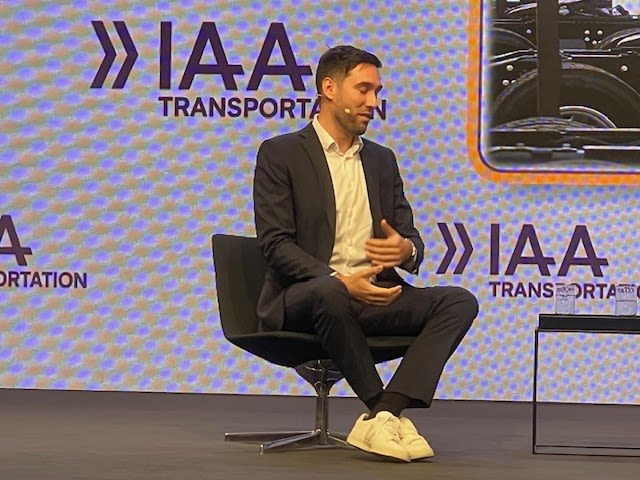
Dejan Antunovic, electrificaton program manager, PepsiCo, said the company is running Tesla Semis successfully in three different applications.
Photo: Jack Roberts
And from there, he said, that philosophy extends through the rest of the vehicle design process.
“We look for areas that we can extract the most value out of our supply chain and drive down costs that way,” he added.
“But then also service maintenance. And we leverage our software, our vertical integration there, along with our inhouse service learnings from our passenger cars."
Using feedback from those servicing the BEVs in the field, he said, Tesla is able to "make [technicians'] jobs easier, get the truck back on the road, reduce service costs, keep part costs low, and ultimately deliver that entire idea of lowest total cost of ownership.”
Pepsico on Tesla Semi: Positive Feedback and Performance
From PepsiCo's point of view, Antunovic praised the simplicity and adaptability of the Tesla design. Feedback from Pepsico drivers and technicians has been overwhelmingly positive so far.
“To my surprise, the transition to the Semi has been a lot smoother and easier for drivers and has been really well received,” he said.
“I have a huge amount of respect for the folks that get up every day and deliver the goods that really make the world turn. And we don't want to get in their way. We want to make sure we have a product that not only do they enjoy driving, but they feel safe in operating — and also that we're not like wasting their time. We want to make sure they’re not wasting time charging.
"We don’t want a truck that they don't look forward to getting into. And so by giving them things like fast charging and a comfortable space to be in, we really get to maximize the driver's day, and I think we've seen that in some of the operations.”
In reality, Antunovic said Pepsico is really running three different heavy-duty fleets with the Tesla Semi.
Pepsi beverage trucks run in urban areas on routes of about 150 kilometers a day.
Pepsico also has a regional, longer-haul fleet that is run in slip-seat fashion that runs about 800 kilometers a day.
And on the Frito-Lay side of the business, Pepsico runs regional haul routes with about half the cargo weight compared to the beverage side of its operations.
“We've been able in really all three of those applications to prove that electrification can work for our business,” Antunovic said. “And what's very important for us is to have been able to demonstrate that heavy-duty EVs should and can mirror and replicate diesel operations.”
More Fleet Management

Color Match Smarter: Tools That Restore & Perform
For fleet managers and collision repair professionals keeping heavy-duty trucks on the road, getting the color right the first time isn't just about appearance — it's about efficiency, turnaround time, and bottom-line results. Discover how today's digital color tools are transforming the repair process from guesswork to precision.
Read More →
FMCSA Pauses Biennial-Update Enforcement Amid Motus Transition
Carriers whose updates were due on or after June 1 have more time, while FMCSA works to stabilize its new registration system and warns of phishing sites impersonating its new carrier registration system, Motus.
Read More →
2026 Blueprint for Countering Smarter Supply Chain Theft
Cargo theft is no longer just the cost of doing business. It's a multi-billion-dollar criminal enterprise exploiting vulnerabilities across your fleet, drivers, and supply chain.
Read More →


How Telematics Improves Visibility, Control, and Performance in Refrigerated Fleets
Explore how telematics help refrigerated fleets improve visibility, uptime, efficiency, compliance, and cargo protection across connected cold chain operations.
Read More →
What the U.S.-Canada Trade War Means for Trucking
Escalating U.S.-Canada tariffs could disrupt cross-border freight, reduce truck volumes, raise costs, and create new uncertainty for carriers on both sides of the border.
Read More →
What Are Trucking’s Top Concerns for 2026?
The American Transportation Research Institute wants to know what's worrying trucking fleet managers, drivers, and other stakeholders in its annual Industry Issues survey.
Read More →
American Trucking Associations Looks for a New Leader
ATA President and CEO Chris Spear abruptly left his job at the association on August 21, at a pivotal time for the trucking industry.
Read More →
Public Wi-Fi Cybersecurity Risks: How Truck Drivers and Fleets Can Protect Their Data
Public Wi-Fi can expose truck drivers and fleets to credential theft, malware, and other cyber threats. Here’s how to reduce the risk on the road.
Read More →
For Nicky Cupp, Fleet Innovation Starts With Frustration
HDT Truck Fleet Innovator Nicky Cupp turns everyday pain points at Fraley & Schilling into opportunities for better technology and smarter processes.
Read More →
Adam Buttgenbach’s Approach to Electric Trucks: Start With Where They Fit
HDT Truck Fleet Innovator Adam Buttgenbach helped PepsiCo build one of North America’s largest EV fleets by focusing on where electric trucks make operational sense.
Read More →