




More from Costello at ATA: Trucking’s Diesel Squeeze Isn’t Letting Up
Why This Trucking Recovery Is Different
Freight demand remains sluggish, but rising costs and tougher enforcement have taken enough capacity out of the market to change the outlook for motor carriers.
October 22, 2026
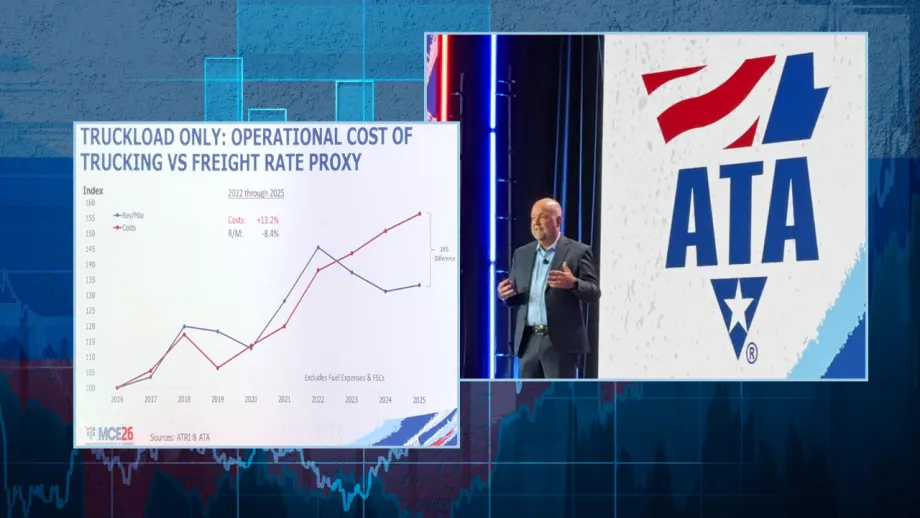
Rising operating costs added to the pressure on trucking fleets during the freight downturn. ATA Chief Economist Bob Costello illustrated the squeeze using indexed cost and revenue data that excluded fuel expenses and fuel surcharges.
Credit:
Deborah Lockridge and ATA, enhanced with assistance of ChatGPT.
6 min to read
Trucking’s freight recovery has arrived in an unusual way: There isn’t much more freight. Instead, fewer trucks and drivers are competing to haul it.
That’s the explanation Bob Costello, chief economist of the American Trucking Associations, offered during ATA’s Management Conference & Exhibition in Charlotte, North Carolina.
“We are in a cycle like we’ve never seen before,” he said. “And it is all supply driven.”
Understanding how the industry got here helps explain both the improving rate environment and why Costello believes it could last for a while.
How the Freight Cycle Usually Works
Anyone who has been in the trucking industry for a while will tell you that there is a cyclical freight cycle:
- Recession or other factors cause amount of freight to shrink.
- Too many trucks chasing too little freight means overcapacity and lower rates.
- That pushes some companies out of business, and when freight demand improves, things are in equilibrium again.
This time, however, the demand side of that equation has contributed little.
“It’s not getting worse,” Costello said of truckload volumes. “But it’s not getting much better.”
capacity reductionATA’s truckload volume measure, which is dominated by contract freight, was essentially flat through August after declining in 2025. It remained about 8.6% below its 2022 peak.
Costello outlined what recent statistics are showing about the big three sources of truck freight: manufacturing output, household consumption, and construction activity
There are pockets of strength. Manufacturing tied to aerospace, computer equipment and electrical equipment has been growing. Data center construction is another standout.
But those gains haven’t translated into a broad freight rebound. The three stronger manufacturing sectors account for only about 10% of manufacturing output. Remove them, Costello said, and manufacturing growth was essentially flat.
For construction, while data centers are booming, higher interest rates are taking their toll on the housing market. With a 30-year fixed mortgage running around 7.5% and home prices as high as they are, people with 3% mortgages aren't going to buy a new house unless they have to move.
In this freight cycle, the recovery is happening mainly because of the other side of the equation: capacity.
Phase One Was a Slow Squeeze
Costello described the capacity reduction as a process that unfolded in two phases.
The first began with the freight recession that followed the pandemic freight boom. Volumes fell. Rates fell. But operating costs kept climbing.
That combination steadily squeezed carriers.
To illustrate the pressure, Costello compared an index he created from the American Transportation Research Institute’s operating-cost data with ATA’s revenue-per-mile data. He excluded fuel costs and fuel surcharges from the comparison.
The indexes tracked relatively closely during the pandemic freight boom. During the downturn, however, revenue per mile fell while costs kept rising.
Some carriers had accumulated savings during the boom that helped them survive the prolonged downturn, he said. Eventually, though, those financial cushions could only go so far.
Capacity was leaving the industry, but not fast enough.
“It was sort of a whittling away of capacity,” Costello said.
Driver Pay Kept Climbing
One expense stood out to Costello: driver pay.
Even during the freight recession, the industry’s hourly-equivalent earnings kept rising.
Costello pointed to Labor Department data covering production and nonsupervisory employees in trucking. It isn’t exclusively a driver measure, and it excludes independent contractors, but he considers it a useful proxy because drivers make up most of that group.
Average hourly earnings were up nearly 51% from 2019, he said. They leveled off somewhat in 2023 before climbing again.
Weekly earnings dipped during the downturn as drivers got fewer miles and loads, then began rising again. Overall, they were about 45% higher than in 2019.
For fleets struggling with lower freight rates, driver pay remained a stubborn cost pressure.
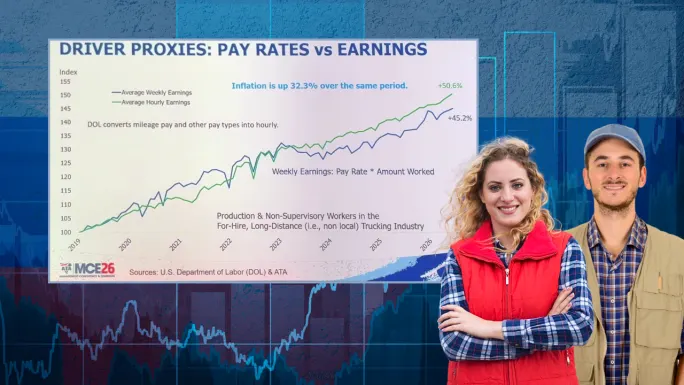
Driver pay rates remained a stubborn cost pressure during the freight downturn, even as fewer miles reduced weekly earnings. The Labor Department data shown cover production and nonsupervisory employees in long-distance trucking, which Costello uses as a proxy for drivers.
Credit:
HDT and ATA
Why Carriers Didn’t Feel the Difference
The first phase did remove capacity. It just didn’t remove enough.
Costello pointed to declining carrier counts, employment, and equipment as evidence that the industry's capacity was shrinking.
He cautioned against treating federal carrier-registration figures as a precise count of operating trucking companies. Fraudulent companies, carriers operating under new identities, and businesses that close without promptly notifying regulators all complicate the numbers.
The downward trend, however, was clear. Motor carriers were exiting the market.
Labor Department employment data told a similar story. The trucking production and nonsupervisory employee count was nearly 8% below its 2022 high.
Yet capacity still hadn’t fallen far enough to match the weak freight market.
“You fleets didn’t feel it,” Costello said, “because it didn’t come down enough to match up to where demand was.”
Phase Two Changed the Market
The second phase added the pressure that finally shifted the balance, Costello said.
"Phase two started to happen last year and it was with the new administration," he said, with its new and increased enforcement of driver regulations.
One example was enforcement against the improper use of B-1 visa drivers for domestic freight movements. Costello said some fleets had used those drivers to provide what he described as “shadow capacity.” Increased scrutiny of those operations is helping remove that capacity from the market.
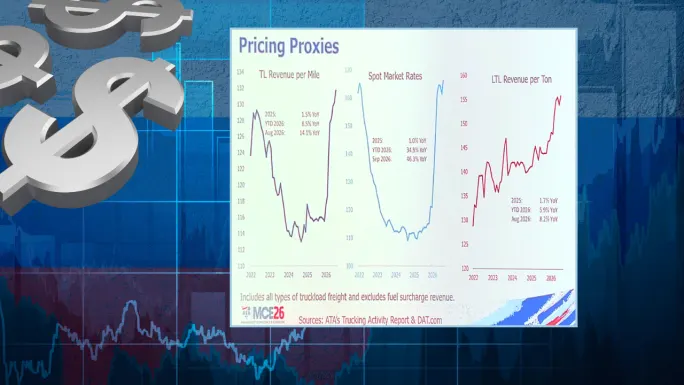
Trucking revenue measures are climbing even as freight volumes remain sluggish. Bob Costello attributes the improving pricing environment primarily to shrinking capacity. The charts use different vertical scales and exclude fuel-surcharge revenue.
Credit:
Deborah Lockridge and ATA, enhanced with assistance from ChatGPT
High diesel prices were another factor removing more capacity from the market in this second phase.
Fuel surcharges offer some protection from price spikes, but they couldn’t immediately offset pump prices rising so fast. Carriers were paying more for fuel while waiting for their surcharges to catch up.
The effect is showing up in carrier revenue measures, including truckload revenue per mile excluding fuel surcharges, spot rates, and less-than-truckload revenue per ton.
The earlier, gradual capacity reduction laid the groundwork. The second round of pressures took enough additional capacity away for carriers to feel the difference.
How Long Can It Last?
Costello sees several developments that could interrupt the improving market. He doesn’t consider any of them especially likely in the near term.
One would be an economic recession that further reduces freight demand. Although he outlined economic headwinds, he said he doesn’t expect a recession.
Another would be a retreat from the Trump Administration's enforcement efforts affecting capacity, such as English language proficiency, ELD fraud, chameleon carriers, and CDL mills.
Costello doesn’t expect a change in congressional control following the midterm elections to end those efforts, because much of the activity comes from the administration.
"One thing that could happen is, maybe there's more hearings about some of the stuff and how they're doing it [that will] slow things down, but I don't think it goes away," Costello said.
"What about, in a couple of years with another presidential election, if we get a Democrat, would it change? Well, there might be some tweaking on it, but I have to tell you, that's not going to be a good look for the Democrats if they start coming in and saying they're reversing the safety stuff, right?"
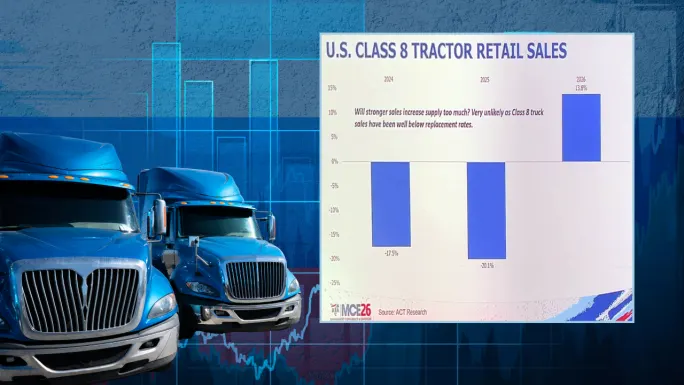
Higher truck sales don’t necessarily mean expanding fleets. Costello expects purchases to remain largely replacement equipment after years of extended trade cycles, limiting how quickly trucking capacity can grow. Sales figures are from ACT Research.
Credit:
Deborah Lockridge and ATA
The third possibility is a surge of new trucks and drivers entering the market.
Finding qualified drivers is becoming more difficult, he said. And although truck purchases are increasing, he sees that buying largely as replacement demand following years of extended trade cycles.
Even with Class 8 tractor retail sales expected to rise about 14% this year, Costello said they would remain below 2024 levels.
"There is a ton of replacement demand out there," he told the audience. "You've been under-buying for a while. You've been extending trade cycles. That's all this is. I think this is all replacement. In fact, I think it's below replacement rates.
That limits how quickly the industry can rebuild the capacity it has lost.
“I think we’ve got some runway here,” Costello said. “And I think that we stay in this for a while.”
More Fleet Management

How to Modernize Your TMS Without Replacing It [Podcast]
Before investing in a new transportation management system, take a closer look at what you've already got. AI, cloud technology and better integrations may offer ways to improve your trucking operations without starting over.
Read More →
Could Your Truck's Connected Devices Be a Cybersecurity Risk?
ELDs, telematics systems and driver tablets help fleets operate more efficiently. But every connected device needs protection against cyberattacks.
Read More →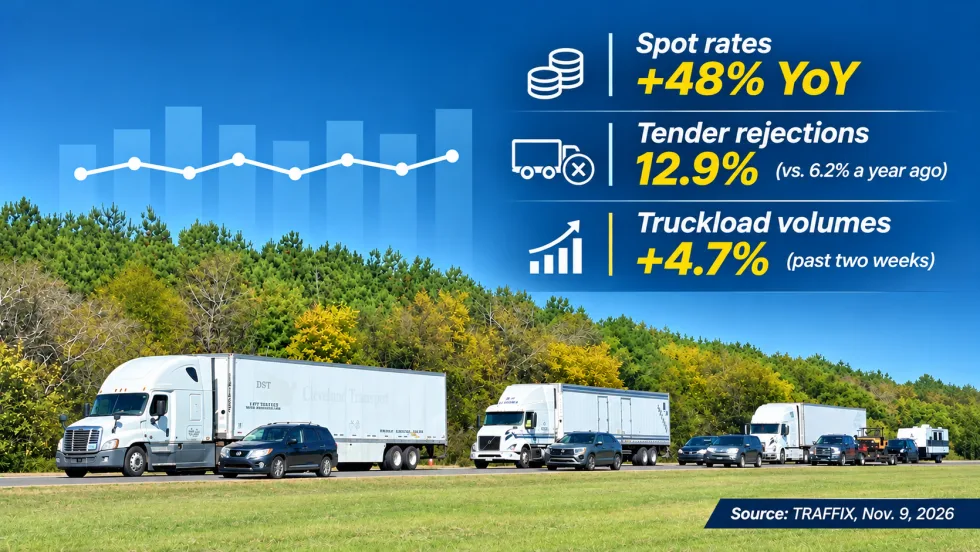
Holiday Freight Meets a Tight Trucking Market
There's no freight boom, but truckload carriers are finding themselves in a stronger position to negotiate rates. And holiday shipping demand could tighten the market further.
Read More →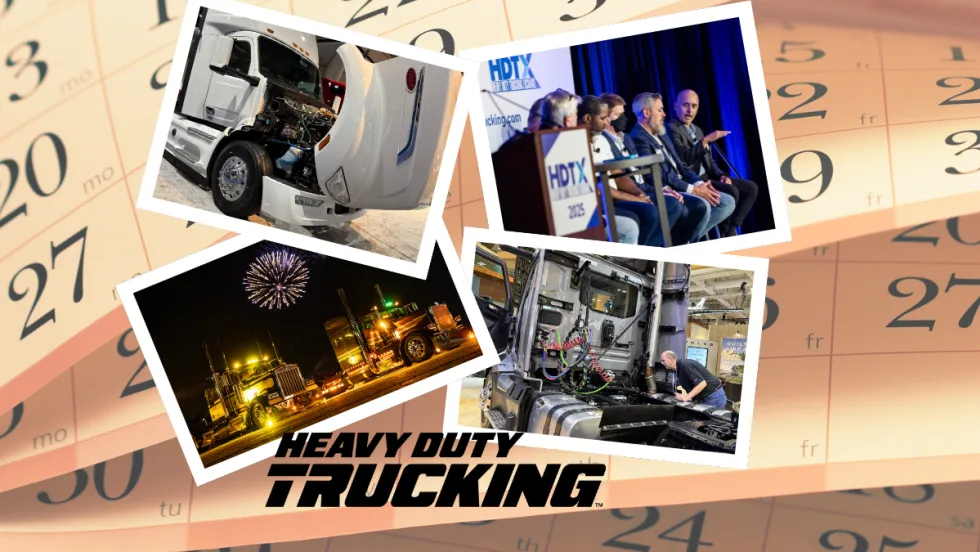
What Trucking Events are Happening in 2027?
Looking for trucking-related conventions, expos, and other events? Heavy Duty Trucking has developed this list of national and larger regional trucking shows and events.
Read More →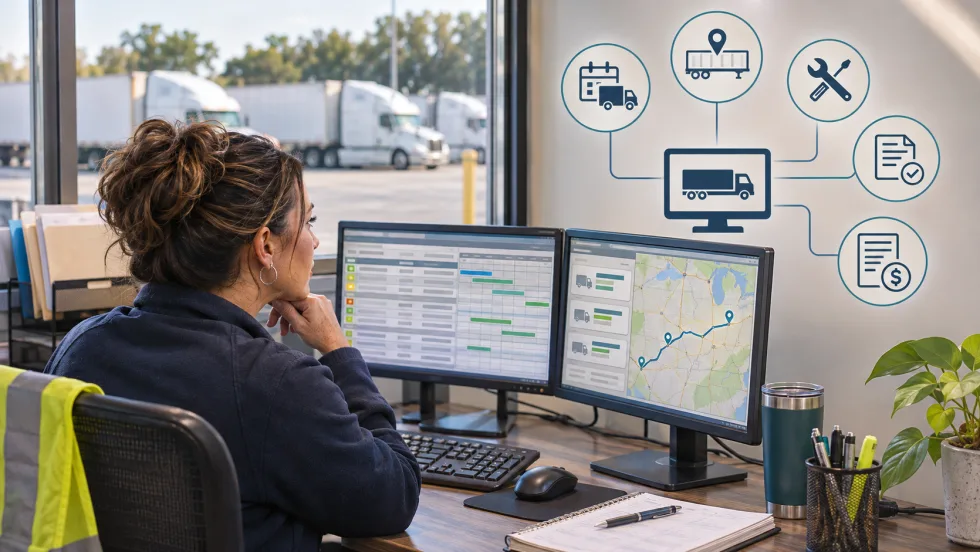
Does Your Trucking Fleet Need a New TMS?
Artificial intelligence and better integrations promise less busywork and more useful data. Can your TMS help your company solve problems? Do you need additional vendors or an upgrade? Or is it time to look for a new platform?
Read More →
Fleet Costs Shape ACT Expo 2027 Agenda
With diesel prices high and operating expenses under pressure, ACT Expo's 2027 agenda emphasizes fuel efficiency, AI, safety and the return on fleet technology investments.
Read More →
Does Your Trucking Fleet Need a New TMS? [Video]
Cloud technology, AI and new integrations are changing what transportation management systems can do. But does taking advantage of those advances mean replacing your existing TMS?
Read More →
Road Ready Becomes Saegic, Launches New Trailer Telematics Gateway
Clarience Technologies is rolling out new hardware and expanding its plans for connecting trailer telematics, maintenance data, and video.
Read More →
Give Your Trucking Fleet a Cybersecurity Walkaround
Your fleet's cybersecurity policies may look good on paper. These seven checks can help you find out whether they’re working.
Read More →
Kodiak Lines Up Fleets for Driverless Trucking
An agreement for 75 trucks, a new Texas freight lane, and progress on safety validation move Kodiak closer to its planned driverless highway launch.
Read More →