As director of continuous improvement at Fraley & Schilling, Nicky Cupp spends her days looking for ways to make work easier for drivers and employees.
Credit:
HDT/Photos Courtesy Nicky Cupp
5 min to read
Nicky Cupp grew up in a trucking family, listening to Red Sovine songs and watching her father and uncles make a living behind the wheel.
Ad Loading...
One of her uncles, she recalls, was one of the first people to have a cell phone back in the 1980s.
"It was this huge brick, but I was like, 'This guy is really cool, what does he do?' And he's a truck driver. So I always thought it was cool, and I knew it was a well-paying position."
She didn't want to become a truck driver herself, but after spending time outside the industry, she realized trucking was where she belonged.
"I did not feel like I was home until I landed in trucking," she says. "Now that I'm here, I'm home."
One of the things she realized once she started working for a less-than-truckload carrier was that even growing up with a truck driver family, she didn’t fully realize how much happened behind the scenes to keep trucks moving.
Now director of continuous improvement at Fraley & Schilling, where she has been for eight years, Cupp spends her days looking for ways to make work easier for drivers and employees across the Indiana-based truckload carrier.
"If you spend 30 seconds in the operations room, you're going to hear someone hang up the phone frustrated," she says. Rather than tuning out the complaints, she listens for what caused them.
Ad Loading...
"Listen for the frustration and rather than running from it, dig into it and see how we can make it better."
What Does Continuous Improvement Mean at Fraley & Schilling?
"Director of continuous improvement" is not a title you see that frequently in trucking.
"Fraley & Schilling's core values are safety, innovation, continuous improvement, partnership, and innovation," Cupp explains. "I get to work with all of the different people within our organization to really streamline processes."
Part of that is making life for the company's drivers better behind the wheel.
"Whether that's through our custom driver app or making the pay process easier, whatever I can do to contribute to all of that as well as driver retention, those are the things that I'm passionate about," she says.
Ad Loading...
"But continuous improvement really is just anywhere in the organization. There is opportunity to constantly be improving, and that's what my role gets to do."
Technology as a Tool to Make People's Jobs Easier
Often, technology is part of the solution, from a self-dispatch system that eliminated paperwork headaches to new reporting tools that cut a payroll process from several days to a fraction of the time.
Fraley & Schilling is using artificial intelligence to improve load assignments by considering driver preferences, available hours, home time, vacations, revenue goals, and other factors that would be nearly impossible for a dispatcher to balance manually. It was one of the first truckload carriers to work with Optym for AI dispatch optimization.
"Listen for the frustration and rather than running from it, dig into it and see how we can make it better."
"Self-dispatch was born out of frustration," Cupp says. "If you listen to the pain points and the things that aren't working for the drivers, the things that aren't working for dispatch, for the back office, it's pretty obvious where you can come in and make changes." Even small changes can enhance everyone's life, she says.
The company is also exploring AI and automation to streamline customer billing and document management.
Ad Loading...
In one case, she worked with an employee who tracked contractor deductions using pen-and-paper notes and multiple spreadsheets. Together they redesigned the process into a simple automated report that was faster and less frustrating for everyone involved.
In Fraley & Schilling's custom driver app, drivers can even watch load-securement videos for the specific cargo they're hauling before they leave the shipper.
Credit:
Fraley & Schilling
Its custom driver app from Eleos handles everything from messaging and navigation to compliance reminders, load securement photos, and real-time pay information.
Drivers are able to use the app to check in at a shipper and enter information in the app, which assigns the load to that driver, and an EDI is automatically tendered to Fraley & Schilling.
Because it's a dedicated account, she explains, "The only time that we touch that load from an office standpoint is the few seconds it takes to bill it and the few seconds it takes to apply the payment." Otherwise it's all done by the driver working in the app.
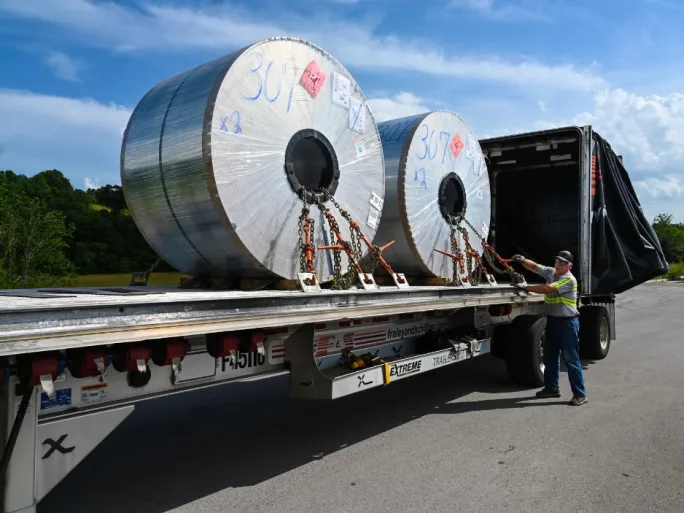
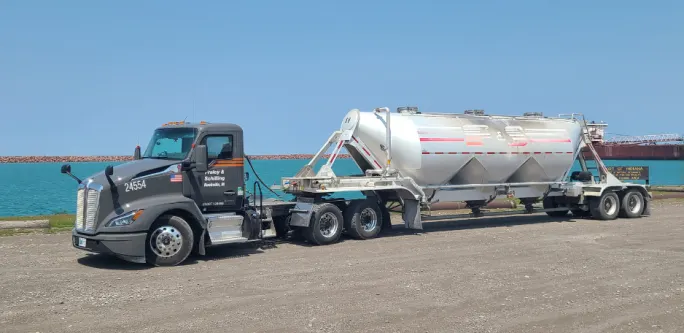
Fraley & Schilling specializes in hauling heavy industrial and building products using lightweight equipment. The majority is flatbed and open-deck freight, like raw metals and construction materials, but they also have a dry bulk division for moving powdery or granular construction and industrial cargoes.
Credit:
Courtesy Fraley & Schilling / Nicky Cupp
The app allows better communication and transparency with drivers and made back-office processes much smoother, as it integrates into the fleet's TMW transportation management software. It has reduced a lot of problems with driver pay that happen when, for instance, a bill of lading is missing or illegible.
Ad Loading...
"There are things as simple as the owner of our company does not want people making a left turn at a specific highway," Cupp says. They were able to program the navigation feature in the app so it will never instruct them to make that turn.
Drivers can even watch load-securement videos for the specific cargo they're hauling before they leave the shipper — important for a company that specializes in hauling steel, building products, and other specialized freight.
In fact, there's a special process for new drivers. When drivers are completing their first five loads, Fraley & Schilling requires them, after they get loaded, to take photos of their load securement before they can move on with the trip. The photos go to the safety manager, who then has a chance to call with any corrections, such as the number of chains or the tarping job.
Managing Change
Introducing new technology requires patience, Cupp says. Rather than rushing to adopt the latest tool, Cupp watches potential partners over time to see whether they follow through on their promises and continue improving their products.
"When we're making a change, start with why," she says. "I think that if people understand why you're doing something, they're a bit more receptive."
Ad Loading...
Whether she's evaluating AI, redesigning a workflow, or simplifying a driver's day, Cupp says the best ideas usually aren't found in a planning meeting.
They're waiting in the next frustrated phone call.
Trucking and logistics teams have plenty of data. The problem is getting the right information in front of the right people soon enough to act. Better-connected data can help teams spot trouble earlier and make smarter decisions before small problems become big ones.
At Insight 2026, Trimble executives argued that fleets may need to redesign workflows to get more from AI as it introduced new products and enhancements. AI’s value will depend on how fleets combine automation with their people's knowledge.
Private fleets are putting their own trucks on demanding customers and high-cost lanes as companies seek greater control over service, costs, and capacity.
For fleet managers and collision repair professionals keeping heavy-duty trucks on the road, getting the color right the first time isn't just about appearance — it's about efficiency, turnaround time, and bottom-line results. Discover how today's digital color tools are transforming the repair process from guesswork to precision.
Carriers whose updates were due on or after June 1 have more time, while FMCSA works to stabilize its new registration system and warns of phishing sites impersonating its new carrier registration system, Motus.
Cargo theft is no longer just the cost of doing business. It's a multi-billion-dollar criminal enterprise exploiting vulnerabilities across your fleet, drivers, and supply chain.
Explore how telematics help refrigerated fleets improve visibility, uptime, efficiency, compliance, and cargo protection across connected cold chain operations.
Escalating U.S.-Canada tariffs could disrupt cross-border freight, reduce truck volumes, raise costs, and create new uncertainty for carriers on both sides of the border.
The American Transportation Research Institute wants to know what's worrying trucking fleet managers, drivers, and other stakeholders in its annual Industry Issues survey.