





Dig Deeper: Why This Trucking Recovery Is Different
Holiday Freight Meets a Tight Trucking Market
There's no freight boom, but truckload carriers are finding themselves in a stronger position to negotiate rates. And holiday shipping demand could tighten the market further.
November 10, 2026
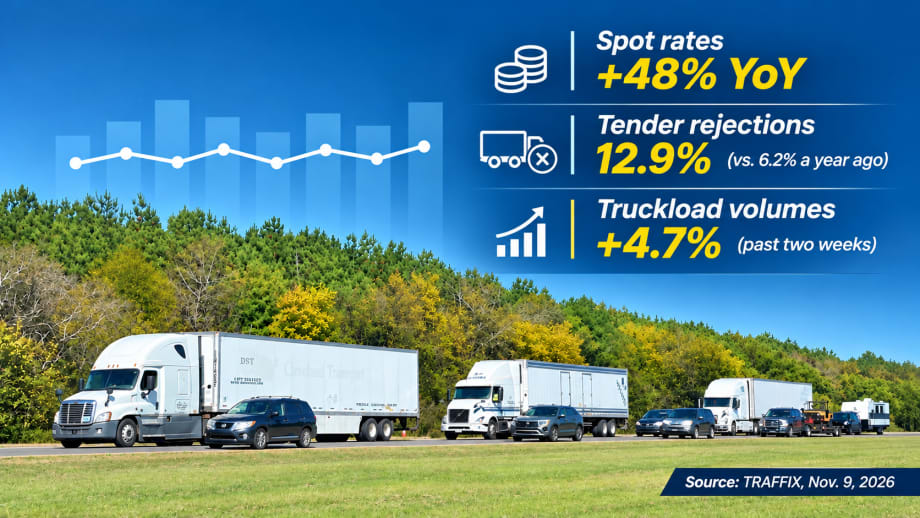
Truckload spot rates remain well above year-ago levels as the holiday shipping season approaches, while rising tender rejections and a recent uptick in freight volumes point to tightening trucking capacity.
Credit:
HDT | Deborah Lockridge photo | Created with help from ChatGPT
4 min to read
- Truckload carriers are in a favorable position to negotiate rates despite there being no significant freight increase.
- The current tight trucking market offers advantages to carriers in terms of rate discussions.
- Anticipated holiday shipping demand is expected to further constrict market conditions.
*Summarized by AI
Truckload carriers are seeing higher spot rates even as freight volumes remain sluggish, suggesting tighter capacity is giving them more leverage in rate negotiations.
The national average dry van spot rate reached $3.05 per mile in October, its highest monthly average since February 2022, according to DAT Freight & Analytics.
That was up 4 cents from September and a whopping 98 cents from October 2025.
Refrigerated and flatbed spot rates also were roughly $1 per mile higher than a year ago, although neither increased in October.
- Dry van: $3.05 per mile, up 4 cents from September and 98 cents year over year.
- Reefer: $3.60, down 2 cents from September but up $1.12 year over year.
- Flatbed: $3.61, unchanged from September and up $1.10 year over year.
All three spot rates were about 45% higher than a year earlier.
Higher Trucking Rates, Fewer Loads
The higher rates aren't being driven by a surge in freight demand.
DAT's Truckload Volume Index showed little change in freight volumes from September, with volumes remaining below year-earlier levels across all three equipment types.
Dry van volumes were down 2% year over year, refrigerated freight was down 9%, and flatbed volumes fell 7%.
Meanwhile, the number of trucks posted as available on DAT One was running 22% to 26% below a year earlier, depending on equipment type.
“Brokers moved fewer loads than a year ago and paid carriers about a dollar a mile more to move them last month,” said Dean Croke, DAT's principal industry analyst.
“While fuel and other operating costs are high, carriers are heading into the holiday freight season in a position to be selective and negotiate better rates.”
Will Holiday Freight Push Rates Higher?
More recent data suggests that capacity remains tight as holiday freight begins moving.
According to third-party logistics provider TRAFFIX's Nov. 9 freight market update, spot rates have been relatively steady for the past two months, but carriers still have more leverage in choosing which loads to accept.
One indication is the tender rejection rate, which measures how often carriers turn down loads offered under existing contracts.
TRAFFIX reported a tender rejection rate of 12.9%, more than double the 6.2% recorded a year earlier. Capacity remains particularly tight for refrigerated and flatbed freight.
At the same time, truckload volumes increased about 4.7% over the previous two weeks, suggesting that holiday freight demand may be picking up.
That could put more upward pressure on rates if capacity remains constrained.
For carriers, the tighter market offers opportunities to negotiate better rates. But with diesel prices and other operating costs remaining high, how much of that additional revenue makes it to the bottom line is another question.

Strip out the estimated fuel portion of spot rates, and the increases look considerably smaller.
Credit:
Deborah Lockridge
Diesel Prices Complicate the Picture
Higher spot rates don't necessarily translate into bigger profits for carriers.
The national average on-highway diesel price was about $6.25 per gallon in October, down slightly from September's $6.29 but about $2.60 higher than a year earlier, according to the U.S. Energy Information Administration.
DAT estimates the fuel portion of spot rates averaged 83 cents per mile for dry vans, 91 cents for reefers and $1 for flatbeds — roughly double the year-earlier amounts.
For a tractor-trailer traveling 500 miles a day and averaging 6 mpg, that meant a daily fuel bill of about $521 in October, compared with $310 in February.
Strip out the estimated fuel portion of spot rates, and the increases look considerably smaller.
Dry van spot linehaul rates averaged $2.22 per mile in October, up 5 cents from September and 55 cents from a year earlier.
Reefer linehaul rates averaged $2.69, down a penny from September, while flatbed linehaul rates rose a penny to $2.61.
All three remain below their highs earlier this year. Dry van linehaul rates, for instance, have fallen 17 cents since July even as the estimated fuel portion has risen 21 cents.
Contract Trucking Rates Also Climb
Contract rates also moved higher in October, with several reaching record levels, according to DAT numbers.
- The average dry van contract rate rose 4 cents to $3.28 per mile, matching the record set in May 2022.
- Refrigerated contract rates reached $3.62 per mile, setting a record for the second consecutive month.
- Flatbed contract rates hit $4.05, their third straight monthly record.
Unlike spot rates, which are negotiated as all-in prices, DAT's reported contract rates include fuel surcharges.
For the first 10 months of 2026, average spot rates for all three equipment types were the highest DAT has recorded for that period since its monthly records began in 2010.
Heading into the holiday shipping season, the question is whether tighter truck capacity will keep rates high even without a significant increase in freight demand.
More Fleet Management

What Trucking Events are Happening in 2027?
Looking for trucking-related conventions, expos, and other events? Heavy Duty Trucking has developed this list of national and larger regional trucking shows and events.
Read More →
Does Your Trucking Fleet Need a New TMS?
Artificial intelligence and better integrations promise less busywork and more useful data. Can your TMS help your company solve problems? Do you need additional vendors or an upgrade? Or is it time to look for a new platform?
Read More →
Fleet Costs Shape ACT Expo 2027 Agenda
With diesel prices high and operating expenses under pressure, ACT Expo's 2027 agenda emphasizes fuel efficiency, AI, safety and the return on fleet technology investments.
Read More →
Does Your Trucking Fleet Need a New TMS? [Video]
Cloud technology, AI and new integrations are changing what transportation management systems can do. But does taking advantage of those advances mean replacing your existing TMS?
Read More →
Road Ready Becomes Saegic, Launches New Trailer Telematics Gateway
Clarience Technologies is rolling out new hardware and expanding its plans for connecting trailer telematics, maintenance data, and video.
Read More →
Give Your Trucking Fleet a Cybersecurity Walkaround
Your fleet's cybersecurity policies may look good on paper. These seven checks can help you find out whether they’re working.
Read More →
Kodiak Lines Up Fleets for Driverless Trucking
An agreement for 75 trucks, a new Texas freight lane, and progress on safety validation move Kodiak closer to its planned driverless highway launch.
Read More →
ITS Logistics Settles Religious Harassment Case
The Nevada-based logistics firm agreed to pay more than $396,000 to settle a religious harassment charge involving an employee's Jewish identity.
Read More →
Your Trucks Are Busy. That Doesn’t Mean They’re Winning.
High utilization doesn’t always mean strong margins. Looking beyond the current load can help fleets make better dispatch decisions and get more value from each truck’s time.
Read More →
Why This Trucking Recovery Is Different
Freight demand remains sluggish, but rising costs and tougher enforcement have taken enough capacity out of the market to change the outlook for motor carriers.
Read More →