Jennie Abarca Is Proving Electric Trucks Can Do the Job
HDT Truck Fleet Innovator Jennie Abarca is building confidence in fleet electrification one load at a time while openly sharing the challenges she encounters along the way as a small-fleet owner.
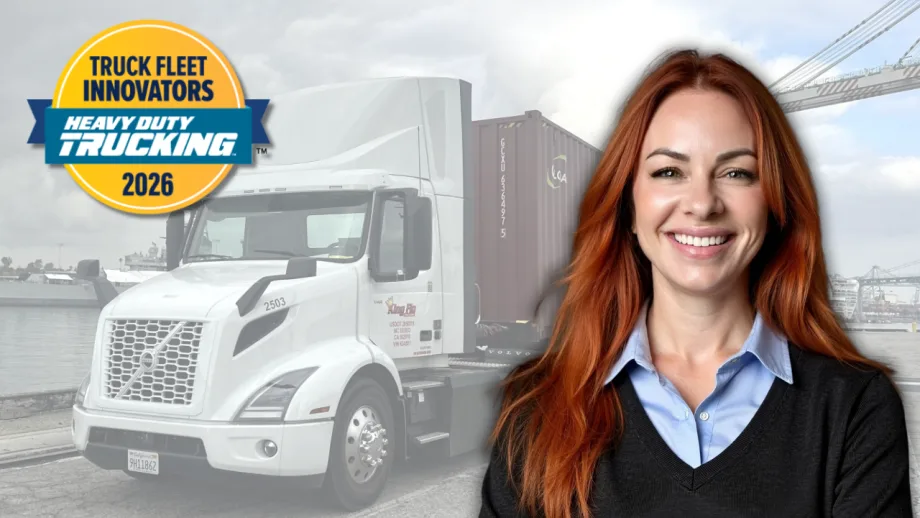
"I want to save the planet one truck at a time,” says 2026 HDT Truck Fleet Innovator Jennie Abarca.
Credit:
HDT/Photos courtesy Jennie Abarca
5 min to read
Jennie Abarca didn't buy electric trucks because she thought they would make her rich. In fact, she says they probably slowed the growth of her company.
Ad Loading...
The Long Beach drayage fleet she founded, King Fio Trucking, has 35 trucks, 11 of them battery-electric, with 21 Teslas on order.
But Abarca's goal wasn't just to be an early adopter and get ahead of the emissions regulations for drayage trucks at the ports and California's Advanced Clean Fleets rule.
Ad Loading...
"I want to save the planet one truck at a time,” she says.
Abarca shares her passion for fleet electrification and trucking with others
Credit:
Courtesy King Fio Trucking
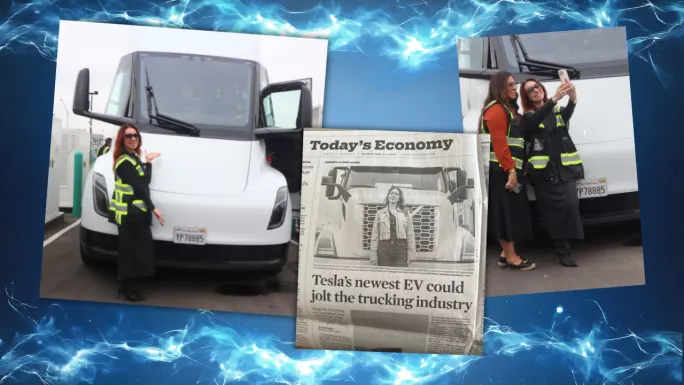
Abarca has become one of the industry’s leading voices on fleet electrification, especially for small fleets. Through industry events, an active social media presence, media interviews, and conversations with other fleets, she shares both the successes and the frustrations of operating electric trucks in the real world.
California may have accelerated the transition of the drayage fleet to zero-emission trucks, but Abarca says her motivation is much more personal. As a parent of a 5-year-old and a 7-year-old, she wants to preserve the planet for her children.
"It was very much an emotional, heart decision,” she says. "Before anything in this world, I am a mommy."
Growing Up Around a Garage
Abarca says while she didn't grow up in a trucking family, her dad was a mechanic and an auto shop teacher.
Ad Loading...
"I feel like everything kind of gravitated towards the garage of our house growing up. I've always loved cars, engines, classic cars. I own two classic cars."
When she started working for a family friend who owned a trucking company, that's where it all started. But she didn’t initially envision herself owning a trucking company. In fact, she left trucking for a job with a manufacturer and spent six years learning the distribution side of logistics.
In the meantime, she met her husband, a truck driver, who bought his own truck and began pushing the idea of starting a company. She also had encouragement — and potential freight — from companies she already knew.
Still, Abarca hesitated. She knew enough about trucking to understand the risks and the demands it could place on her life.
“I know the stress of running a trucking company,” she says. “I was worried about not really having a social life, not being able to be a parent when that time came.”
Ad Loading...
Balancing Family and Trucking Leadership
So she kept working for the distributor while working part-time on the trucking business. But when she became pregnant with her first child at 39, she knew she didn't want to return to the long commute to her job while trying to run a trucking business on the side and be a parent.
"In my heart I'm a trucker. This is the industry that I have loved and given most of my adult life to. But once I became a mom, trucking became second in my life."
"I knew if I was gonna have a chance at being a good mom, I needed to start delegating and start passing responsibilities on to people," she says. So she started bringing on employees at King Fio.
Not that it was easy; as anyone who has grown a small business knows, it can be hard not to be involved in every aspect of the business. "When you own your own business, nobody loves it like you love it."
While on maternity leave, "I worked on my relationships with my customers, because I knew I was not gonna go back to a full-time job, that King Fio was going to be my full-time job, and so pretty much ever since then it's been full force."
Ad Loading...
That was seven years ago. Today she has 52 employees and nearly no employee turnover.
"I think when I'm happier, and when I'm doing the things that I feel that I need to do as a human, I'm actually a better business owner," she says.
Making a Zero-Emission Commitment
A relationship with Forum Mobility helped her learn about the state of the technology and gradually decide to move forward with electric trucks.
Abarca says she's keeping to the commitment she made before California killed off its Advanced Clean Fleets rule to be zero emissions by 2030.
"The freight recession didn't help me on that journey, but I'm still very serious about it."
Ad Loading...
As she adds EVs to the fleet, she's dismantling her older diesels.
"I don't plan on putting another diesel truck out on the road," she says.
That's meant slower growth for the company. "I normally buy four to five trucks a year. My growth has been slow because the electric trucks are very expensive.
"It hurt, but it was a good decision. Especially when diesel's $7 a gallon.
"The mind and the engineering is there. The electricity, what we need to fuel is there. We just need to get the trucks rolling on the road and show people that they're dependable and scalable."
Ad Loading...
Making the EV Transition
When she started bringing electric trucks on board at King Fio, Abarca assigned her most seasoned drivers to the first electric trucks.
"They kind of set the tone and told everybody, 'These things rock.'" Now she has a waiting list of drivers who want one.
One surprise had nothing to do with the trucks themselves.
"I thought customers were going to be banging down my door," she says. "That did not happen."
Instead, she found herself proving, one load at a time, that electric trucks could do the job. Customers had concerns about how dependable these new trucks would be. Would they run out of juice or break down and be unable to deliver on time?
Ad Loading...
So electric trucks aren’t just dedicated for customers who want them. They haul the freight right alongside their diesel counterparts. Abarca has told skeptical customers, "I've been delivering on an electric truck to you for over a year now. You just didn't know it."
Abarca knows electrification isn't the answer for every fleet today, and she's realistic about the challenges.
Credit:
HDT/Photos from King Fio Trucking
'We Can't Be the Last'
Abarca remembers watching many small drayage carriers disappear when California's first emissions regulations took effect because they weren't willing to adapt.
"When the new emissions rulings started to roll out, I was like, 'We've got to do this right away,'" she recalls. "We cannot be the last."
That doesn’t mean it’s been easy. She knows electrification isn't the answer for every fleet today, and she's realistic about the challenges. Grants, charging infrastructure, higher upfront costs, and customer acceptance all remain hurdles.
But she also believes standing still carries its own risks.
Ad Loading...
"I think the risk of not changing and not being part of the innovation is much scarier than changing and trying to do things differently,” she says. "I think if we don't change, we become obsolete."
Why do battery-electric Class 8 trucks remain so expensive? A California bill signed by Gov. Gavin Newsom would give fleets and state agencies more visibility into what manufacturers charge.
Volvo’s updated D13 promises lower emissions without sacrificing performance or fuel economy. Take a closer look at what changed inside the engine in this HDT Spotlight video.
Energy Vision estimates fleets could recover the higher purchase price of an RNG-fueled Class 8 tractor in 1.3 to 2.8 years under current fuel-price scenarios.
Calstart is now Catalyst Mobility, reflecting the nonprofit’s growing national role in clean transportation, including zero-emission trucks, infrastructure and incentive programs.
Average U.S. diesel prices have climbed to nearly $6 a gallon, surpassing the 2022 record as tight refinery capacity and Middle East disruptions keep fuel costs elevated.
Fuel delivery depends on more than what happens at the injector. For fleet, maintenance and technical professionals, looking at the full path from pump to injector can provide useful context for understanding engine performance.
The Port Authority of New York and New Jersey announced millions in incentives for zero-emission drayage trucks, yard tractors, and new charging hubs near the port.
Detroit isn’t starting from scratch to meet EPA 2027 diesel emissions standards. Its Gen 6 DD13 and DD15 engines keep much of today’s platform while updating the fuel and aftertreatment systems.
California, Oregon, Washington, British Columbia and Baja California are coordinating plans for truck charging and hydrogen fueling from Canada to Mexico.