



This article is part of an HDT series, “NACFE’s Electric Fleet Leaders.”
Charge 32 Electric Trucks Simultaneously? Schneider Found a Way
Flexibility, Scalability Guide OK Produce’s Path to Fleet Electrification
 MENU
MENU SEARCH
Pepsi is one of the first fleets in the nation deploying Tesla Semi electric trucks in long-haul routes with heavy loads out of its Sacramento, California, distribution center. Its operations are featured in the North American Council for Freight Efficiency’s Run on Less Electric-Depot program.
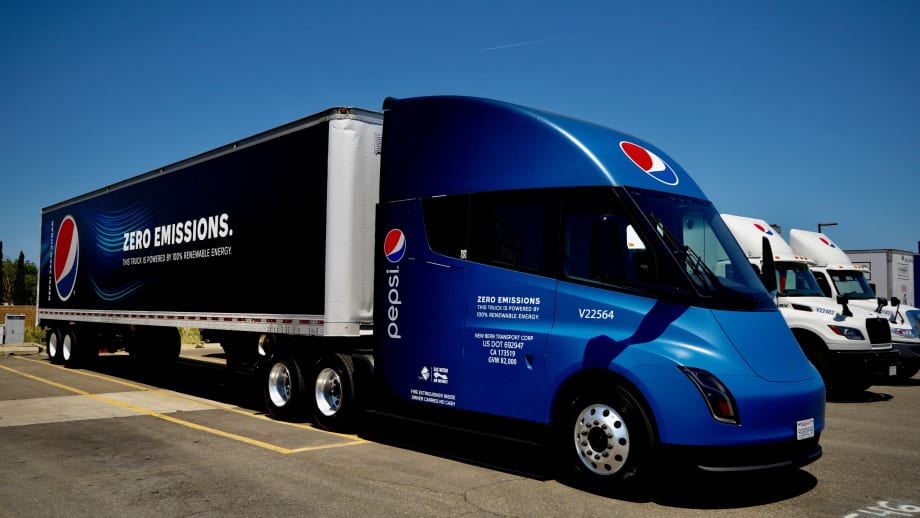
PepsiCo is running 21 Tesla Semis up to 450 miles a day on regional haul routes out of its Sacramento, California, distribution center.
Photo: NACFE
PepsiCo’s aggressive corporate climate goals made the $86 billion beverage and fast food giant a natural for the North American Council for Freight Efficiency’s Run on Less Electric-Depot fleet study.
NAFCE has released a profile of Pepsi’s Sacramento, California, distribution center, which is leading the company’s charge into electric vehicles. This distribution center is one of the first of many Pepsi is planning to build across North America. It’s an aggressive conversion and building program aimed at helping Pepsi reach a 75% reduction in carbon emissions by 2030, and 100% by 2040.
The profile is one of those featuring fleets participating in NACFE's Run on Less Electric-Depot program. ROL-E Depot is a year-long study by NACFE analysts studying real-world battery-electric truck use and infrastructure issues. The goal is to help North American fleets begin to transition to battery-electric trucks by conveying lessons learned by fleets in the study.
As part of that process, NACFE is releasing profiles of the fleets it is working with, to give as much insight as possible into their electric-truck operations and adopting electric trucks at scale.
HDT is covering each of the 10 fleets participating in Run on Less Electric-Depot.
Although the blue Tesla Semi trucks running out of Pepsi’s Sacramento facility attract most of the attention concerning this project, there’s a lot more going on.
According to Amanda Devoe, transformation and strategy director, PepsiCo Fleet, the Sacramento facility embodies Pepsi’s commitment to battling climate change.
The facility features solar-power collection technology that helps feed 700-kW chargers. These are used not only for the 21 Tesla Semis already operating out of the facility, but also for electric yard tractors and a fleet of Ford eTransit service vans.
Currently, the facility is about halfway through its conversion to electric trucks. Additional charging capabilities will be added as needed to satisfy the demands once the fleet is 100% electric.
“BEVs are essential for us,” Devoe said. “A good majority of our fleet going to market runs under 100 miles. The trucks run for 12 hours a day. So BEVs are most advantageous for us.”
Dejan Antunovic, electrification program manager, said that the majority of the routes being run are either city transportation routes, or regional runs with eight to 12 stops.
“We have three dedicated over-the-road, long-haul routes that range from 250 to 450 miles,” he added in the NACFE video on the Pepsi profile page showcased on the Run on Less Electric-Depot website. “We have been aggressive to push the limit and demonstrate we are able to achieve very high range with a fully loaded tractor-trailer with that fleet.”
One of the big range enablers on the Tesla Semis has been the trucks’ regenerative braking system, Antunovic noted. These systems capture kinetic energy and store it in the truck’s battery to help replenish their state of charge.
“We’ve seen very strong efficiencies and performance based off the regen on the Tesla Semis,” Antunovic said on the NACFE video. “For example, going across Donner’s Pass and back, from here to Nevada, we were able to, on the trip back, actually zero out in terms of state of charge improving due to regenerative braking. Which for us is massive. That extends range for us in a way that is invaluable.
"In terms of the regen, the efficiency of the tractor, and the routes that we’re taking, as well as the drivers who have been enabled, for the past several months we’ve been able to stay below 1.7 kWh per mile in terms of efficiency for this fleet.”
Corbin Emslie, logistics and transportation supervisor for PepsiCo, said that once the trucks are back at the facility in Sacramento, they recharge quickly.
“With the massive charger that we have, in 20-30 minutes it’s back up to 95%, from 5% or 10%. The turnaround is quick.”
New truck OEMs don’t come along very often these days. So the performance of Tesla as a new player in the Class 8 truck world will certainly be of as much interest as any aspect of PepsiCo's Sacramento operations. And Pepsi drivers seem to be pleased with their new Tesla Semi trucks, as several attested in the NACFE video.
“I actually volunteered because I was really excited to drive the electric truck,” said Casey Thijon, one of the drivers. “I’m not a techie person. I was afraid of the iPhone when it first came out. There’s no switches and gauges in the cab of the truck. So, I strictly go off the monitors. And within a half hour, I was comfortable. If you know how to use a smartphone, then you can easily operate one of these trucks.
"The turn radius is awesome. It’s better than my car. It’s a lot more comfortable. They’re quieter. They’re smoother. They look nicer. They don’t look as intimidating. I think that when they see other women doing it, that will give them the motivation to get into it. This truck being more comfortable, I think they would consider driving a big rig.”
Another driver, Rhianna Castro, added, “We’re the first in the world to have Teslas. And to be part of that is exciting.”
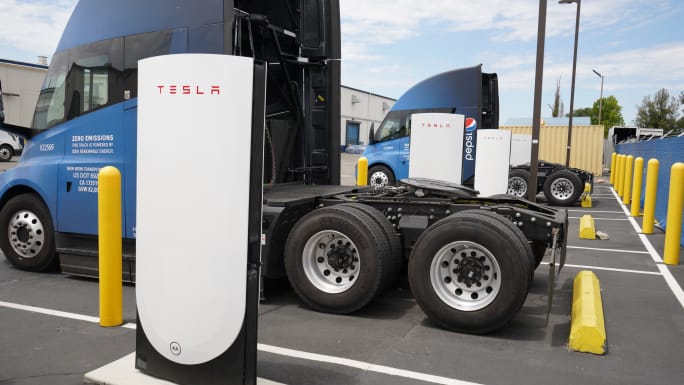
According to Pepsi, the Tesla Semi trucks can go from 0 to 75% state of charge in 45 minutes.
Photo: NACFE
Casto is a swing shift driver whose day starts at 2 p.m.
“I’ve been driving it for about three or four months now,” she said. “We get questions every time we go to a different facility. Long-haul drivers always ask us a bunch of questions. I tell them it’s just comfortable and so easy to drive. You’re so close to the front of the tractor, your visibility is just amazing.”
Pepsi is using its Sacramento operations as both a learning opportunity and as a template for future electric infrastructure installations going forward, Devoe said.
Pepsi's decision to install proprietary charging infrastructure makes sense, according to Marie Brougham, supervisor, strategic account management, Sacramento Municipal Utility District.
“When doing fleet projects of this scale you need a dedicated service,” she said in the NACFE video. She explained doing so enables fleets to take advantage of specific fleet electricity rates. “It also serves you well for your LCFS [low-carbon fuel standard] credits for your accounting and not co-mingling that with other loads,” she added.
Devoe explaned that “it’s an incredible amount of lead time and work to go and engage the utility company, secure the availability, permit and deliver the construction and erect the hardware up, followed by commissioning, testing interoperability. So, we’re planning about 18 months and trying to work up to two years ahead in our total PepsiCo-owned infrastructure, installation, and strategy.”
Given the construction, the utility, and the complexity in that lead time, Devoe added that it is easier for Pepsi to move a holistic project forward one time — i.e. touch it once.
“When you’re ingraining that much of an energy pull, that many different collaborators to one location, we have now determined — hindsight 20/20 — it is in fact the most efficient way to go fully deploy electric vehicle supply equipment with that first touch,” she said. “But I think that we’ll find in our future locations, we develop holistically the entire depot rather than a component or a conservative element of it.”

Volvo’s updated D13 promises lower emissions without sacrificing performance or fuel economy. Take a closer look at what changed inside the engine in this HDT Spotlight video.
Read More →
Energy Vision estimates fleets could recover the higher purchase price of an RNG-fueled Class 8 tractor in 1.3 to 2.8 years under current fuel-price scenarios.
Read More →
Calstart is now Catalyst Mobility, reflecting the nonprofit’s growing national role in clean transportation, including zero-emission trucks, infrastructure and incentive programs.
Read More →
Average U.S. diesel prices have climbed to nearly $6 a gallon, surpassing the 2022 record as tight refinery capacity and Middle East disruptions keep fuel costs elevated.
Read More →
Fuel delivery depends on more than what happens at the injector. For fleet, maintenance and technical professionals, looking at the full path from pump to injector can provide useful context for understanding engine performance.
Read More →
The Port Authority of New York and New Jersey announced millions in incentives for zero-emission drayage trucks, yard tractors, and new charging hubs near the port.
Read More →
Why do battery-electric Class 8 trucks remain so expensive? A California bill headed to Gov. Gavin Newsom would give fleets and state agencies more visibility into what manufacturers charge.
Read More →
Detroit isn’t starting from scratch to meet EPA 2027 diesel emissions standards. Its Gen 6 DD13 and DD15 engines keep much of today’s platform while updating the fuel and aftertreatment systems.
Read More →
California, Oregon, Washington, British Columbia and Baja California are coordinating plans for truck charging and hydrogen fueling from Canada to Mexico.
Read More →
Learn more about Kenworth's T880E battery-electric vocational truck at the Paccar Technical Center, including its range, applications, upfitting considerations, and PTO options, in this HDT Spotlight video.
Read More →