





2013: ATA's Graves Takes Aim at Republican Party as Part of the Challenges Faced by Trucking
American Trucking Associations Looks for a New Leader
ATA President and CEO Chris Spear abruptly left his job at the association on August 21, at a pivotal time for the trucking industry.
August 24, 2026
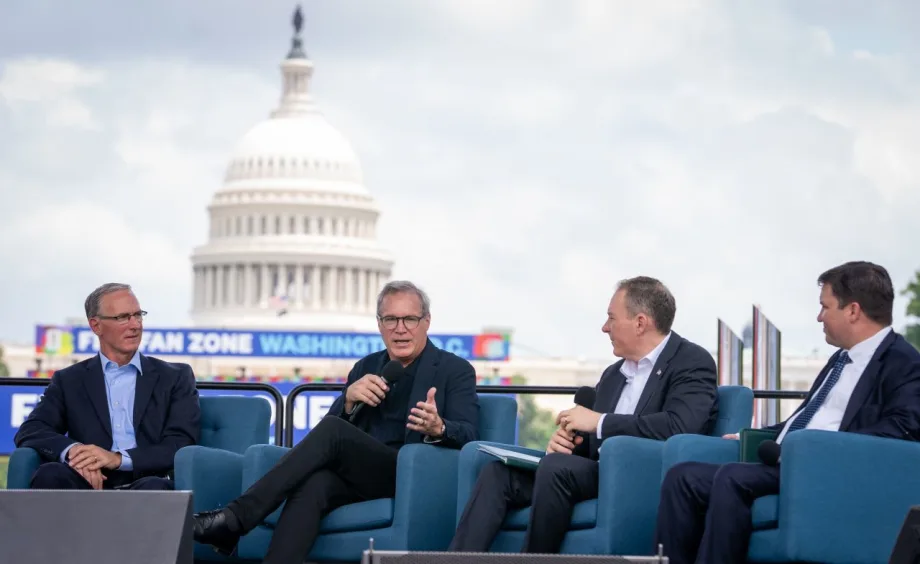
In late July, Chris Spear appeared with EPA Administrator Lee Zeldin on the National Mall in Washington, D.C., talking up a proposed rule to modify the 2027 emissions regulations.
Credit:
American Trucking Associations
2 min to read
- Chris Spear, President and CEO of the American Trucking Associations (ATA), has suddenly departed from his role.
- His unexpected exit occurs during a significant period for the trucking sector, indicating potential implications for the industry.
- The ATA is now tasked with finding new leadership following Spear's abrupt departure.
*Summarized by AI
The American Trucking Associations is in search of a new leader. President and CEO Chris Spear informed ATA’s Executive Committee on August 21 that he was leaving ATA, effective immediately.
In 2016, Spear, a former ATA senior vice president of legislative affairs, was named as the successor to Bill Graves, who retired after more than 13 years with ATA.
Immediately prior to the ATA position, Spear was vice president of government affairs at Hyundai Motor Company and had a long career on Capitol Hill, in federal agencies as well as in the private sector.
Spear led ATA for just over a decade. His departure comes before his most recent contract was due to be completed in 2029.
Spear ‘Didn’t Take This Job to Make Friends’
During President Trump’s first term, Spear praised the administration for working with the trucking industry and for working to improve trade policy. ATA officials and 12 America’s Road Team captains visit to the White House resulted in a widely distributed image of the president behind the wheel of a truck, apparently have the time of his life.
And while the association has still been working closely with the administration during Trump’s second term on issues such as rolling back greenhouse gas emission regulations and addressing safety initiatives promoted by the trucking industry, Spear occasionally has spoken forcefully against some presidential initiatives, especially tariffs, global trade, and the war in Iran.
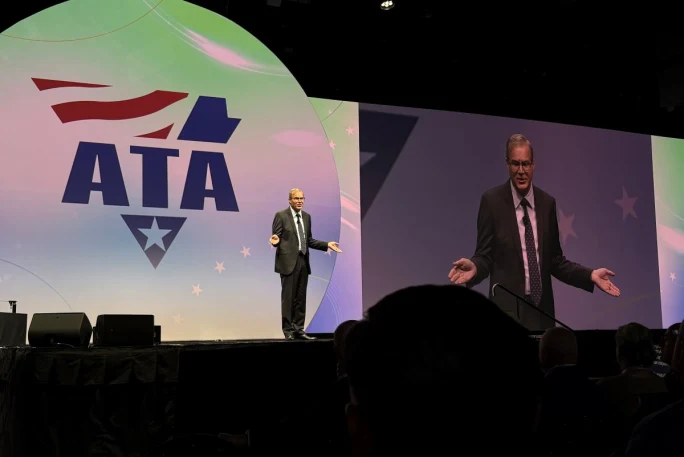
Chris Spear speaks at the 2025 ATA Management Conference & Exhibition.
Photo: Deborah Lockridge
During his address at ATA’s Management Conference and Exhibition last October, Spear outlined the association’s “wins” in the previous year, including stopping California ZEV mandates and making progress in lawsuit abuse reform, independent contractor classification, and cargo theft.
Spear’s style has been seen by some as more abrasive than his predecessor. But as he said in 2019, “I didn’t take this job to make friends. I took this job to make a difference.”
What’s Next for ATA?
In a statement, ATA Chairman Greg Hodgen thanked Spear for his more than a decade of service to the association and the trucking industry.
“During his tenure, ATA secured significant policy victories, strengthened its advocacy operation, and elevated trucking’s voice in Washington,” Hodgen said.
“One of Chris’ most important accomplishments was assembling an exceptionally talented and experienced team to represent this industry. ATA has the advocacy horsepower to keep advancing our priorities without missing a beat.”
ATA’s Board will convene a search committee to identify the association’s next president and CEO.
More Fleet Management

Geotab Links Fleet Card to Vehicle Data
The new card combines fuel discounts with telematics-based purchase controls. Geotab’s analysis also points to potential savings from choosing lower-priced fuel stops.
Read More →
How MFA Helps Protect Trucking Fleets
Multi-factor authentication adds protection when passwords are stolen. Here’s how it works and where fleets should start.
Read More →
How Better Freight Data Helps Trucking Teams Get Ahead of Disruption
Trucking and logistics teams have plenty of data. The problem is getting the right information in front of the right people soon enough to act. Better-connected data can help teams spot trouble earlier and make smarter decisions before small problems become big ones.
Read More →

Trimble: Taking Artificial Intelligence in Trucking Beyond Faster Tasks
At Insight 2026, Trimble executives argued that fleets may need to redesign workflows to get more from AI as it introduced new products and enhancements. AI’s value will depend on how fleets combine automation with their people's knowledge.
Read More →
Sponsored•September 28, 2026
Build a bulletproof fleet: Uniting ELDs and dash cams for total compliance
An ELD can prove compliance, but it cannot always prove what happened on the road. Discover how uniting accurate ELD data with AI-powered dash cam video can help your fleet strengthen compliance, defend against liability, protect drivers and reduce operational costs.
Read More →
Nominations Open for HDT Emerging Leaders
Heavy Duty Trucking is looking for accomplished trucking fleet professionals under 40 who are making an impact and helping lead the industry forward.
Read More →
Why Private Fleets Are Taking More Freight
Private fleets are putting their own trucks on demanding customers and high-cost lanes as companies seek greater control over service, costs, and capacity.
Read More →
Sponsored•September 16, 2026
Color Match Smarter: Tools That Restore & Perform
For fleet managers and collision repair professionals keeping heavy-duty trucks on the road, getting the color right the first time isn't just about appearance — it's about efficiency, turnaround time, and bottom-line results. Discover how today's digital color tools are transforming the repair process from guesswork to precision.
Read More →
FMCSA Pauses Biennial-Update Enforcement Amid Motus Transition
Carriers whose updates were due on or after June 1 have more time, while FMCSA works to stabilize its new registration system and warns of phishing sites impersonating its new carrier registration system, Motus.
Read More →
Sponsored•September 14, 2026
2026 Blueprint for Countering Smarter Supply Chain Theft
Cargo theft is no longer just the cost of doing business. It's a multi-billion-dollar criminal enterprise exploiting vulnerabilities across your fleet, drivers, and supply chain.
Read More →