





Economy Tops Trucking Industry Issues Ranking as New Concerns Emerge
ATA's Spear Celebrates Lobbying Wins for Trucking
In front of a smaller-than-usual audience in San Diego, American Trucking Associations’ President and CEO Spear acknowledged the challenging economic conditions trucking fleets continue to face, but said the association's lobbyists have had a number of legislative and regulatory "wins" under the Republican-controlled government.
October 27, 2025
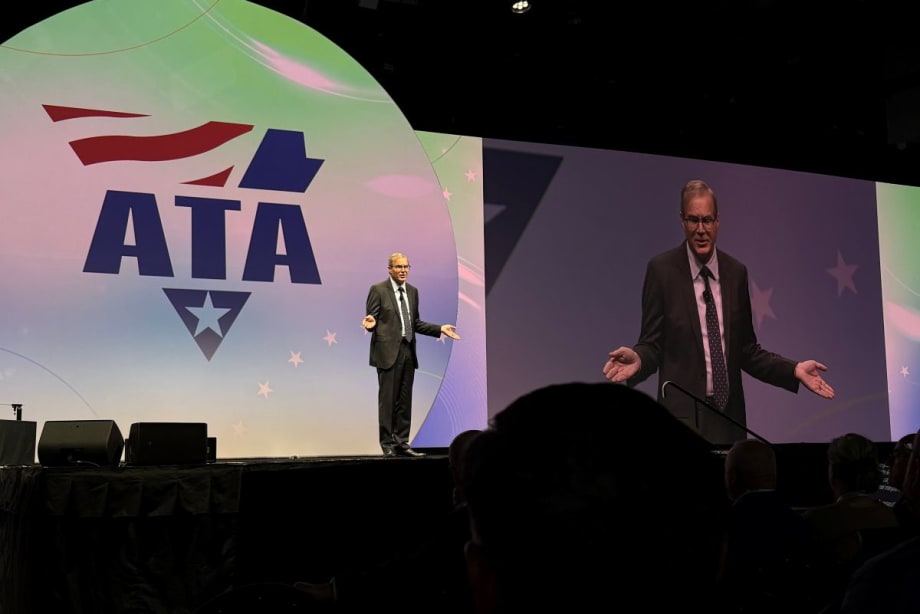
ATA President and CEO Chris Spear speaks during the American Trucking Associations' annual Management Conference & Exhibition in San Diego.
Photo: Deborah Lockridge
6 min to read
In front of a smaller-than-usual audience in San Diego, American Trucking Associations’ President and CEO Spear acknowledged the economic conditions trucking fleets continue to face, in a market where freight demand remains soft and capacity is too high.
“While cyclical freight is not uncommon, this is the third straight year the industry is feeling the pain of a freight recession,” he said. “We know what a challenge that is and continues to be for each of you.”
It also likely was the reason for what appeared to be a smaller number of attendees to ATA’s annual Management Conference & Exhibition October 27.
The difficult environment, he said, is why the American Trucking Associations’ advocacy is more important than ever.
Spear highlighted some of the organization’s “wins” over the past year – as well as challenges, including President Trump’s tariffs.
In the first seven months of this Congress, ATA testified seven times on Capitol Hill. On top of that, ATA’s Call on Washington program is expected to shatter attendance and meeting records in 2025, Spear said.
“Nearly every week Congress is in session, we bring truckers from across the country to DC to speak with their representatives, keeping up a steady drumbeat for trucking issues within the halls of Congress.”
Emissions Wins
“ATA stopped California’s mad dash to zero emissions in its tracks,” Spear said.
Even before last November’s elections, Spear said, ATA representatives explained in Congressional hearings that battery-electric trucks do not have the infrastructure, do not have the cost parity, and do not have the operational capacity to compete with clean-diesel trucks.
“According to [the American Transportation Research Institute], California’s scheme would have required our national grid to supply 40% more power to charge all our trucks,” Spear said.
“That’s more than a little ironic,” he said with a chuckle, “coming from a state that’s infamous for blackouts.”
They took the same message directly to then-candidate President Trump in Florida last summer.
“And since taking office last January, California’s Advanced Clean Truck, Advanced Clean Fleet, Low NOx and EPA’s Greenhouse Gas III requirements have all been eliminated,” he said. “In 10 months!”
“We have one last major domino to fall… EPA’s Low NOx rule. This rule is effective… it’s also untested and littered with several added costs per power unit that have little to no impact on the environment. Our conversations with the EPA are ongoing and we’re pushing for an immediate answer on their reopening, delaying and changing the rule.”
Lawsuit Abuse
Lawsuit abuse reform rose in this year’s ATRI survey of top industry issues, to the number one spot. But Spear pointed out that it’s been a priority for several years.
“In 2019, we were here in San Diego, when you declared this issue a tier 1 ATA priority…and we declared war on the trial bar,” Spear said.
Since then, ATA has worked with its affiliated trucking associations in states with the highest chances of passing lawsuit abuse legislation, and nearly 20 states have passed legislation, with more to come.
“But this White House and Congress may well be in a position to help us push through some federal reforms, including a bill we had introduced last month that would move these frivolous state suits to a level playing field in federal court,” Spear said.
It marks the first time, he said, that ATA has put in a secondary lawsuit abuse reform strategy on top of its state lobbying efforts to advance federal legislation into full motion.
Independent Contractor/Employee Classification
At ATA’s Mid-Year conference, they hosted Labor Secretary Chavez-DeRemer and began a dialogue about the issue of independent contractor standards that classify many trucking owner-operators as employees.
During the first Trump term, the Labor Department put in place a two-part test that made it easier to prove owner operator truck drivers were independent contractors. The Biden administration swung back the other way with a stricter, more complex test.
“Having a rule we understand and can comply with will protect the more than 350,000 independent contractors who have a critical role in our industry. It’s their choice… and our federal government needs to listen to them, not self-serving union bosses,” Spear said.
Driver Shortage: Quality, not Quantity
“The shortage in talent has never been about the number of people with a commercial driver’s license,” Spear said. “It’s about qualifications. We don’t lack people with CDLs… What we lack is a number of qualified drivers who meet our high standards of professionalism and safety.
“Qualified means you can speak English, read road signs, understand safety rules, and respect our laws,” he said. “Qualified means you are not abusing alcohol or using drugs. Qualified means you earned your CDL the right way, not through a rubber-stamped process in a state that looks the other way.”
The ATA supports Transportation Secretary Sean Duffy’s efforts to crack down on enforcement of the federal English Language Proficiency requirement; suspend visas for foreign truck drivers while audits and investigations are conducted, and target fleets that abuse the use of foreign B1 visa drivers to avoid paying higher wages.
“Cabotage is illegal. And we now have an administration willing to step up and enforce the law.”
Cargo Theft
Another area where ATA is gaining momentum at the federal level is cargo theft.
“These shadowy transnational criminal organizations, often operating out of places like Eastern Europe and Russia, have reach. Without turning a key, they attack our companies and identify the most high-value freight available… delivering it to dummy drop sites and making it nearly impossible to track.”
Over one-third of Congress is now cosponsoring cargo theft legislation lobbied for by ATA.
“And we’re expecting far more to occur on cargo theft in the coming months, including the administration getting even more engaged as a result of all the media attention we’ve been able to generate.”
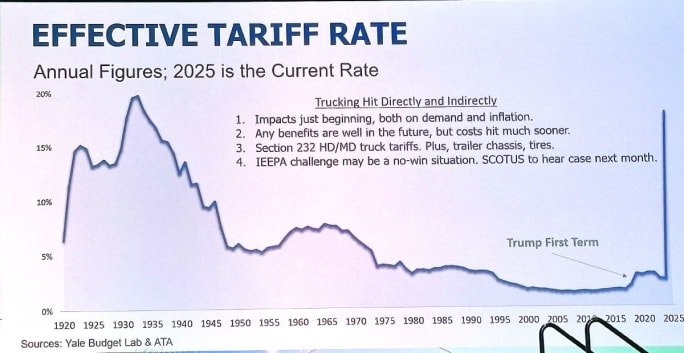
ATA Chief Economist Bob Costello explained why President Trump's tariffs could cause problems for the trucking industry.
Source: ATA
Trump's Tariffs
There’s one area where ATA is not in sync with the Trump administration: Tariffs.
In the morning's economic overview by ATA Chief Economist Bob Costello expressed concern about tariffs and their effect on the economy and the trucking industry.
"We are at 18% tariffs," he said. "We have not been there since the 1930s."
And while many people believe the tariffs have not had a negative effect on the economy, Costello said, "We are in bottom of second or top of third inning when it comes to the impact of tariffs.
"Any benefits of tariffs… are years in the future," Costello said. "But the cost, while still not happening in full force, is much quicker."
So it's understandable that Spear later said, “ATA has and will continue to oppose any elevating use of tariffs that adversely impact the movement of freight..
“Free and fair trade are critical to America’s future. The president, however, believes strongly in tariffs as a policy tool. That’s not going to change."
So far, Spear said, ATA's strategy has allowed it to "clearly object" without compromising progress on other issues.
“That said… if tariffs continue trucking’s prolonged freight recession, ATA may well consider strategic shifts that address the direct and indirect impacts on our industry.”
Stay the Course
“I began these remarks sharing that my staff and I understand the economic challenges you’ve all faced these last three years," Spear said as he wrapped up his speech.
" As truckers, we’re resilient… But despite the much-needed wins these last few months, we still need that certainty, growth and sustainable future if trucking is to support the United States economy as the long-term world leader.”
More Fleet Management

Sponsored•September 16, 2026
Color Match Smarter: Tools That Restore & Perform
For fleet managers and collision repair professionals keeping heavy-duty trucks on the road, getting the color right the first time isn't just about appearance — it's about efficiency, turnaround time, and bottom-line results. Discover how today's digital color tools are transforming the repair process from guesswork to precision.
Read More →
FMCSA Pauses Biennial-Update Enforcement Amid Motus Transition
Carriers whose updates were due on or after June 1 have more time, while FMCSA works to stabilize its new registration system and warns of phishing sites impersonating its new carrier registration system, Motus.
Read More →
Sponsored•September 14, 2026
2026 Blueprint for Countering Smarter Supply Chain Theft
Cargo theft is no longer just the cost of doing business. It's a multi-billion-dollar criminal enterprise exploiting vulnerabilities across your fleet, drivers, and supply chain.
Read More →


Sponsored•September 1, 2026
How Telematics Improves Visibility, Control, and Performance in Refrigerated Fleets
Explore how telematics help refrigerated fleets improve visibility, uptime, efficiency, compliance, and cargo protection across connected cold chain operations.
Read More →
What the U.S.-Canada Trade War Means for Trucking
Escalating U.S.-Canada tariffs could disrupt cross-border freight, reduce truck volumes, raise costs, and create new uncertainty for carriers on both sides of the border.
Read More →
What Are Trucking’s Top Concerns for 2026?
The American Transportation Research Institute wants to know what's worrying trucking fleet managers, drivers, and other stakeholders in its annual Industry Issues survey.
Read More →
American Trucking Associations Looks for a New Leader
ATA President and CEO Chris Spear abruptly left his job at the association on August 21, at a pivotal time for the trucking industry.
Read More →
Public Wi-Fi Cybersecurity Risks: How Truck Drivers and Fleets Can Protect Their Data
Public Wi-Fi can expose truck drivers and fleets to credential theft, malware, and other cyber threats. Here’s how to reduce the risk on the road.
Read More →
For Nicky Cupp, Fleet Innovation Starts With Frustration
HDT Truck Fleet Innovator Nicky Cupp turns everyday pain points at Fraley & Schilling into opportunities for better technology and smarter processes.
Read More →
Adam Buttgenbach’s Approach to Electric Trucks: Start With Where They Fit
HDT Truck Fleet Innovator Adam Buttgenbach helped PepsiCo build one of North America’s largest EV fleets by focusing on where electric trucks make operational sense.
Read More →