




From Tequila to Electronics, Cargo Thieves Are Exploiting Weak Links in the Supply Chain
What the American Transportation Research Institute learned about cargo theft trends and prevention strategies in a new report.


A new report from the American Transportation Research Institute digs into trends in cargo theft and how it can be combatted.
HDT Graphic
Celebrity chef Guy Fieri and rocker Sammy Hagar got a personal look at the exploding problem of cargo theft when two truckloads of their Santo vanished on their way to a Pennsylvania warehouse.
Investigators soon discovered the motor carriers hired by the logistics company to haul the loads didn’t exist. And while they did recover 11,000 of the 24,000 bottles of tequila, it’s a perfect example of the type of cargo theft that's been rapidly rising. Often called strategic cargo theft, or theft by fraud, this kind of theft often involves fictitious pickups, double brokering schemes, or fake motor carriers.
Their story aired on CBS’ 60 Minutes just days before the American Transportation Research Institute released new research on cargo theft in its report, The Fight Against Cargo Theft: Insights from the Trucking Industry.
ATRI obtained detailed cargo theft data from motor carriers, logistics service providers, insurers, and more to understand and quantify the scale and causes of cargo theft – as well as potential cargo-theft prevention strategies.
ATRI is a 501(c)(3) not-for-profit research organization with ties to the American Trucking Associations.
Just How Bad Is Cargo Theft?
The ATRI research documents the high cost of theft to both motor carriers, who average more than $520,000 in annual theft losses, and to logistics service providers such as brokers and third-party logistics providers, who average more than $1.84 million in annual losses.
The annualized cargo theft cost to the industry is as high as $6.6 billion, or more than $18 million per day, according to ATRI.
In 2023, CargoNet received reports on 2,852 incidents from participating carriers, which amounted to $332 million worth of stolen cargo, with an average loss of $116,397 per incident.
While this wasn't reflected in the ATRI report, CargoNet earlier this year reported that 2024 was another record year for cargo theft across the United States and Canada in 2024, with 3,625 reported incidents, or a 27% increase from 2023.
The estimated average value per theft rose to $202,364, up from $187,895 in 2023.
The increase is largely being driven by the rise of theft by fraud, or strategic cargo theft, taking advantage of the ability to trick shippers, brokers, and carriers using electronic means, according to ATRI. In addition, CargoNet reports that cargo theft increasingly is being perpetrated by well-organized cargo theft groups.
What Cargo Thieves are Stealing
Cargo thieves ultimately are interested in items that can be resold easily and without detection. “Food and beverage” is typically cited by CargoNet as the top category of stolen cargo.
Among ATRI respondents, food was also the most commonly stolen product, followed by electronics, automotive parts/vehicles, and beverages.
The Rise of Strategic Cargo Theft
In 2018, just over 2% of cargo thefts were strategic theft, or “theft by fraud,” ATRI reports. In 2022, that number jumped to nearly 9%, and in 2023 to 25%.
Two-thirds of the respondents to ATRI’s survey had experienced cargo theft. Among the logistics service providers, strategic theft was by far the most common type of theft, at 63%. However, among motor carriers, the most common theft type was pilferage at 40%.
In addition, 42% of the motor carriers that had experienced cargo theft had also lost a truck or trailer as part of a theft.
According to the answers from ATRI motor carrier respondents, nearly three-quarters of cargo stolen is never recovered. For the logistics providers responding to the ATRI survey, more cargo is recovered.
ATRI theorized that because logistics service providers tend to be the victims of larger-value thefts, it may make more sense to invest in working to recover the cargo. For motor carriers, however, the largest theft category was pilferage, and there’s less incentive to investigate small thefts as well as what are typically smaller items being harder to track and recover.
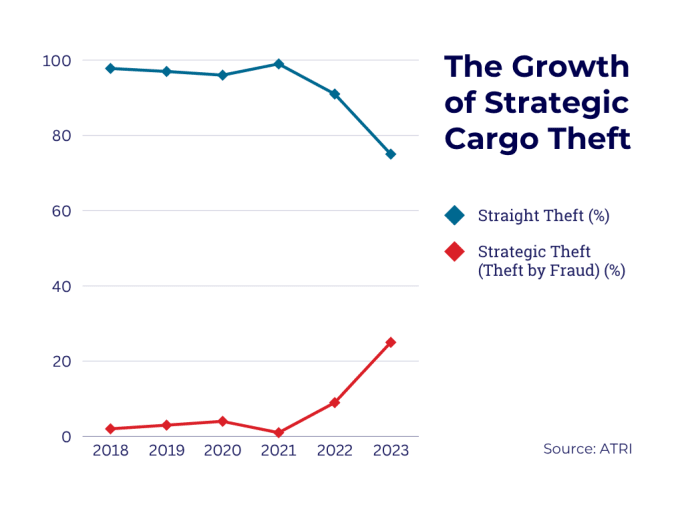
The amount of strategic cargo theft has risen dramatically, but for motor carriers in ATRI's survey, pilferage was the most common type of cargo theft.
Source: ATRI (HDT Graphic)
Where Cargo Theft Occurs
Some location types are more vulnerable to theft than others. CargoNet’s latest top-five ranked locations where thefts most often occur are:
Warehouse
Other (Unclassified Location)
Carrier Terminal/Lot
Parking Lot (Retail)
Truck Stop
Among the ATRI survey respondents, the most common location for motor carriers that had experienced cargo theft was at their terminals, at 24%. That was followed by “other overnight parking location, then truckstop/rest areas.
For logistics providers, more than half of cargo theft occurred at the customer pick-up location, which makes sense given the amount of strategic theft among this group. The second most common was at truckstop/rest areas and at terminals.
Geographic 'Hot Spots' for Cargo Theft
Geographically, ATRI data showed that cargo thefts are more common near major freight and logistics hubs.
“Such locations are often in major cities with strained law enforcement, numerous busy interstate corridors, and significant freight activity. All of these factors help cargo thieves proceed undetected,” the report explains.
At the state level in 2023, available data indicate that 41% of total cargo thefts in the U.S. were reported to have occurred in the nation’s most populous state, California.
An additional 12% of cargo thefts occurred in Texas, followed by Illinois and Tennessee, both with 11%.
Among ATRI respondents, California also was the top state for cargo theft. Illinois, Florida, Texas, and Georgia were hot spots for both carriers and logistics providers, although the order differed, and Tennessee also showed up in the logistics providers numbers.
Counter-Strategies to Battle Cargo Theft
The report goes on to recommend counter-strategies, including fostering a “security culture” across the supply chain.
Tactics used by motor carriers in the study include:
Training for drivers on best practices, including following company-established parking and trailer drop guidelines.
Establishing internal processes and policies to minimize the risk of cargo theft.
Using physical deterrents such as locks on equipment, and fencing and security systems for facilities.
Tracking and monitoring equipment using GPS tracking, geofencing, and real time monitoring.
For logistics service providers, ATRI said, the single most important tool used by brokers is thorough motor carrier vetting. The second most frequent strategy was in communicating with carriers, shippers and receivers.
ATRI also said it is important to strengthen partnerships with law enforcement.
The report also identified an opportunity to lobby for state legislation that would help, such as designating cargo theft as a distinct crime and establishing a state task force/advisory board.
In addition, it said, almost all research participants said that there is inadequate data-sharing across government agencies and between industry and government, and that a federal-level centralized cargo theft reporting agency or program is needed.
Stopping Costly Cargo Theft
The ATRI report also includes a series of case studies documenting the real-world cargo theft experiences of shippers and motor carriers.
“Unfortunately, we’ve reached a point where cargo theft has become a standard cost of doing business for trucking companies, with consumers ultimately footing the bill for many billions of dollars in losses. Something must be done to stop these costly crimes,” saidBen Banks, TCW Inc. president, in an ATRI news release.
“ATRI’s new research on cargo theft puts real-world numbers to the issue and will hopefully motivate stakeholders to act quickly on solutions.”
More Fleet Management

How Telematics Improves Visibility, Control, and Performance in Refrigerated Fleets
Explore how telematics help refrigerated fleets improve visibility, uptime, efficiency, compliance, and cargo protection across connected cold chain operations.
Read More →
What the U.S.-Canada Trade War Means for Trucking
Escalating U.S.-Canada tariffs could disrupt cross-border freight, reduce truck volumes, raise costs, and create new uncertainty for carriers on both sides of the border.
Read More →
What Are Trucking’s Top Concerns for 2026?
The American Transportation Research Institute wants to know what's worrying trucking fleet managers, drivers, and other stakeholders in its annual Industry Issues survey.
Read More →

American Trucking Associations Looks for a New Leader
ATA President and CEO Chris Spear abruptly left his job at the association on August 21, at a pivotal time for the trucking industry.
Read More →
Public Wi-Fi Cybersecurity Risks: How Truck Drivers and Fleets Can Protect Their Data
Public Wi-Fi can expose truck drivers and fleets to credential theft, malware, and other cyber threats. Here’s how to reduce the risk on the road.
Read More →
For Nicky Cupp, Fleet Innovation Starts With Frustration
HDT Truck Fleet Innovator Nicky Cupp turns everyday pain points at Fraley & Schilling into opportunities for better technology and smarter processes.
Read More →
Adam Buttgenbach’s Approach to Electric Trucks: Start With Where They Fit
HDT Truck Fleet Innovator Adam Buttgenbach helped PepsiCo build one of North America’s largest EV fleets by focusing on where electric trucks make operational sense.
Read More →
Deen Albert: Let Automation Do the Math, People Make the Decisions
HDT Truck Fleet Innovator Deen Albert makes sure people are still at the heart of operations at Grand Island Express, even while adopting artificial intelligence tools. AI-assisted dispatch helped boost revenue 25% with the same number of trucks.
Read More →
Trimble’s New AI Agent Takes Aim at Fleet Back-Office Busywork
Arc Agent works across Trimble TMS products to automate repetitive tasks such as freight orders, maintenance, invoices, fuel costs and more.
Read More →
How HDT’s 2026 Truck Fleet Innovators Are Rethinking Fleet Operations
Meet five trucking leaders who are challenging assumptions, solving operational problems, and putting innovative ideas to work.
Read More →