





From 2025: Congress Eyes New Highway Bill — and a New Way to Fund It
Trucking's Annual Congestion Costs Reach $128.2 Billion
That's the average cost, according to new ATRI research. And the wasted time and diesel are staggering.
November 18, 2026
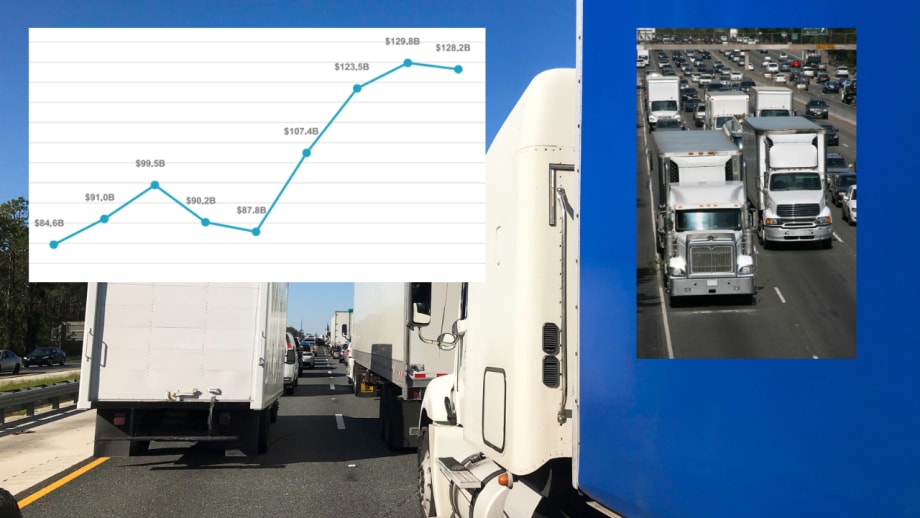
2024 was the third year in a row that annual congestion costs have been more than $120 billion.
Credit:
HDT
4 min to read
- Highway congestion continues to take a heavy toll on trucking, with annual costs topping $120 billion for the third consecutive year.
- Congestion got worse in 2024, but the total cost fell slightly because the prolonged freight recession meant fewer truck miles traveled.
- Truck traffic is growing faster than highway capacity. Over the past decade, tractor-trailer mileage on interstates increased nearly 25%, while interstate lane miles grew just 4.5%.
*Summarized by AI
How much did highway congestion cost the trucking industry in 2024? More than $128 billion, according to the American Transportation Research Institute’s report, “Cost of Congestion to the Trucking Industry: 2026 Update.”
That includes:
- 1.24 billion hours of delay – that’s the equivalent of more than 450,000 truck drivers sitting idle for an entire year.
- 6.66 billion gallons of diesel fuel wasted, for additional fuel costs of $25.04 billion. The fuel economy of a truck in congestion is estimated to be 3.73 mpg, or 5.36 gallons of diesel consumed per hour of congested operation.
- The average congestion cost per truck was nearly $8,000.
The 128.2 billion in costs to the trucking industry caused by congestion on U.S. highways in 2024 was down slightly from the record high of $129.8 billion in 2023. But it was $4.7 billion higher than in 2022.
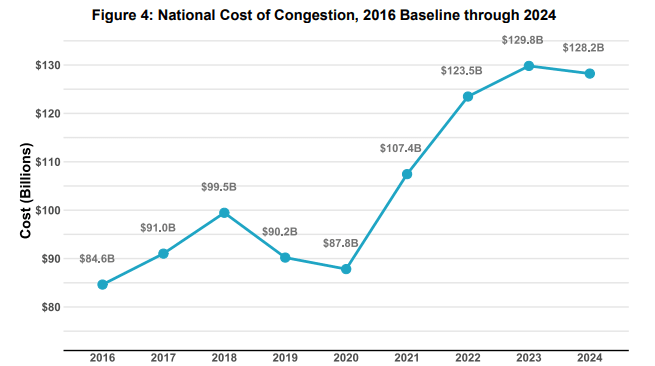
ATRI's congestion cost numbers represent the cost of all types of delays, from slight slowdowns to gridlock.
Credit:
American Transportation Research Institute
It's the third year in a row that annual congestion costs have been more than $120 billion. In the post-pandemic trucking environment, operating costs have increased substantially. Meanwhile, traffic congestion is moving closer to its pre-pandemic level.
The majority (57%) of tractor-trailer mileage is driven on interstate highways, ATRI said. Over the past 10 years, this mileage has grown by nearly 25% while interstate lane miles have increased just 4.5%.
Why is Congestion Costing Trucking More?
The ATRI report calculates congestion costs using three areas of data:
- Average truck speeds
- Truck volumes
- Average cost of operating a truck
Average truck speeds continued to fall gradually from pandemic-era highs, indicating that congestion became worse on U.S. highways. This is in part due to employer policies across the nation requiring workers to work in the office more often or continuously.
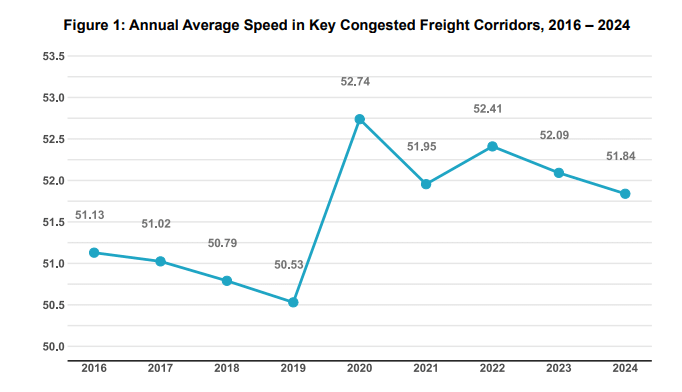
The average truck speed in 2024 was 1.7% lower than its 2020 peak, when COVID-19 closures significantly reduced personal vehicle traffic.
Credit:
American Transportation Research Institute
The national cost of congestion in 2024 was $128.2 billion – 3.8% higher than in 2022 and 28.8% higher than the pre-pandemic peak of $99.5 billion in 2018.
Highway congestion worsened in both 2023 and 2024 as measured by average truck speeds, while the operational costs of trucking remained stable and truck VMT declined.
Where Does Congestion Cost Trucking the Most?
ATRI’s analysis also examined regional, state, and metro-area delays and related costs.
The Northeast had the highest congestion costs, followed by the South Atlantic.
Combined, the top ten states accounted for more than half (53%) of trucking’s congestion costs nationwide.
Three of the top 10 states had costs of more than $10 billion: Texas, California, and Florida. They, along with New York, have had the highest congestion costs of all states since the ATRI released its first Cost of Congestion research over a decade ago.
This year, Illinois rose to the number 5 spot from 7 in 2022. Tennessee, Georgia, and North Carolina dropped in comparison to 2022.
Perhaps that shouldn't be a surprise, since earlier this year ATRI named a Chicago interchange the most congested freight bottleneck in the country for the first time.
The metropolitan areas with the highest congestion costs were New York City, Miami, and Chicago.
The Need for Investments in Highways and Infrastructure
"It is no surprise that the New York City metro area ranked first in the nation for congestion costs. Our region is home to one of the country’s busiest port complexes, air cargo hubs and a regional food distribution center, as well as several of its most heavily traveled freight corridors,” said Zach Miller, vice president of government affairs for the Trucking Association of New York.
“Investments like the Hunts Point Interstate Access Project in the Bronx are essential to improving freight mobility and supporting our region’s growth. We need sustained investment in infrastructure to reduce congestion and the costs it imposes on businesses and consumers."
The findings come as Congress prepares to tackle a new surface transportation funding bill, with Democrats taking control of both chambers in January.
The 2021 Infrastructure Investment and Jobs Act (IIJA) provided federal highway system funding of direct outlays of $54.6 billion in 2024. Total highway expenditures across all levels of government were $159.1 billion that same year – a record high even after adjusting for inflation, according to ATRI.
Current surface transportation funding authorization under the IIJA expired in September 2026 and was temporarily extended, but a new surface transportation reauthorization has not yet been passed. The Congressional Budget Office projected in mid-2026 that the Highway Trust Fund itself will be exhausted by the end of 2028 if no action is taken.
More Fleet Management

How to Modernize Your TMS Without Replacing It [Podcast]
Before investing in a new transportation management system, take a closer look at what you've already got. AI, cloud technology and better integrations may offer ways to improve your trucking operations without starting over.
Read More →
Could Your Truck's Connected Devices Be a Cybersecurity Risk?
ELDs, telematics systems and driver tablets help fleets operate more efficiently. But every connected device needs protection against cyberattacks.
Read More →
Holiday Freight Meets a Tight Trucking Market
There's no freight boom, but truckload carriers are finding themselves in a stronger position to negotiate rates. And holiday shipping demand could tighten the market further.
Read More →
What Trucking Events are Happening in 2027?
Looking for trucking-related conventions, expos, and other events? Heavy Duty Trucking has developed this list of national and larger regional trucking shows and events.
Read More →
Does Your Trucking Fleet Need a New TMS?
Artificial intelligence and better integrations promise less busywork and more useful data. Can your TMS help your company solve problems? Do you need additional vendors or an upgrade? Or is it time to look for a new platform?
Read More →
Fleet Costs Shape ACT Expo 2027 Agenda
With diesel prices high and operating expenses under pressure, ACT Expo's 2027 agenda emphasizes fuel efficiency, AI, safety and the return on fleet technology investments.
Read More →
Does Your Trucking Fleet Need a New TMS? [Video]
Cloud technology, AI and new integrations are changing what transportation management systems can do. But does taking advantage of those advances mean replacing your existing TMS?
Read More →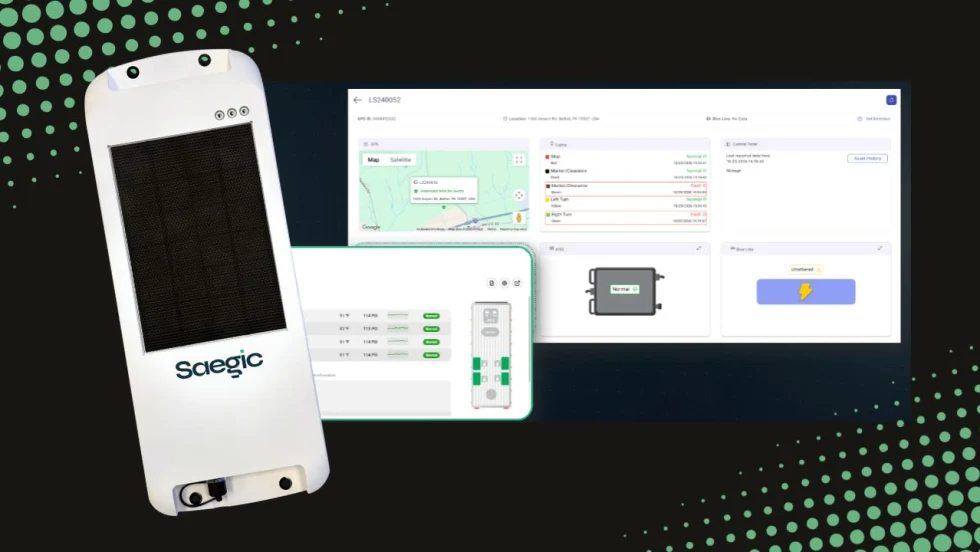
Road Ready Becomes Saegic, Launches New Trailer Telematics Gateway
Clarience Technologies is rolling out new hardware and expanding its plans for connecting trailer telematics, maintenance data, and video.
Read More →
Give Your Trucking Fleet a Cybersecurity Walkaround
Your fleet's cybersecurity policies may look good on paper. These seven checks can help you find out whether they’re working.
Read More →
Kodiak Lines Up Fleets for Driverless Trucking
An agreement for 75 trucks, a new Texas freight lane, and progress on safety validation move Kodiak closer to its planned driverless highway launch.
Read More →