




ATA President Spear Cheers Emissions Reg Rollbacks
In his address to attendees at ATA's TMC Annual Meeting in Nashville, on March 10, ATA president Chris Spear said that U.S. environmental policies are no longer being dictated out of California.

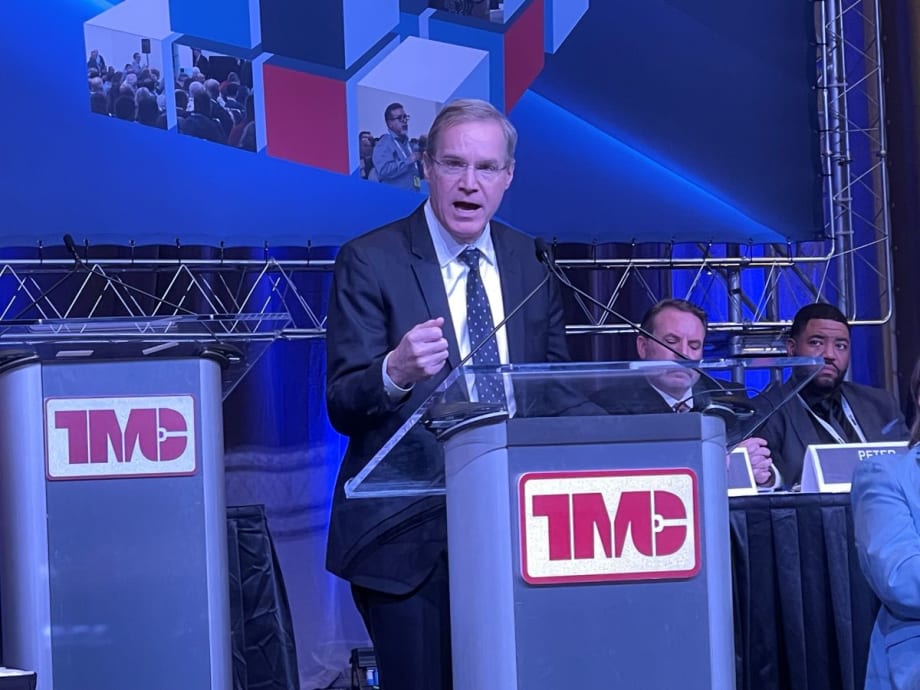
In his remarks at the TMC Annual Meeting in Nashville, on March 10, ATA president Chris Spear struck an optimistic note regarding the early days of the second Trump administration.
Photo: Jack Roberts
There is a lot of confusion in Washington, D.C. right now. But the American Trucking Associations will be working diligently to ensure that the least amount of pain and disruption possible impacts trucking.
That was the message delivered by ATA president Chris Spear. As is customary, Spear took to the main stage during ATA’s Technology and Maintenance Council Annual Meeting in Nashville on March 10.
Ahead of the official opening of the TMC show floor, Spear told attendees that the trucking industry continues to play a decades-old “valued and celebrated” role in keeping the U.S. and North American economies strong.
Minimizing the Pain
“What you do here matters,” Spear said. It’s making a difference right now. On Capitol Hill right now, you’re seeing debates unfold on tax and trade. As well as other high-level issues. And they will set the tenor for how our industry grows. We certainly benefited from the last tax cuts under President Trump in his first administration. And his second term is going to be equally impact, allowing our industry to invest in newer, equipment, technology, training, workforce, pay, all the things that make our companies stronger.
Looking the broader economic picture, Spear admitted that there is “a lot of confusion” at the moment – particularly when it comes to on-and-off-again tariffs targeting Canada, China and Mexico.
“Are the tariffs on?” Spear asked. “Are they off? How high will they be? How low? Will the other countries reciprocate?”
All of those things are virtually impossible to track at the moment, Spear said.
“But this is not a surprise,” he added. “We knew this was going to happen. We knew this was going to be very, very important part of this president's agenda. Our question isn't if he was going to do these things. Our focus is on the duration. Because they're directly impactful on our industry. Even small adjustments in trade policies will have an immediate impact on the trucking industry.”
However, Spear pledged that regardless of what policies President Trump decides to implement, ATA would work tirelessly to minimize the pain to the trucking industry.
Beyond Tariffs
Looking beyond large economic policies, Spear was optimistic that the Trump administration will deliver positive results for trucking.
“Our nation’s infrastructure is in dire need of modernization,” he said.
The Trump administration is also rolling back aggressive diesel exhaust emissions regulations and other environmental rules – many of which have championed by the California Air Resource Board.
“I would be quick to remind you that now, this is not the Unites States of California,” he added to a round of hearty applause.
And ATA will be active on this front, Spear assured attendees.
“We will be working with this White House, this EPA, the House, and the Senate, to ensure that these waivers and rules act are revoked per as early as this week, when Congress returns from its recess,” Spear said. This is about seamless interstate commerce. Our industry operates in every state and in every congressional district. Your elected officials need to understand that it is paramount for our growth to have one standard for the entire country to adhere to. We do not a patchwork of unachievable standards and timelines.”
In time, electrification will have its place, Spear added. But it will be specific to certain segments of the industry. These include drayage, refuse, school busses and other places where the required infrastructure and power grid and be installed and grow accordingly.
“But I believe this administration is going to make clear that long gone are the days of national policy being dictated out of Sacramento, the breeding ground of all those past restrictive policies,” Spear said.
More Fuel Smarts

How Volvo Updated Its D13 for EPA 2027 [Watch]
Volvo’s updated D13 promises lower emissions without sacrificing performance or fuel economy. Take a closer look at what changed inside the engine in this HDT Spotlight video.
Read More →
Diesel Price Spike Shortens Payback for Natural Gas Trucks, Report Says
Energy Vision estimates fleets could recover the higher purchase price of an RNG-fueled Class 8 tractor in 1.3 to 2.8 years under current fuel-price scenarios.
Read More →
Calstart Becomes Catalyst Mobility, Reflecting Broader Focus
Calstart is now Catalyst Mobility, reflecting the nonprofit’s growing national role in clean transportation, including zero-emission trucks, infrastructure and incentive programs.
Read More →

Record Diesel Prices Squeeze Trucking Fleets
Average U.S. diesel prices have climbed to nearly $6 a gallon, surpassing the 2022 record as tight refinery capacity and Middle East disruptions keep fuel costs elevated.
Read More →
How Fuel Delivery Shapes Engine Performance
Fuel delivery depends on more than what happens at the injector. For fleet, maintenance and technical professionals, looking at the full path from pump to injector can provide useful context for understanding engine performance.
Read More →
East Coast Port Launches $45M Electric Truck Push
The Port Authority of New York and New Jersey announced millions in incentives for zero-emission drayage trucks, yard tractors, and new charging hubs near the port.
Read More →
California Bill Could Shed Light on Electric Truck Prices
Why do battery-electric Class 8 trucks remain so expensive? A California bill headed to Gov. Gavin Newsom would give fleets and state agencies more visibility into what manufacturers charge.
Read More →
Detroit Opens Orders for EPA 2027 Engines
Detroit isn’t starting from scratch to meet EPA 2027 diesel emissions standards. Its Gen 6 DD13 and DD15 engines keep much of today’s platform while updating the fuel and aftertreatment systems.
Read More →
Zero-Emission Truck Corridor Planned for West Coast
California, Oregon, Washington, British Columbia and Baja California are coordinating plans for truck charging and hydrogen fueling from Canada to Mexico.
Read More →
A Closer Look at Kenworth’s Electric T880E Vocational Truck [Video]
Learn more about Kenworth's T880E battery-electric vocational truck at the Paccar Technical Center, including its range, applications, upfitting considerations, and PTO options, in this HDT Spotlight video.
Read More →