





Trucking Conditions Index Climbs to Highest Level Since 2022
DAT: Flatbed Demand Climbs as Van and Reefer Rates Soften
DAT Freight & Analytics data shows tightening flatbed capacity, easing produce markets, and softening van and reefer rates.
March 12, 2026
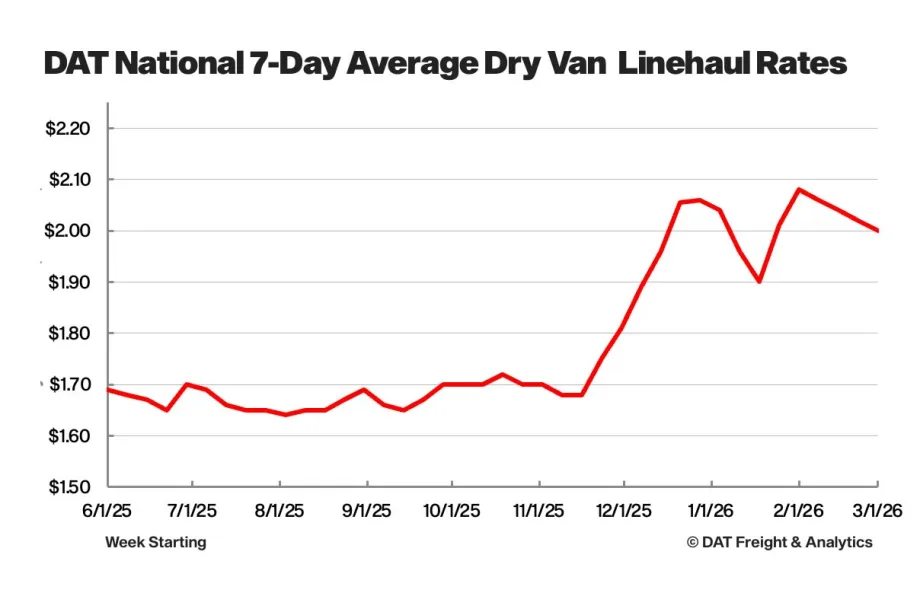
Despite the week-over-week decline, van load volumes remained significantly elevated, DAT reported.
Credit:
DAT Freight & Analytics
3 min to read
Flatbed demand continued to strengthen in early March as capacity constraints pushed spot rates higher, while dry van and refrigerated markets softened week over week. That’s according to the latest data from DAT Freight & Analytics.
During the week of March 1–7 (Week 10), flatbed loads posted on the DAT One marketplace rose 4%, while the average spot rate increased 4 cents to $2.70 per mile.
By comparison, dry van and refrigerated spot rates each fell 3 cents to $2.36 and $2.75 per mile, respectively.
Overall marketplace activity cooled slightly. Total load posts declined 4% to 3.3 million, and truck posts also dropped 4% to 219,869.
DAT analysts said the underlying driver of spot market pricing remains constrained capacity rather than a surge in freight volumes. Rising fuel costs could further tighten supply: diesel prices approaching $5 per gallon may push some carriers to temporarily park equipment, adding pressure on available capacity.
Van Loads Cool After Weather-Driven Spike
Dry van activity eased after a weather-related surge in the previous week.
Van load posts totaled 1.31 million, down 8% week over week, while the number of trucks posted declined 5% to 162,354. The national average van linehaul rate slipped 2 cents to $2.00 per mile, and the load-to-truck ratio edged down to 8.1 from 8.4.
Despite the week-over-week decline, van load volumes remained significantly elevated.
DAT reported that dry van load posts were 53% higher than the same week last year and nearly double the 10-year average when excluding the pandemic-driven years of 2021 and 2022.
Reefer Market Resets as Produce Capacity Improves
Refrigerated freight also cooled, reflecting improved truck availability in major produce regions.
Reefer loads fell 10% week over week to 542,704, while truck posts declined 7% to 36,498. The average reefer linehaul rate dropped 3 cents to $2.38 per mile, and the load-to-truck ratio dipped to 14.9 from 15.3.
According to DAT industry analyst Dean Croke, the produce market has reached a turning point. For the first time in weeks, the USDA Specialty Crops National Truck Rate Report showed “adequate” refrigerated truck availability across all 11 geographic regions.
The capacity crunch that had tightened markets in California, Florida, and South Texas has largely unwound. Florida outbound lanes have seen four consecutive weeks of spot-rate declines, while Nogales lanes ticked higher and South Texas rates firmed slightly.
Florida’s weather-damaged crop supply is also shrinking the pool of available reefer loads faster than capacity can tighten. On the Lakeland-to-Atlanta lane, spot rates ranging from $1,050 to $1,250 are far below the $2,100–$2,300 range seen four weeks ago, though still about $100 higher per load than a year ago based on DAT’s seven-day rolling averages.
Flatbed Market Extends Upward Trajectory
Flatbed freight remained the strongest segment of the spot market.
Flatbed load posts rose 4% to 1.49 million, while equipment posts increased 1% to 21,017. The average flatbed linehaul rate climbed 4 cents to $2.33 per mile, and the load-to-truck ratio rose to 70.3 from 68.9.
Croke noted that the national flatbed linehaul rate is now 29 cents higher year over year and 16 cents above the same week in 2018, another period of strong flatbed demand. Load posts are also nearly 47% higher compared to last year.
Diesel Near $5 Raises Capacity Questions
Fuel prices remain a key variable for the spot market.
Fuel typically accounts for about one-third of truck operating costs. With diesel prices nearing $5 per gallon in some areas, carriers may face pressure to limit operations if rates do not keep pace with expenses.
Unlike contract freight, spot market rates do not include a separate fuel surcharge. Instead, carriers and brokers negotiate a single all-in rate per mile that is expected to reflect current diesel prices because spot loads are typically booked close to pickup.
If diesel prices remain elevated, DAT analysts warn the market could see further capacity tightening as some carriers temporarily park trucks rather than operate at a loss.
More Fleet Management

Sponsored•September 16, 2026
Color Match Smarter: Tools That Restore & Perform
For fleet managers and collision repair professionals keeping heavy-duty trucks on the road, getting the color right the first time isn't just about appearance — it's about efficiency, turnaround time, and bottom-line results. Discover how today's digital color tools are transforming the repair process from guesswork to precision.
Read More →
FMCSA Pauses Biennial-Update Enforcement Amid Motus Transition
Carriers whose updates were due on or after June 1 have more time, while FMCSA works to stabilize its new registration system and warns of phishing sites impersonating its new carrier registration system, Motus.
Read More →
Sponsored•September 14, 2026
2026 Blueprint for Countering Smarter Supply Chain Theft
Cargo theft is no longer just the cost of doing business. It's a multi-billion-dollar criminal enterprise exploiting vulnerabilities across your fleet, drivers, and supply chain.
Read More →


Sponsored•September 1, 2026
How Telematics Improves Visibility, Control, and Performance in Refrigerated Fleets
Explore how telematics help refrigerated fleets improve visibility, uptime, efficiency, compliance, and cargo protection across connected cold chain operations.
Read More →
What the U.S.-Canada Trade War Means for Trucking
Escalating U.S.-Canada tariffs could disrupt cross-border freight, reduce truck volumes, raise costs, and create new uncertainty for carriers on both sides of the border.
Read More →
What Are Trucking’s Top Concerns for 2026?
The American Transportation Research Institute wants to know what's worrying trucking fleet managers, drivers, and other stakeholders in its annual Industry Issues survey.
Read More →
American Trucking Associations Looks for a New Leader
ATA President and CEO Chris Spear abruptly left his job at the association on August 21, at a pivotal time for the trucking industry.
Read More →
Public Wi-Fi Cybersecurity Risks: How Truck Drivers and Fleets Can Protect Their Data
Public Wi-Fi can expose truck drivers and fleets to credential theft, malware, and other cyber threats. Here’s how to reduce the risk on the road.
Read More →
For Nicky Cupp, Fleet Innovation Starts With Frustration
HDT Truck Fleet Innovator Nicky Cupp turns everyday pain points at Fraley & Schilling into opportunities for better technology and smarter processes.
Read More →
Adam Buttgenbach’s Approach to Electric Trucks: Start With Where They Fit
HDT Truck Fleet Innovator Adam Buttgenbach helped PepsiCo build one of North America’s largest EV fleets by focusing on where electric trucks make operational sense.
Read More →