




Diesel Price Spike Shortens Payback for Natural Gas Trucks, Report Says
Energy Vision estimates fleets could recover the higher purchase price of an RNG-fueled Class 8 tractor in 1.3 to 2.8 years under current fuel-price scenarios.

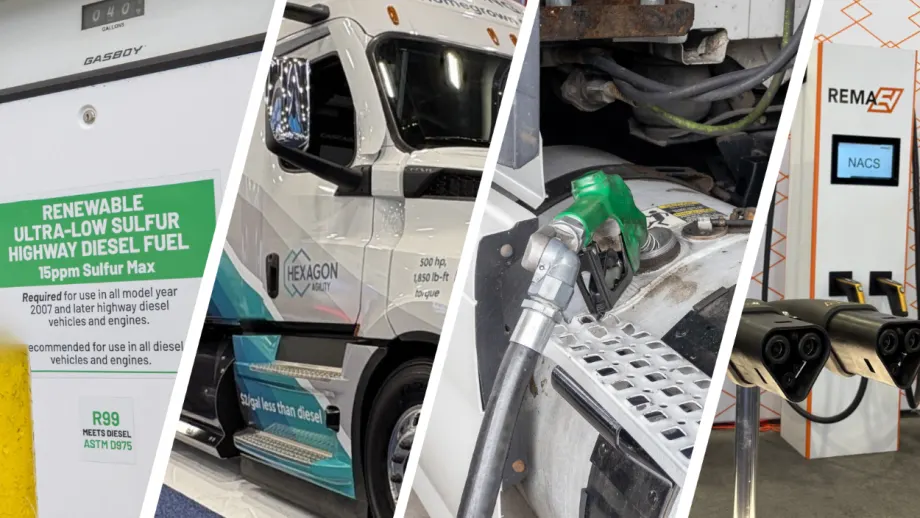
When diesel prices spike, the ROI on alternative fuels changes.
HDT
With diesel prices climbing sharply, the economics of renewable natural gas trucks may be looking more attractive to some fleets.
That’s the conclusion of an updated report from the nonprofit Energy Vision, which examines options for replacing older Class 7 and 8 diesel trucks.
The national average price of on-highway diesel reached $6.285 per gallon on Sept. 14, about 65% higher than the $3.81 reported shortly before the Iran war began in February. In California, diesel averaged $8.039 per gallon, according to the latest U.S. Energy Information Administration data.
Energy Vision’s updated report, “A Path to a Healthier America: Ditching Old Diesel Trucks,” compares three alternatives:
- New diesel trucks running on renewable diesel
- Battery-electric trucks
- Natural gas trucks fueled with renewable natural gas
The original report was published in March 2025. Energy Vision revisited its economic comparisons after fuel prices changed dramatically.
Renewable diesel generally is priced close to petroleum diesel, according to the report, so its price has risen along with conventional diesel. Natural gas prices, meanwhile, have been less affected by the oil-supply disruptions.
As of early September, the report estimated that compressed natural gas cost about $2 less per diesel gallon equivalent than diesel nationally and about $3.50 less in California.
Renewable natural gas accounted for 94% of the natural gas used as vehicle fuel in 2025, according to figures from the natural gas vehicle industry group The Transport Project.
How Quickly Could an RNG Truck Pay for Itself?
A new Class 8 natural gas tractor equipped with an engine such as the Cummins X15N costs an estimated $75,000 more than a comparable diesel truck, according to Energy Vision.
The potential fuel savings, however, could make up that difference relatively quickly.
For a tractor running 100,000 miles a year and averaging 6 miles per diesel gallon equivalent, Energy Vision estimated a payback period of 1.3 years if RNG costs $3.50 less per DGE than diesel. With a $2 price advantage, the projected payback stretches to 2.3 years.
For a truck running 80,000 miles a year, the estimated payback ranges from 1.6 to 2.8 years.
These estimates are based on fuel savings rather than a comprehensive total-cost-of-ownership analysis. They assume the price difference between diesel and RNG will continue and do not account for differences in financing, maintenance, fueling infrastructure or residual value.
“The economics of heavy-duty trucking have changed significantly in the past year and shifted the cost-benefit calculation for replacing diesel with clean alternatives,” said Michael Lerner, Energy Vision’s director of research and publications and lead author of the report.
Lerner said the widening price gap between diesel and natural gas makes RNG “the most cost-effective, feasible, commercially available” option examined in the report for replacing diesel trucks at scale.
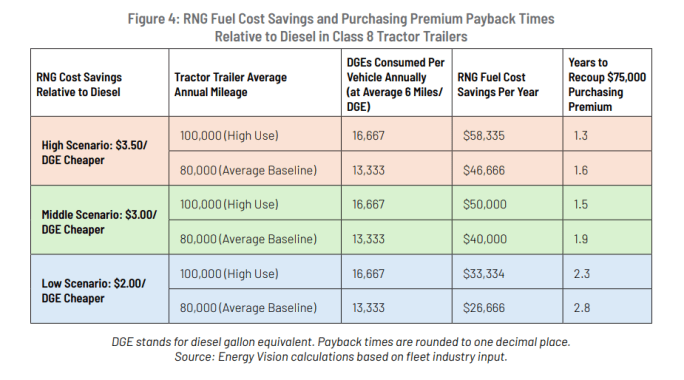
Energy Vision’s updated report, “A Path to a Healthier America: Ditching Old Diesel Trucks,” compares three alternatives to diesel: New trucks using renewable diesel, CNG trucks fueled with renewable natural gas, and battery-electric trucks.
Energy Vision
Truck and Fuel Availability Remain Questions
Even if the numbers work for a fleet, truck availability could limit how quickly it can act.
Energy Vision said slightly more than 1,000 trucks equipped with the Cummins X15N were operating as of July 2026. The report acknowledged that manufacturers currently could not supply the 65,000 tractors included in its replacement scenario.
However, the report cited a Cummins projection that X15N sales could reach 20,000 to 25,000 trucks annually by around 2030.
Fueling access is another consideration. The report counted approximately 1,400 CNG fueling stations nationwide as of August 2026, with 767 offering RNG. That was up from 527 stations offering RNG in January 2025.
Whether those stations are useful to an individual fleet will depend heavily on where its trucks operate. Fleets also may need to consider the cost of installing private fueling infrastructure.
Comparing RNG With Electric and Renewable Diesel
Renewable diesel has the lowest upfront cost of the three alternatives because fleets can use it in conventional diesel engines. Energy Vision estimated, however, that it would deliver fewer public-health benefits than either RNG or battery-electric trucks.
Battery-electric trucks produce no tailpipe emissions, but the report pointed to higher vehicle prices, charging-infrastructure costs, utility interconnection delays and limited model availability as barriers to widespread adoption.
Citing Calstart data, Energy Vision said 2,895 heavy-duty electric trucks, including 386 refuse trucks, had been deployed in the United States as of December 2025. That compares with an estimated 5.2 million Class 7 and 8 trucks operating nationwide.
The report focused on approximately 130,000 pre-2013 heavy-duty diesel trucks operating in 31 populous counties. Energy Vision estimated that replacing those trucks with RNG-powered models could prevent 1,560 to 2,205 premature deaths over 15 years.
The health estimates were developed using the Environmental Protection Agency’s Co-Benefits Risk Assessment model and Energy Vision’s own emissions calculations. The organization estimated cumulative avoided healthcare costs of approximately $30.3 billion over the trucks’ projected 15-year operating lives.
Energy Vision is a national environmental nonprofit focused on reducing methane emissions and using captured methane to decarbonize transportation and other hard-to-abate sectors.
More Fuel Smarts

Calstart Becomes Catalyst Mobility, Reflecting Broader Focus
Calstart is now Catalyst Mobility, reflecting the nonprofit’s growing national role in clean transportation, including zero-emission trucks, infrastructure and incentive programs.
Read More →
Record Diesel Prices Squeeze Trucking Fleets
Average U.S. diesel prices have climbed to nearly $6 a gallon, surpassing the 2022 record as tight refinery capacity and Middle East disruptions keep fuel costs elevated.
Read More →
How Fuel Delivery Shapes Engine Performance
Fuel delivery depends on more than what happens at the injector. For fleet, maintenance and technical professionals, looking at the full path from pump to injector can provide useful context for understanding engine performance.
Read More →

East Coast Port Launches $45M Electric Truck Push
The Port Authority of New York and New Jersey announced millions in incentives for zero-emission drayage trucks, yard tractors, and new charging hubs near the port.
Read More →
California Bill Could Shed Light on Electric Truck Prices
Why do battery-electric Class 8 trucks remain so expensive? A California bill headed to Gov. Gavin Newsom would give fleets and state agencies more visibility into what manufacturers charge.
Read More →
Detroit Opens Orders for EPA 2027 Engines
Detroit isn’t starting from scratch to meet EPA 2027 diesel emissions standards. Its Gen 6 DD13 and DD15 engines keep much of today’s platform while updating the fuel and aftertreatment systems.
Read More →
Zero-Emission Truck Corridor Planned for West Coast
California, Oregon, Washington, British Columbia and Baja California are coordinating plans for truck charging and hydrogen fueling from Canada to Mexico.
Read More →
A Closer Look at Kenworth’s Electric T880E Vocational Truck [Video]
Learn more about Kenworth's T880E battery-electric vocational truck at the Paccar Technical Center, including its range, applications, upfitting considerations, and PTO options, in this HDT Spotlight video.
Read More →
Kenworth T880E Brings EV Power to Vocational Trucks
A closer look at the Kenworth T880E’s range, charging, powertrain and upfit options — and where fleets are showing the most interest.
Read More →
Jennie Abarca Is Proving Electric Trucks Can Do the Job
HDT Truck Fleet Innovator Jennie Abarca is building confidence in fleet electrification one load at a time while openly sharing the challenges she encounters along the way as a small-fleet owner.
Read More →