




TMC 2025 Takeaway: The Journey Toward Vertical Integration
HDT's Deborah Lockridge on how the trucking industry has moved toward "vertical integration" over the past 25 years.

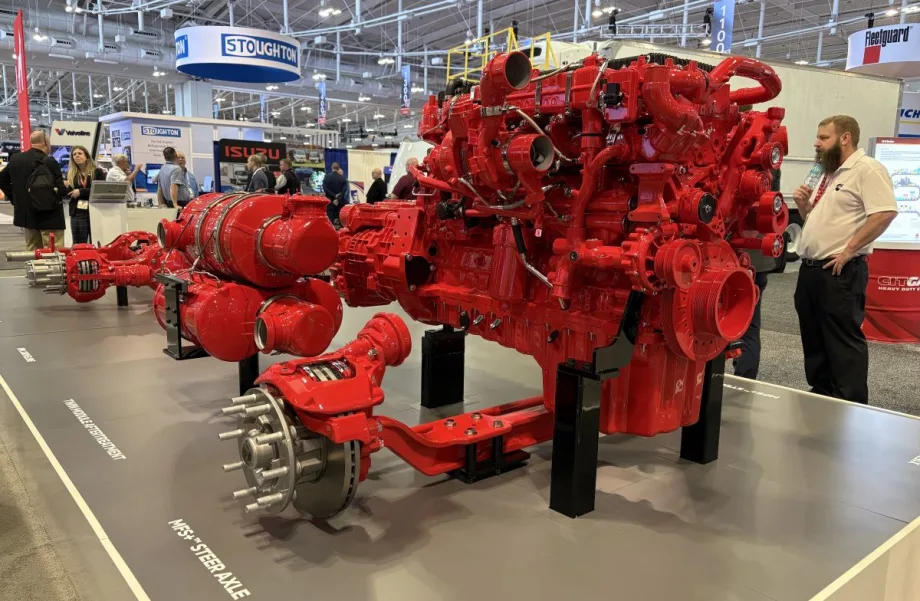
One example of vertical integration at TMC: Cummins' bright-red display of its X15 integrated powertrain.
Photo: Deborah Lockridge
Once upon a time, there were three big truck engine makers in the U.S.: Caterpillar, Cummins, and Detroit. A couple of truck makers, like Mack and Volvo, offered their own engines. You ordered a truck and spec'ed the engine you wanted, which transmission, which axles, and so on, and they typically were all from different companies.
Then along came Volvo Trucks, with its own engines and transmissions, which brought to the U.S. the concept of vertical integration, common in Europe.
That journey toward vertical integration struck me after coming home from the American Trucking Associations' Technology & Maintenance Council meeting in Nashville last month.
In Europe, buying a heavy truck was (and is), more like buying a passenger car. You have a pick of a few packages, with major components such as engines and transmissions made by the OE. The dealer probably takes care of all your maintenance.
But in 1999, Marc Gustafson, then president and CEO of Volvo Trucks North America, told members of the Heavy Duty Manufacturers Association that big changes were coming in the way we spec, buy and sell trucks.
While these changes wouldn’t go as far as European-style vertical integration, Gustafson said, he predicted a more modular approach. The industry couldn’t afford to have hundreds of products to spec and hundreds of companies to deal with, he explained.
Customers would still have choices, Gustafson predicted, but the choices would be between highly engineered product packages and systems, not individual bolt-on products.
In addition to the increased globalization of the truck market, another big trend driving virtual integration was emissions regulations and the need for fuel efficiency. Engineers discovered that a vertically integrated powertrain could be designed as a single system for the best efficiency.
In the 25 years since then, the North American truck market has inched more and more toward vertical integration. As we moved into the early 2010s, OEMs pushed vertical integration even more. In 2012, I reported on the vertical integration trend that was apparent based on announcements at the Mid-America Trucking Show. "Downspeeding" was a new concept.
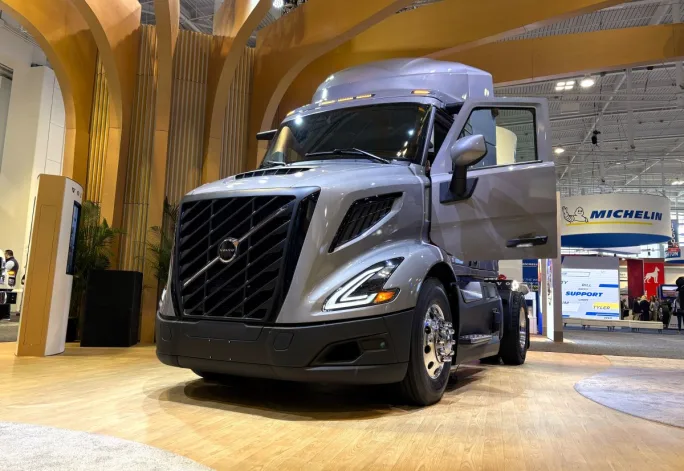
Volvo has been a leader in the move toward vertical integration in heavy-duty trucks.
Photo: Deborah Lockridge
Vertical Integration Today
And here we are in 2025, and I come back from another big trucking event again struck by vertical integration.
Perhaps the most striking example at TMC in Nashville was Cummins.
Back in the 2010s, there were questions about whether Cummins could continue to succeed in a vertically integrated truck-making world. (Caterpillar had been pushed out of the truck market already by the daunting 2010 emissions regulations.)
But instead, Cummins has adapted and thrived. It has moved into electrification, created new engines for alternative fuels, and developed its own vertically integrated powertrain systems.
At TMC, the company’s booth was dominated by a highly visible all-red powertrain display, showcasing the latest X15 engine, aftertreatment, transmission, axles, and so on.
“It was a journey of 10 years to get us here, where we finally have the whole powertrain,” said Cummins’ Mario Sanchez-Lara in an interview walk-around with HDT Executive Editor Jack Roberts at TMC. Integrating the powertrain allows it to extract the most efficiency out of the engine, he explained.
The journey included Cummins’ 2017 50/50 joint venture with Eaton, Eaton Cummins Automated Transmission Technologies, and its 2022 acquisition of Meritor that brought in axles and other necessary pieces of the puzzle.
Sanchez-Lara said the Cummins integrated powertrain doesn’t mean the company is choosing everything for the customer, something some customers fear about this integration trend. There are plenty of options in gearsets, aftertreatment, engine ratings, and so on that make it suitable for a wide range of applications, he explained.
Vertical Integration: Not Just for Powertrains
Vertical integration is going beyond trucks, too.
Wabash, showing off its trailers as a service offering and latest trailer technology at TMC, also talked about vertical integration it’s using with its panels and floor in its latest trailer, including the fact that it’s heavily using domestic products.
Vertical integration even becomes a factor within components themselves.
ConMet, for instance, was celebrating 30 years of its PreSet wheel-end technology at TMC. It also touts the benefits of vertical integration for its product, noting that all critical components, including hub castings, bearings, seals, spindle nuts, and spacers, are designed and engineered in-house to guarantee compatibility and reliability throughout the entire system.
And there was another sign of how the industry is inching more toward European-style truck ordering along with vertical integration.
In unveiling its all-new Volvo VNR regional truck at TMC, Volvo said it would be accompanied by a new spec’ing process with new packaging options for powertrain and safety. Company officials said this was an industry first that simplifies and optimizes the configuration and ordering process and streamlines assembly operations.
More Blog Posts

Beyond the Central Transport Settlement: Lessons on Hiring and Risk
The $5.5 million discrimination settlement raises broader questions about hiring practices, safety performance, and the hidden risks that can lurk in a fleet's recruiting process.
Read More →
Are Diesel Shortages Something to Worry About Again?
There’s a certain déjà vu when tensions flare in the Middle East and diesel price spikes can give you panic attacks. What parallels are there between the current situation and the 1970s energy crisis?
Read More →
NOx Isn’t Laughing Gas. Let’s Clear That Up.
A recent EPA reference mixed up NOx and nitrous oxide. It’s an easy mistake. Just not one you expect to see in emissions policy. Let’s look at the difference.
Read More →
TMC 2025 Takeaway 2: Buy... or Subscribe?
TaaS. Does that mean trucks as a service, trailers as a service, or tires as a service? HDT's Deborah Lockridge has another takeaway from the Technology & Maintenance Council meeting in her blog.
Read More →
Trucks Are For Girls!
HDT Editor and Associate Publisher Deborah Lockridge is a longtime Girl Scout leader and loves to connect her passion for inspiring girls with her love of the trucking industry.
Read More →
Trucking Advocacy: Impact Beyond the 2024 Elections
No matter who wins the election, trucking continues to work to educate the people who pass the laws and make the rules that affect the industry. HDT's Deborah Lockridge shares insights from two major trucking associations in her All That's Trucking blog.
Read More →
Recharge Your Brain for Better Business
Skimping on vacation may be the worst thing you can do for your business, your career, and your mental health. In her All That's Trucking blog, Deborah Lockridge writes about the importance of giving your brain what it needs to be innovative.
Read More →
Trucker Pre-Trip Leads to Mission 'Im-paw-sible'
See what happened when a truck driver found an unexpected stowaway during his pre-trip inspection.
Read More →
HDT Editor: 2023's Most Important Trucking Topics
Read Deborah Lockridge's picks for the most significant stories we covered at HDT in 2023: freight recession, zero-emission trucks, drivers and marijuana, and more.
Read More →
3 Takeaways from ATA's 2023 Management Conference
HDT's Deborah Lockridge talks about key themes that emerged during sessions, conversations, and on the show floor during the American Trucking Associations' annual management conference.
Read More →