




Spec'ing Trailer Floors: From the Bottom Up
Flooring is a critical part of the trailer spec and floors are key when deciding how long you plan to keep the trailer. Get the floor right, and your trailer will last the proper length of time.


If you can’t guarantee you’ll haul only light loads with minimal forklift exposure, better spec for the worst. Save a few bucks by downrating the flooring spec, and you’ll pay for it later.
Photos: Jim Park
Dry van trailers are still treated like commodities, and pricing has been very competitive. But some observers think that might be changing as fleets face shortages of skilled trailer technicians to repair problems they built into their trailers the day they signed the purchase order.
Flooring is a critical part of the trailer spec, and floors are key when deciding how long you plan to keep the trailer. You have to consider how many load/unload cycles it will see in its lifetime and try to determine the impact of the water and road contamination to which it will be exposed over its lifetime.
John Carr, vice president of sales and marketing at Havco Wood Products, says if you have to spend a lot of money and labor to uprate the trailer prior to selling it, you probably should have spent a little more up front for a more durable floor.
“A couple of dollars more per square foot to get a more durable floor is less expensive than the cost of reconditioning an under-spec’d floor,” he says.
Make Sure Your Trailer Floors Can Handle the Load
Let’s start with the loads the trailer will carry. A typical truckload carrier can likely get away with a lighter floor spec if the trailer seldom sees really heavy loads. If it’s likely to see high-density loads like rolls of paper or loads of canned beverages, you’ll need something a little more robust. If you’re a long-haul operator loading or unloading once or twice a day or even less, a lighter spec might work. If you’re hauling freight on and off the trailer several times a day, the floor will get much more of a workout over its lifetime, so a more robust spec would be in order.
If you can’t guarantee any of the above operating scenarios, then you have little choice but to spec for the worst.
“Overloading is a problem and will not only destroy the floor but also the crossmembers and other structural components of the trailer,” says Chris Wolford, executive vice president of sales and marketing at Rockland Flooring.
Wolford says carriers often purchase stock units and then put them into beverage or paper service without thinking about it.
“The floor system of a typical stock trailer is not engineered to handle heavy, concentrated loads, so major problems will eventually follow. Replacing a floor can cost upwards of $4,000, which is why it’s important for fleets to spec their trailers with careful consideration of how that asset will be used,” Wolford says.
Of course, your trailer can be designed to carry heavy loads, but the privilege could come with a weight and cost penalty. You could spec a thicker floor, say 1-3/8 of an inch rather than 1-5/16 thickness, or tighten up the spacing on the crossmembers, going with 6-, 8-, or 10-inch centers rather than the typical 12. That will improve the floor rating – but it will add weight and cost.
“It’s always better to have a thicker floor than to reduce the spacing of the crossmembers, because a crossmember is heavier,” says Yves Taillefer, sales manager, Prolam Floors. “You can also buy a very strong but lightweight floor, but you will pay a lot more for it.”
Depending on the manufacturer, the floor may be 60-100 pounds lighter, but it could cost upwards of $1,000 more than a standard floor. “It will usually last longer, too,” Taillefer says. “Unless you plan to keep the trailer for 12-15 years or longer, you may not see the benefit from the higher upfront cost.”
Spec'ing Floors for a Long-Life Trailer
According to Wolford, the industry seems to be looking for a trailer or floor with a 10- to 12-year service life. Some carriers trade their trailers in five years, while others will keep them for more than 20 years. That requires a range of spec’ing and cost options.
“We are also seeing more fleets ‘over-specifying’ their trailers, which is a strategy worth considering,” he points out. “Realizing the floor is an integral part of a trailer and shoulders much of the daily demands of loading and unloading, some carriers are specifying more floor than they actually need. With a composite floor and floor protection package, for instance, they can haul almost anything, reduce maintenance costs, a longer service life, and higher resale value when it comes time to trade.”
A composite floor usually adds an epoxy/fiberglass element to the underside of the floor, which may nearly double its strength. With the added strength, manufacturers can shave anywhere from 1/16 to 1/4 of an inch from the thickness of the wood. That can save 250 to 350 pounds without jeopardizing strength, while improving the durability of the floor.
“The composite sheet radiates the load over a greater area,” says Carr. “That spreads the load out over more crossmembers, which leads to less bowing and bending of the crossmembers, thus extending their life.”
The composite undercoating also provides lifetime protection against water permeation. Fleets spec’ing for long life almost always invest in upgraded undercoating to protect the floor, especially in areas with particularly harsh conditions, such as above the wheels. Trailers that operate in moist environments or where corrosive snow and ice melting compounds are widely used often make the additional investment in a good undercoating.
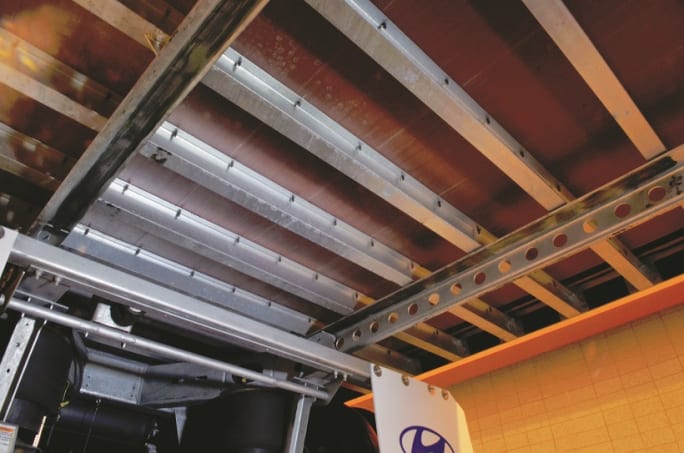
You could spec a thicker floor or tighten up the spacing on the crossmembers, going with 6-, 8-, or 10-inch centers rather than the typical 12. That will improve the floor rating, but it will add weight and cost.
Protecting Trailer Floors from the Environment
Protecting the glue line and wood from the underside is critical because it’s exposed to the elements, Wolford warns. While undercoating options have improved, he sees more carriers upgrading to composite floors because the composite underlay is impermeable to water, extremely durable and also adds strength.
“More importantly for the fleet, there’s no routine maintenance on the underside of a composite floor other than periodic visual inspection,” Wolford says.
The entire underside of the trailer is exposed to water and various other contaminants and needs some additional protection such as a moisture-resistant coating. The most vulnerable point inside the trailer is under the steel threshold plate at the back.
“Water gets trapped under there when trailers are left with their doors open in a drop lot and when backed into non-sealed loading docks in the rain,” Carr notes. “Clues that your wood floor may be deteriorating include excessive gouging, scratches, surface checks and de-lamination of the glue line between the sticks. If you start noticing unusually high incidents of such damage, it’s time to have the floor checked.”
Water-based paint was used for decades by trailer makers as an undercoating material, but newer and better materials are now available, such as a polyurethane undercoating called P.u.R.
“A P.u.R undercoating won’t give you any additional floor strength, but it will provide a better moisture barrier and lower maintenance requirements over the trailer’s life,” says Taillefer.
Several treatments are available for the topside of the floor, including some that offer enhanced traction for safety while protecting the floor from water incursion.
The problem with some topcoats is that they may have to be reapplied a few times over the life of the trailer, whereas wood treaded with a compound like Prolam’s Waxin or Waxin 100, where the wood is literally soaked in it, will retain their moisture resistance much longer, Risi says.
“You have to compare the upfront cost of the treatments versus repair and downtime costs later in life,” he explains. “We can prove it’s better to make the investment upfront, like using galvanized crossmembers, a good topcoat and a very durable undercoating, than to have to go back and reapply the coatings during the trailer’s life. The upcharge for the long-life treatments can be surprisingly inexpensive, compared to the benefits.”
More Equipment

How Volvo Updated Its D13 for EPA 2027 [Watch]
Volvo’s updated D13 promises lower emissions without sacrificing performance or fuel economy. Take a closer look at what changed inside the engine in this HDT Spotlight video.
Read More →
Michelin Tire Improves Efficiency and Durability for Regional Fleets
The Michelin X Multi Energy D2 is a regional haul drive tire engineered to help fleets improve fuel efficiency, durability and traction in demanding stop-and-go operations.
Read More →
ZF Expands Commercial Vehicle Push in North America
ZF is expanding its North American commercial-vehicle presence with new transmission applications, electrification, trailer technology and autonomous-driving systems.
Read More →
Tesla Wants a Self-Driving Semi. Are Cameras Enough?
Could Tesla’s camera-only autonomous driving technology work on an 80,000-pound Semi? In this commentary, HDT's Deborah Lockridge takes a look at Tesla, Cybercab, and how autonomous trucks see the road.
Read More →
Kodiak: Driverless Long-Haul Truck Launch on Track for 2026
Kodiak AI says its driverless long-haul safety case is 93% complete and it remains on track to begin commercial operations by year-end 2026.
Read More →
What DOT’s Automated Vehicle Strategy Means for Trucking
The U.S. Department of Transportation issued a new automated-vehicle strategy that outlines plans for driverless-truck regulations, cross-state freight corridors, and federal safety standards.
Read More →
East Coast Port Launches $45M Electric Truck Push
The Port Authority of New York and New Jersey announced millions in incentives for zero-emission drayage trucks, yard tractors, and new charging hubs near the port.
Read More →
PlusAI Going Public to Fund Autonomous Truck Launch
A SPAC deal could provide PlusAI with up to $300 million as it works toward a 2027 commercial launch of factory-built autonomous trucks.
Read More →
NHTSA Moves to Rewrite Truck Fuel-Economy Rules
The National Highway Traffic Safety Administration says it lacks authority to regulate medium- and heavy-duty truck engines separately from complete vehicles, but the existing standards have not yet been eliminated.
Read More →
Detroit Opens Orders for EPA 2027 Engines
Detroit isn’t starting from scratch to meet EPA 2027 diesel emissions standards. Its Gen 6 DD13 and DD15 engines keep much of today’s platform while updating the fuel and aftertreatment systems.
Read More →