




Phillips Connect Expands Smart Trailer Platform with New Safety, Cargo and Equipment Intelligence
Phillips Connect Smart Trailer enhancements give fleets deeper operational insights from trailers -- even when another provider supplies basic GPS tracking.

New additions to Phillips Connect Smart Trailer technology are aimed at expanding how fleets capture and use data from connected trailers.
Phillips Connect
Phillips Connect rolled out a series of platform enhancements at the Technology & Maintenance Council Annual Meeting. New additions to its Smart Trailer technology are aimed at expanding how fleets capture and use data from connected trailers.
The updates span multiple trailer systems. These include cargo monitoring, roadside safety, brake performance and liftgate operations. All are designed to move fleets beyond simple GPS trailer tracking toward deeper operational intelligence.
“Track-and-trace GPS units have long been the baseline for trailer visibility, but fleets need more than location to make informed decisions that affect operations, safety, dispatch, compliance and maintenance,” said Mark Wallin, general manager and senior vice president of product at Phillips Connect. “The next generation of connected trailer technology is already here.”
JumpStart Program Opens Door to Smart Trailer Data
Among the biggest announcements was the launch of JumpStart, a program designed to help fleets begin capturing trailer intelligence without replacing their existing GPS tracking provider.
Many fleets already use third-party telematics for location tracking but cannot access deeper data from trailer systems such as brakes, tires or cargo activity.
JumpStart allows fleets to start adding smart trailer capabilities through six entry points:
- Automated trailer identification
- Cargo intelligence
- Brake system monitoring
- Tire health monitoring
- Liftgate performance monitoring
- Temperature monitoring
Fleets can deploy any of these capabilities independently and expand their connected trailer capabilities over time.
According to Phillips Connect, the goal is to remove barriers that often prevent fleets from adopting more advanced trailer intelligence while they remain under contract with existing telematics providers.
CargoVision Adds People Detection
Phillips Connect also introduced People Detection, a new capability within its CargoVision platform.
CargoVision uses sensors and visual intelligence to monitor trailer interiors. The new feature allows fleets to detect when individuals enter or exit the cargo area during loading, unloading or other operations.

A new Driver Behavior Insights feature allows fleets to analyze how trailers are being operated on the road.
The added visibility can help fleets monitor loading activity, identify potential cargo theft risks and better understand how trailers are being used throughout the day.
The system can also provide alerts if unauthorized access occurs inside the trailer.
Trailer Data Reveals Driver Behavior
Another platform update adds Driver Behavior Insights, allowing fleets to analyze how trailers are being operated on the road.
Using onboard trailer sensor data, the system can detect events such as harsh braking, aggressive acceleration and sharp cornering.
This capability is particularly useful when trailers are hauled by third-party tractors. This is a common situation in drop-and-hook operations, leased equipment arrangements or carrier partnerships, Wallin noted.
In those cases, the trailer owner often has no visibility into driver behavior through traditional tractor telematics.
By capturing driving events through trailer sensors, fleets can identify risky operating patterns earlier and better protect cargo, equipment and their brand.
New Trailer System Intelligence Partnerships
Phillips Connect also announced enhancements tied to partnerships with several equipment providers.
Through collaboration with Emergency Safety Solutions (ESS), the company introduced new roadside safety capabilities. When a driver activates hazard lights on a stopped trailer, the system triggers ESS’s H.E.L.P. DeliverSAFE technology.
The system flashes trailer lights in a distinctive high-visibility pattern and sends real-time roadside hazard alerts to nearby motorists through navigation apps and in-dash vehicle systems.
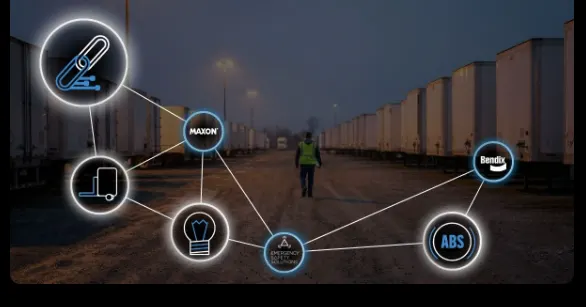
Phillips Connect also expanded data integration with Bendix brake systems, enabling fleets to access diagnostic trouble codes, brake wear data and roll stability information from trailers equipped with Bendix TABS Advanced electronic control units.
In addition, a partnership with Maxon brings deeper liftgate intelligence into the platform for liftgates equipped with Maxon’s Max Link technology, providing data on liftgate usage, battery health and system performance.
Building a Connected Trailer Ecosystem
Phillips Connect says the new capabilities reflect its broader strategy to expand the role of the trailer as a source of operational data.
Historically, telematics investments have focused heavily on tractors, leaving trailers largely limited to basic location tracking.
By integrating data from multiple trailer systems into a single platform, the company aims to give fleets better insight into how trailers are being used, maintained and operated across their networks.
More Equipment

How Volvo Updated Its D13 for EPA 2027 [Watch]
Volvo’s updated D13 promises lower emissions without sacrificing performance or fuel economy. Take a closer look at what changed inside the engine in this HDT Spotlight video.
Read More →
Michelin Tire Improves Efficiency and Durability for Regional Fleets
The Michelin X Multi Energy D2 is a regional haul drive tire engineered to help fleets improve fuel efficiency, durability and traction in demanding stop-and-go operations.
Read More →
ZF Expands Commercial Vehicle Push in North America
ZF is expanding its North American commercial-vehicle presence with new transmission applications, electrification, trailer technology and autonomous-driving systems.
Read More →
Tesla Wants a Self-Driving Semi. Are Cameras Enough?
Could Tesla’s camera-only autonomous driving technology work on an 80,000-pound Semi? In this commentary, HDT's Deborah Lockridge takes a look at Tesla, Cybercab, and how autonomous trucks see the road.
Read More →
Kodiak: Driverless Long-Haul Truck Launch on Track for 2026
Kodiak AI says its driverless long-haul safety case is 93% complete and it remains on track to begin commercial operations by year-end 2026.
Read More →
What DOT’s Automated Vehicle Strategy Means for Trucking
The U.S. Department of Transportation issued a new automated-vehicle strategy that outlines plans for driverless-truck regulations, cross-state freight corridors, and federal safety standards.
Read More →
East Coast Port Launches $45M Electric Truck Push
The Port Authority of New York and New Jersey announced millions in incentives for zero-emission drayage trucks, yard tractors, and new charging hubs near the port.
Read More →
PlusAI Going Public to Fund Autonomous Truck Launch
A SPAC deal could provide PlusAI with up to $300 million as it works toward a 2027 commercial launch of factory-built autonomous trucks.
Read More →
NHTSA Moves to Rewrite Truck Fuel-Economy Rules
The National Highway Traffic Safety Administration says it lacks authority to regulate medium- and heavy-duty truck engines separately from complete vehicles, but the existing standards have not yet been eliminated.
Read More →
Detroit Opens Orders for EPA 2027 Engines
Detroit isn’t starting from scratch to meet EPA 2027 diesel emissions standards. Its Gen 6 DD13 and DD15 engines keep much of today’s platform while updating the fuel and aftertreatment systems.
Read More →