





Dig Deeper: How Telematics is Transforming Trailers
Phillips Connect Focuses on Smart Trailers
Phillips Connect made several announcements to help fleets and drivers benefit from smarter trailers, including new smart nosebox gateways, backup cameras, and a partnership with Utility to launch the Utility Connect trailer telematics system.
March 6, 2022
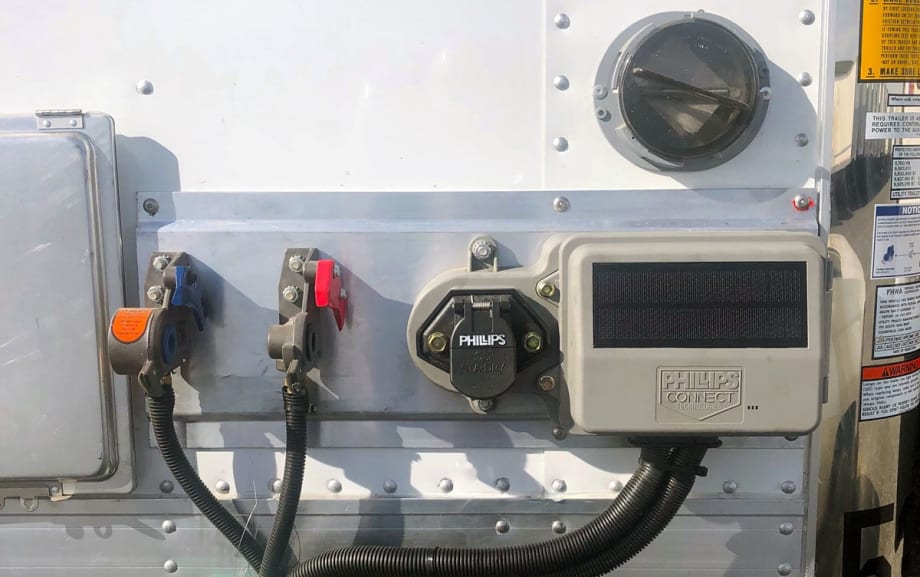
At launch, Utility Connect will include GPS trailer tracking, light-out detection, intelligent ABS fault code reporting, tire inflation system monitoring, and the ability to connect to additional sensors.
Photo: Phillips Connect
4 min to read
Phillips Connect made several announcements to help fleets and drivers benefit from smarter trailers, including new smart nosebox gateways, backup cameras, and a partnership with Utility to launch the Utility Connect trailer telematics system.
The announcements were made during a press conference at the American Trucking Associations’ Technology & Maintenance Council Annual Meeting and Transportation Technology Exhibition on March 6.
Phillips told reporters that the company has installed more smart-trailer telematics solutions in North America than all of its competitors combined. The company is growing, investing in new facilities, multiple key hires, and new manufacturing lines and equipment. It has increased its annual global R&D plan by more than 300% since January 2021.
Utility Trailer Telematics System
Utility Trailer announced its Utility Connect trailer telematics system, which it is launching with Phillips Connect as its exclusive partner.
The Utility Connect system uses Utility’s proprietary wiring harness, which has been reengineered to work with the Phillips Connect Smart7 nosebox.
At launch, Utility Connect will include GPS trailer tracking, light-out detection, intelligent ABS fault code reporting, tire inflation system monitoring, and the ability to connect to additional sensors (sold separately) such as door open/closed, ultrasonic cargo detection, and interior cargo cameras.
It also has built-in expansion capabilities, offering over-the-air communication updates that will integrate with advanced tire pressure monitoring systems, Bendix’s Roll-Stability system, trailer weight, air tank pressure, and optional brake pad wear-sensors for disc brakes. Future systems will include connection to reefer units and liftgates for monitoring status and maintenance.
Because Phillips Industries is the standard wiring harness supplier for Utility Trailer, upgrading to the telematics version of its existing harness can be done without slowing trailer production rates. All connections of the Utility harness are soldered, and connections are over-molded.
The Connect1 online or mobile platform displays all the critical alerts for a trailer on just one screen. Fleets with multiple telematics solutions can use it to get to the right provider’s platform with a few keystrokes and a single click.
Smart Nosebox GPS Gateways
Phillips Connect introduced three new smart nosebox GPS gateways. Retrofittable or specified on new equipment, the new Phillips Connect Smart noseboxes transform trailers into managed assets that provide telematics benefits with a positive ROI, according to the announcement.
The Smart S7 Swiveling Nosebox, Smart Q-Box, and Smart iBox are advanced cellular gateways, GPS trackers, and sensor hubs that deliver total awareness of trailer location, status, and critical trailer conditions to the cloud. All are equipped with a Phillips Quick-Change-Socket (QCS2) Sta-Dry 7-way connection requiring no additional harnessing or electrical connections.
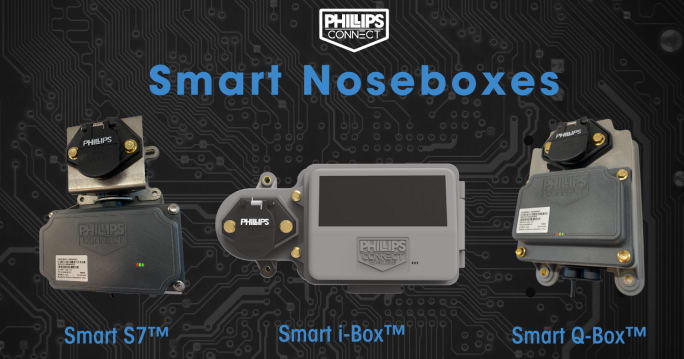
Phillips Connect Smart noseboxes transform trailers into managed assets that provide telematics benefits.
Photo: Phillips Connect
Integrated sensors include GPS location, tractor power, and ABS PLC data such as VIN, fault lamp status, and trouble codes. Additionally, data from a wide variety of external sensors are available through Bluetooth LE, GPIO, and an extendable RS485-based Phillips Connect PCT Bus.
The Smart S7 swiveling nosebox offers additional benefits to fleets. The swivel feature, developed by Phillips Industries a decade ago, allows cables to simply follow the movement of the truck when the truck/trailer combination has to maneuver into tight spaces, creating a severe angle between them. This situation can result in expensive and time-consuming damage to the trailer-side connections. The Smart S7 swiveling nosebox accommodates a turn up to 80 degrees (40 degrees left or 40 degrees right) and will automatically disconnect the electrical connection if the turn exceeds that angle.
The new gateway devices operate on the Connect1 platform, which provides complete fleet analytics through personalized dashboards. By fully customizing the Connect1 dashboards, fleets can see the real-time status of an entire operation through custom notifications, geofences, reports, and more.
Backup Cameras for Trailers
Why is it that every car produced comes with a built-in backup camera, yet truckers, who have more than 60 feet from their eyes to the bumper of their trailer, still back up blindly? Phillips decided to address that problem with new BackupVision cameras.
The cameras have less than 1 second of latency (the time it takes the video to get from the back of the trailer to the cab) and integrated spotlights. Phillips is giving ELD manufacturers full access to the data free of charge so that it can be displayed on those screens.
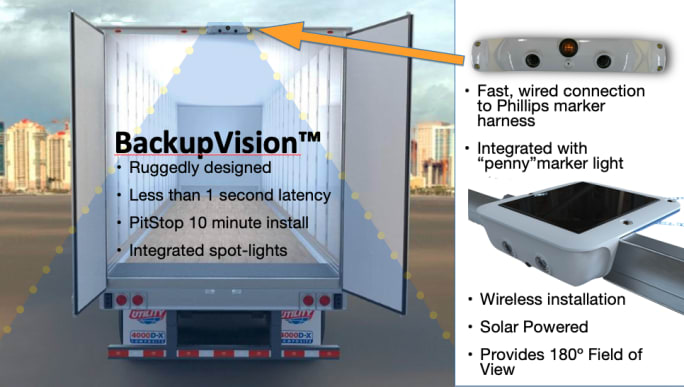
Phillips BackupVision backup cameras The camera offers a 180-degree view and more than 20 feet of visibility behind the trailer.
Photo: From Phillips Connect Powerpoint presentation
There is a wired version for swing doors and a wireless, solar-powered version for roll-up doors. Both communicate via WiFi to the cab’s ELD or driver’s smart phone. Drivers use a QR Code to get the video feed on their smartphones.
The camera offers a 180-degree view and more than 20 feet of visibility behind the trailer, according to Phillips.
Additional smart features are available when the cameras are paired with a Phillips Connect gateway, such as uploading images to cloud and video storage when impacts are detected.
Phillips promised a simple 10-minute installation on loaded or unloaded trailers, and fast programming with the IOS or Android mobile app.
In the future, BackupVision camera information could be relayed to the driver information screens we’re increasingly seeing in the dash of trucks. Rob Phillips, CEO of Phillips Industries and Phillips Connect, told reporters that he would like to see that happen, there’s not much interest from OEs right now.
“They’re only interested in the truck. The trailer is just something it pulls.” He said it’s time for standardized view screens in truck cabs to facilitate technology such as trailer cams.
More Equipment

How Volvo Updated Its D13 for EPA 2027 [Watch]
Volvo’s updated D13 promises lower emissions without sacrificing performance or fuel economy. Take a closer look at what changed inside the engine in this HDT Spotlight video.
Read More →
Michelin Tire Improves Efficiency and Durability for Regional Fleets
The Michelin X Multi Energy D2 is a regional haul drive tire engineered to help fleets improve fuel efficiency, durability and traction in demanding stop-and-go operations.
Read More →
ZF Expands Commercial Vehicle Push in North America
ZF is expanding its North American commercial-vehicle presence with new transmission applications, electrification, trailer technology and autonomous-driving systems.
Read More →
Tesla Wants a Self-Driving Semi. Are Cameras Enough?
Could Tesla’s camera-only autonomous driving technology work on an 80,000-pound Semi? In this commentary, HDT's Deborah Lockridge takes a look at Tesla, Cybercab, and how autonomous trucks see the road.
Read More →
Kodiak: Driverless Long-Haul Truck Launch on Track for 2026
Kodiak AI says its driverless long-haul safety case is 93% complete and it remains on track to begin commercial operations by year-end 2026.
Read More →
What DOT’s Automated Vehicle Strategy Means for Trucking
The U.S. Department of Transportation issued a new automated-vehicle strategy that outlines plans for driverless-truck regulations, cross-state freight corridors, and federal safety standards.
Read More →
East Coast Port Launches $45M Electric Truck Push
The Port Authority of New York and New Jersey announced millions in incentives for zero-emission drayage trucks, yard tractors, and new charging hubs near the port.
Read More →
PlusAI Going Public to Fund Autonomous Truck Launch
A SPAC deal could provide PlusAI with up to $300 million as it works toward a 2027 commercial launch of factory-built autonomous trucks.
Read More →
NHTSA Moves to Rewrite Truck Fuel-Economy Rules
The National Highway Traffic Safety Administration says it lacks authority to regulate medium- and heavy-duty truck engines separately from complete vehicles, but the existing standards have not yet been eliminated.
Read More →
Detroit Opens Orders for EPA 2027 Engines
Detroit isn’t starting from scratch to meet EPA 2027 diesel emissions standards. Its Gen 6 DD13 and DD15 engines keep much of today’s platform while updating the fuel and aftertreatment systems.
Read More →