




A New Approach to Lighting Reliability
Peterson’s Genesis lighting system and repairable J560 connector target two persistent fleet problems: LED light failures and costly electrical connector downtime.

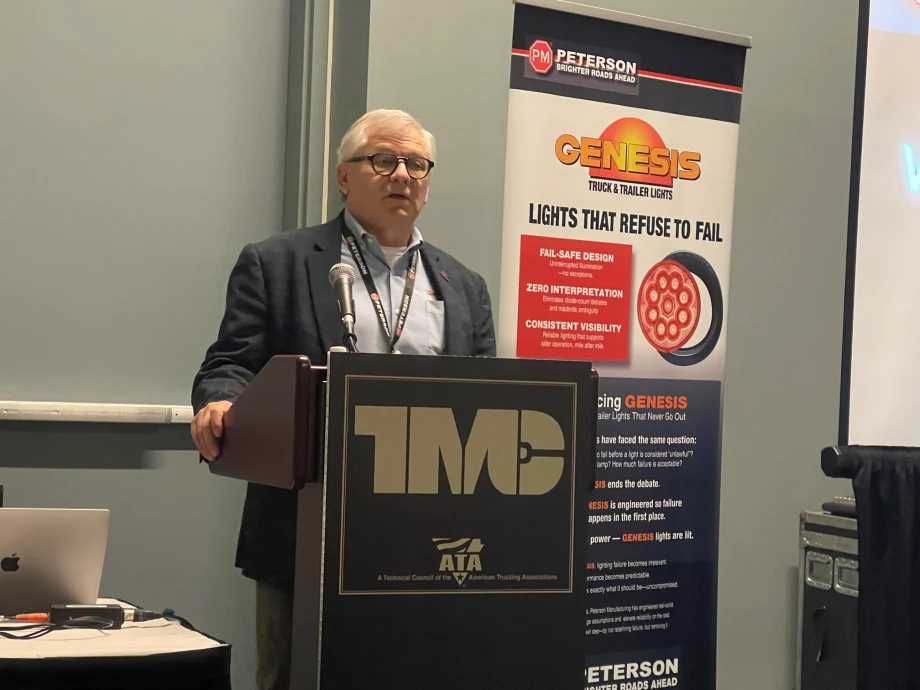
Al Anderson speaks to the media at the TMC Annual Meeting in Nashville.
Jack Roberts
Peterson Manufacturing unveiled a new generation of truck and trailer lighting at the Technology & Maintenance Council’s annual meeting, introducing the Genesis fail-safe lighting system designed to eliminate the long-running industry debate over LED light failure.
Al Anderson, Peterson’s vice president of sales and marketing, said the trucking industry has never settled on a clear definition of when an LED lamp is considered failed.
“How many diodes have to fail before a light is considered ineffective or unlawful?” Anderson said during a press briefing at TMC. “Is it one? Two? Half the diodes? The uncomfortable truth is there’s no consistent answer.”
That ambiguity stems largely from how most LED lamps are designed. In many cases, multiple LEDs share the same circuit path. When one diode fails, it can take an entire section of the light with it, potentially creating visibility and compliance concerns during roadside inspections.
The lack of a clear threshold can leave fleets facing uncertainty, downtime, and safety risks tied to reduced visibility.
Peterson’s response was to rethink how LED lamps function.
Genesis Lighting Designed to Eliminate Failure
The company’s Genesis truck and trailer light is designed around a concept Anderson described as “fail-safe” operation.
Rather than grouping LEDs on shared circuits, Genesis lights allow each diode to operate independently. When a diode eventually reaches the end of its life, the system automatically redistributes output among the remaining LEDs.
“As long as there’s power, there’s light,” Anderson said. “When one diode reaches the end of its life, the system compensates instantly. There’s no flicker and no visible change.”
From the outside, the light maintains the same brightness and appearance, eliminating what Anderson called the industry’s ongoing “diode count debate.”
For fleets, the design means fewer compliance questions, more predictable visibility for other drivers, and less risk of inspection violations tied to partial LED failure.
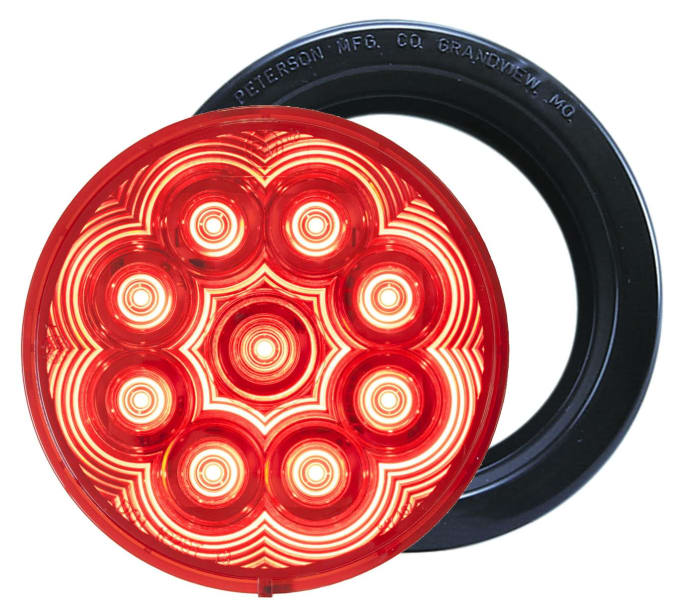
The Genesis truck and trailer light is designed around a concept Paterson Manufacturing described as “fail-safe” operation.
Peterson plans to offer Genesis technology first inits premium lighting lines, including nine-diode round lamps and 10-diode oval lamps commonly used on truck and trailer applications.
Company officials framed the technology as more than a product improvement.
“This isn’t just a lighting product,” Anderson said. “It’s a philosophical shift. We stopped asking how much failure is acceptable and started asking why accept failure at all.”
Repairable J560 Connector Targets Common Failure Point
Peterson also introduced a repairable J560 electrical connector, aimed at addressing one of the most common sources of lighting and electrical issues between tractors and trailers.
According to Anderson, most electrical failures involving the J560 connection occur at the connector ends rather than the cable itself.
“The cable in the middle is usually fine,” he said. “Almost 100% of the time it’s the connector on one end or the other that’s damaged.”
Traditionally, repairing a damaged connector means replacing the entire electrical cord assembly, which can take hours and generate unnecessary waste.
Peterson’s new design allows technicians to repair the connector in place with a simple twist, eliminating the need for tools or cable replacement.
Repairs can be completed in less than a minute, the company said, helping fleets avoid costly service calls, minimize downtime, and keep trucks moving.
The repairable design also preserves cable length and reduces the number of discarded assemblies.
Systems Built for Serviceability
The company also highlighted modular lighting box kits designed to simplify installation and maintenance. The systems allow fleets to configure one or multiple lighting boxes depending on the application and quickly replace damaged components.
Together, Peterson executives said the new products reflect a broader focus on reliability and serviceability.
“Our industry has spent way too much time debating how much failure is acceptable,” Anderson said. “Genesis removes that debate entirely, and the repairable J560 gives control back to the fleet.”
Peterson is demonstrating the new lighting technology and connector systems at its TMC exhibit booth during the conference.
More Equipment

How Volvo Updated Its D13 for EPA 2027 [Watch]
Volvo’s updated D13 promises lower emissions without sacrificing performance or fuel economy. Take a closer look at what changed inside the engine in this HDT Spotlight video.
Read More →
Michelin Tire Improves Efficiency and Durability for Regional Fleets
The Michelin X Multi Energy D2 is a regional haul drive tire engineered to help fleets improve fuel efficiency, durability and traction in demanding stop-and-go operations.
Read More →
ZF Expands Commercial Vehicle Push in North America
ZF is expanding its North American commercial-vehicle presence with new transmission applications, electrification, trailer technology and autonomous-driving systems.
Read More →
Tesla Wants a Self-Driving Semi. Are Cameras Enough?
Could Tesla’s camera-only autonomous driving technology work on an 80,000-pound Semi? In this commentary, HDT's Deborah Lockridge takes a look at Tesla, Cybercab, and how autonomous trucks see the road.
Read More →
Kodiak: Driverless Long-Haul Truck Launch on Track for 2026
Kodiak AI says its driverless long-haul safety case is 93% complete and it remains on track to begin commercial operations by year-end 2026.
Read More →
What DOT’s Automated Vehicle Strategy Means for Trucking
The U.S. Department of Transportation issued a new automated-vehicle strategy that outlines plans for driverless-truck regulations, cross-state freight corridors, and federal safety standards.
Read More →
East Coast Port Launches $45M Electric Truck Push
The Port Authority of New York and New Jersey announced millions in incentives for zero-emission drayage trucks, yard tractors, and new charging hubs near the port.
Read More →
PlusAI Going Public to Fund Autonomous Truck Launch
A SPAC deal could provide PlusAI with up to $300 million as it works toward a 2027 commercial launch of factory-built autonomous trucks.
Read More →
NHTSA Moves to Rewrite Truck Fuel-Economy Rules
The National Highway Traffic Safety Administration says it lacks authority to regulate medium- and heavy-duty truck engines separately from complete vehicles, but the existing standards have not yet been eliminated.
Read More →
Detroit Opens Orders for EPA 2027 Engines
Detroit isn’t starting from scratch to meet EPA 2027 diesel emissions standards. Its Gen 6 DD13 and DD15 engines keep much of today’s platform while updating the fuel and aftertreatment systems.
Read More →