




Hazard Lights Move into the Modern Era
Emergency Safety Solutions is updating flashing hazard lights on disabled vehicles in some truly remarkable ways.

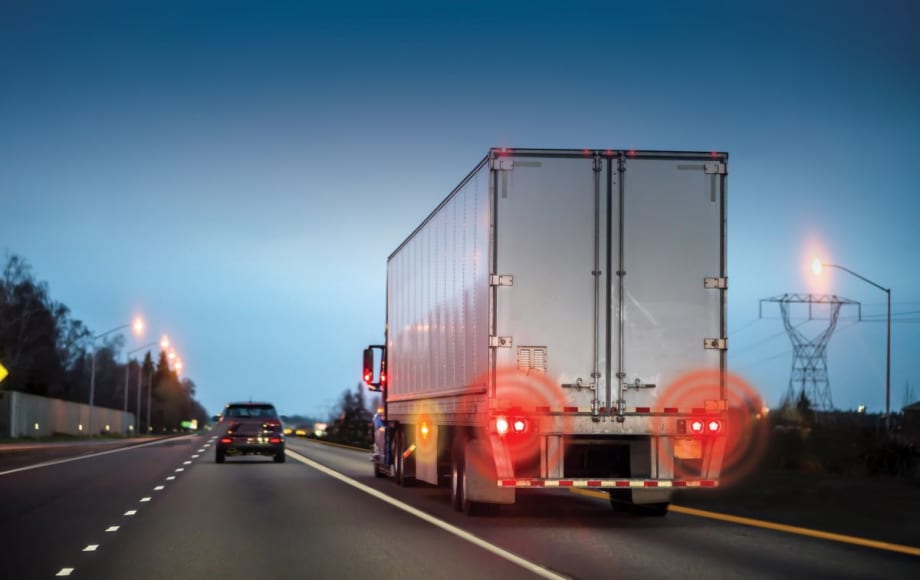
An all-new take on hazard lights has caught the attention of both fleets and truck OEMs.
Photo: ESS
New tech is the name of the game at the CES trade show. So naturally, you see a lot of advanced, cutting-edge concepts and products that redefine an existing technology or even introduce an entirely new one.
But some of the coolest stuff you see are things so blatantly obvious, you can’t believe no one thought of it sooner. That was the case when I visited the Emergency Safety Solutions booth for an up-close look at its new HELP DeliverSafe smart, digital lighting alert system.
A Comprehensive Emergency Management System
ESS’s tagline is, “It’s time to see disabled vehicles in a new light.” And that’s a perfect summation of what HELP DeliverSafe is and does. Slowly blinking hazard lights have been an important safety function on vehicles for decades. But ESS is taking hazard lights into the modern era.
HELP stands for Hazard Enhanced Location Protocol. According to Michael O’Brien, executive director of strategic development for ESS, HELP is an intelligent emergency communications feature that uses two communication means to make disabled vehicles much more visible to other drivers.
“First is a new, highly conspicuous emergency-based lighting output,” O’Brien explained. “HELP Lighting Alerts increase the visual conspicuity of stationary and disabled vehicles by adding an emergency mode to a vehicle’s standard hazard light system.”
In an accident situation, it does this by initiating faster and sharper flash rates from the vehicle’s lighting system. The effect is comparable to a strobe light, which immediately catches the eye of drivers and alerts them that they’re approaching a dangerous situation.
But that’s just the beginning of what the HELP system does.
Working with Onboard Intelligence
“The system works in conjunction with smart onboard intelligence in the vehicle,” O’Brien said. “That means that HELP's emergency mode activation features deploy automatically upon collision (airbag deployment) or other safety trigger events such as tire blowout, rollover, driveline failure, or an autonomous driving system ‘safe stop.’ There’s also a manual activation by the driver when the vehicle is stationary and in park.”
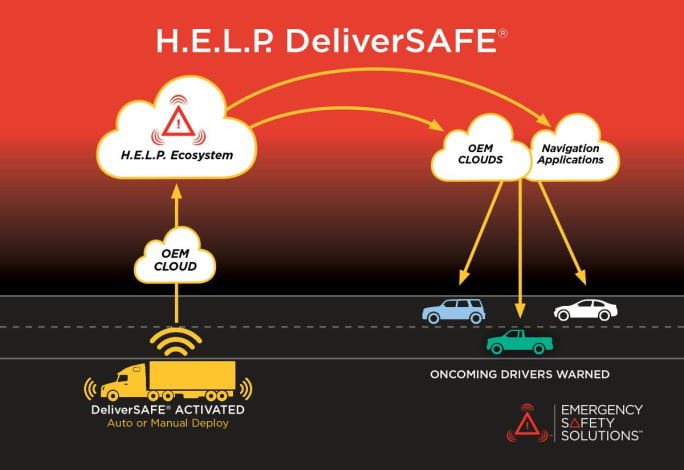
The moment air bags are deployed, the ESS H.E.L.P. system activates hazard lights, warns oncoming drivers via navigation apps and flashes an alert to local emergency responders and fleet headquarters.
Graphic: ESS
Once engaged, it automatically sends digital alerts to any oncoming vehicles in the area via navigation and mapping applications, displaying the disabled vehicle’s location on their in-vehicle display screens.
“Taken together, these features deliver multiple advanced warnings to oncoming traffic that there’s an accident or disabled vehicle up ahead,” O’Brien said. “That gives approaching drivers much more time to safely respond to disabled vehicles. Additionally, if the air bags on the vehicle have been deployed, the system recognizes that an accident has occurred and can alert local emergency response teams to dispatch help.”
HELP Is On The Way to Trucking
Given the elegance and common-sense backing up the HELP system, it’s not surprising to learn that the American Trucking Associations and North American truck OEMs are interested.
“We’ve talked to ATA and understand that fleets across the country are dealing with insurance costs spiraling out of control as well as nuclear verdicts,” O’Brien said. “Unfortunately, for a lot of lawyers out there, trucking fleets are simply a cash-rich environment for litigation. So, the trucking industry has seen our HELP system and come to us for help.”
That help is taking shape in the form of an integrated HELP solution designed specifically for tractor-trailers, O’Brien said.
“We’re working on this problem from both sides,” he said, working with both fleets and original equipment manufacturers. “And it’s challenging to come up with an integrated solution, because there are so many players in the industry running so many different kinds of equipment.”
For example, he said, Amazon wants to use the system. "The problem is that Amazon owns their trailers. But many of the tractors used to pull them are owned by independent operators. So, it’s been challenging coming up with an integrated solution that works in situations like that.”
Bringing in the Fleet Back Office
ESS has been working with a tanker fleet in Texas to perfect the commercial vehicle version of H.E.L.P., O’Brien said. That system will include even more features than currently available on the passenger car version.
“Our partner fleet in Texas is a carrier for Shell,” he explained. “So, they're extremely safety oriented. And of course, they also have a fleet management software system, as many fleets do. We want to integrate HELP into that system — and others like it — so that not only will drivers in the vicinity of the disabled vehicle know that a vehicle has stalled or an accident has occurred, but an alert will be flashed back to the fleet, as well.”
O’Brien said ESS is doing this by using a back-end connection to the cloud to send alerts through various fleet management software systems available today.
“Drivers love this system,” he said. “If something goes wrong, they don’t have to worry about alerting other drivers or calling for help. Because our system does that for them automatically. They’re safer in the immediate vicinity of the disabled vehicle because of the high flash rate from lights on their vehicle and the digital alert sent to nearby cars. And they also have the peace of mind knowing that their fleet safety officers and emergency response units are already aware that there’s a problem and that help is on the way.”
More Safety & Compliance
PrePass, Kodiak Connect Driverless Trucks to Roadside Enforcement
The system will allow enforcement agencies to verify Enhanced Inspection information and decide whether Kodiak’s autonomous trucks can bypass roadside screening sites.
Read More →
From One Generation to the Next: How Mentorship Builds Safer Truck Drivers
After three decades in trucking, Harold Perry shares what he's learned about driver safety, mentorship, and helping the next generation build confidence behind the wheel.
Read More →
FMCSA Pauses Biennial-Update Enforcement Amid Motus Transition
Carriers whose updates were due on or after June 1 have more time, while FMCSA works to stabilize its new registration system and warns of phishing sites impersonating its new carrier registration system, Motus.
Read More →
ZF Expands Commercial Vehicle Push in North America
ZF is expanding its North American commercial-vehicle presence with new transmission applications, electrification, trailer technology and autonomous-driving systems.
Read More →
Truck Drivers Need More Than Another Alert
Fleets have more visibility into truck health, safety events, and driver activity than ever. The next challenge is turning all that information into useful guidance for the person who has to decide what to do next.
Read More →
Tesla Wants a Self-Driving Semi. Are Cameras Enough?
Could Tesla’s camera-only autonomous driving technology work on an 80,000-pound Semi? In this commentary, HDT's Deborah Lockridge takes a look at Tesla, Cybercab, and how autonomous trucks see the road.
Read More →
What DOT’s Automated Vehicle Strategy Means for Trucking
The U.S. Department of Transportation issued a new automated-vehicle strategy that outlines plans for driverless-truck regulations, cross-state freight corridors, and federal safety standards.
Read More →
NYC Expands Speed, Pedestrian Safety Tech Across Fleet
New York City is expanding intelligent speed assistance and pedestrian-alert systems across its municipal fleet, moving the technologies from pilot programs into vehicle procurement and retrofit requirements.
Read More →
FMCSA Removes 110 Truck Driver Training Schools from Certified ELDT List
Federal regulators also are targeting more than 160 additional training providers and launching a nationwide audit of third-party CDL skills testers as part of a broader crackdown on trucking fraud.
Read More →
Beyond DOT Compliance: What Makes a Trucking Fleet Truly Safe?
A trucking fleet can follow every rule and still make unsafe decisions. The real test comes when safety conflicts with freight, productivity, or cost.
Read More →