





Read more about Trevor Milton: Nikola Motor CEO Compares Truck Manufacturers to Kodak
Nikola Founder Trevor Milton Convicted of Fraud
Was Nikola Motors founder Trevor Milton a “con man,” or just overly enthusiastic in his promotion of the company's progress in making zero-emission trucks?
October 18, 2022
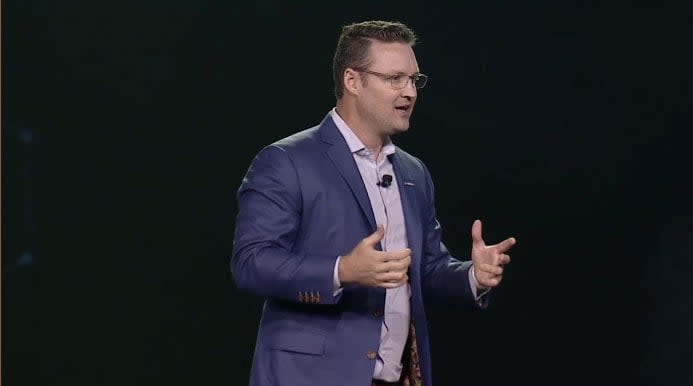
Trevor Milton at Nikola World
Screen capture from live-streamed event
3 min to read
Was Nikola Motors founder Trevor Milton a “con man,” or just overly enthusiastic?
A jury in U.S. District Court in Manhattan apparently agreed with the prosecutor that it was more of the former. Milton was convicted of one count of securities fraud and two counts of wire fraud, although acquitted on an additional count of securities fraud, for using falsifications to pump up the value of the company on Wall Street. The judge allowed Milton to remain free on a $100 million bond until sentencing in January.
“Trevor Milton is a con man,” said assistant U.S. attorney Jordan Estes in summarizing the government’s case. “He lied to investors to get their money, plain and simple.”
Milton defense lawyer Marc Mukasey, while admitting that Milton sometimes spoke in the present tense about things Nikola hoped to achieve in the future, compared him to an overenthusiastic parent who brags about his child.
The fuel-cell and electric-truck company was born in 2015 in Milton’s basement. By late 2016, Milton presided over a much-anticipated unveiling of a futuristic-looking truck. At the time, the plans were for the electric drive system to be powered by a combination of hydrogen fuel cells, lithium-ion batteries and regenerative braking. Milton said the truck would be in production by 2020, with an expected annual build rate of 50,000 units.

The very first unveiling of a Nikola truck was in late 2016.
Photo: Tom Berg
The truck was nowhere near production by 2020, but Nikola went public that year by merging with a special purpose acquisition corporation, or SPAC, called VectoIQ Acquisition Corporation.
“The deal with the so-called blank-check corporation allowed Nikola to avoid some of the regulatory scrutiny usually applied to initial public offerings,” explained the New York Times.
Hindenburg Alleges Nikola Falsehoods
Nikola shares peaked near $80 in June 2020. However, investment firm Hindenburg Research issued a report accusing him lying about the company’s technology. The Hindenburg Research report made a series of claims against Nikola. The report was announced as the company announced a partnership with General Motors to produce the Badger zero-emissions pickup.
Nikola said the report was inaccurate and called it “a hit job for short-sale profit driven by greed.”
The Hindenburg report cited a July 2020 podcast in which Milton said five of the trucks were “coming off the assembly line right now in Ulm, Germany,” though a spokesperson for Bosch, the manufacturing partner building the trucks, confirmed that “they haven’t made any trucks yet,” according to Hindenburg. Bosch said the report took comments from the Bosch employee taken out of context, and Nikola responded that the five trucks were currently being built and commissioned in Ulm as pre-production builds.
The Hindenburg report also took Nikola to task for overstating agreements with Anheuser Busch and Republic Services, when in fact those companies are not obligated to purchase any vehicles.
One of the most reported falsifications the report pointed to was an ad where a Nikola truck was rolled down an incline to make it look like a working prototype. Mukasey dismissed the video as mere “special effects,” telling the jury that it’s “certainly not a crime to use special effects. Otherwise the government would have to indict the Energizer Bunny.”
Nikola Today
Milton resigned as executive chairman a few weeks after the Hindenburg report.
Since then, the company has continued to develop zero-emission trucks in his absence, in partnership with European truck maker Iveco. Nikola started production of the battery-electric Nikola Tre at a new plant in Coolidge, Arizona, in March. In September, Nikola and Iveco announced at the IAA commercial vehicle show they were commercially launching the European Nikola Tre battery-electric vehicle and unveiled the European Nikola Tre fuel cell electric vehicle (FCEV) beta version.
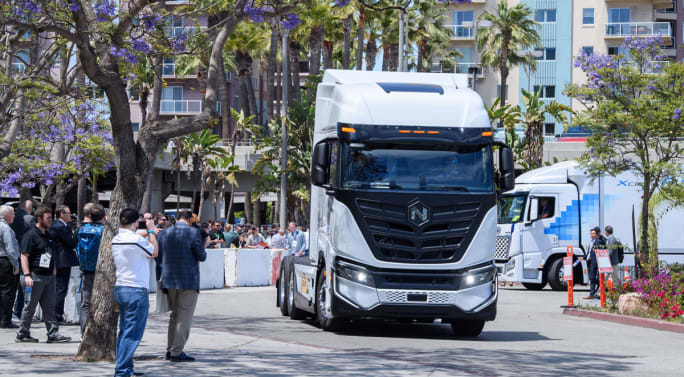
The battery-electric Nikola Tre in a ride-and-drive at ACT Expo earlier this year.
Photo: ACT Expo
More Fuel Smarts

How Volvo Updated Its D13 for EPA 2027 [Watch]
Volvo’s updated D13 promises lower emissions without sacrificing performance or fuel economy. Take a closer look at what changed inside the engine in this HDT Spotlight video.
Read More →
Diesel Price Spike Shortens Payback for Natural Gas Trucks, Report Says
Energy Vision estimates fleets could recover the higher purchase price of an RNG-fueled Class 8 tractor in 1.3 to 2.8 years under current fuel-price scenarios.
Read More →
Calstart Becomes Catalyst Mobility, Reflecting Broader Focus
Calstart is now Catalyst Mobility, reflecting the nonprofit’s growing national role in clean transportation, including zero-emission trucks, infrastructure and incentive programs.
Read More →

Record Diesel Prices Squeeze Trucking Fleets
Average U.S. diesel prices have climbed to nearly $6 a gallon, surpassing the 2022 record as tight refinery capacity and Middle East disruptions keep fuel costs elevated.
Read More →
Sponsored•September 9, 2026
How Fuel Delivery Shapes Engine Performance
Fuel delivery depends on more than what happens at the injector. For fleet, maintenance and technical professionals, looking at the full path from pump to injector can provide useful context for understanding engine performance.
Read More →
East Coast Port Launches $45M Electric Truck Push
The Port Authority of New York and New Jersey announced millions in incentives for zero-emission drayage trucks, yard tractors, and new charging hubs near the port.
Read More →
California Bill Could Shed Light on Electric Truck Prices
Why do battery-electric Class 8 trucks remain so expensive? A California bill headed to Gov. Gavin Newsom would give fleets and state agencies more visibility into what manufacturers charge.
Read More →
Detroit Opens Orders for EPA 2027 Engines
Detroit isn’t starting from scratch to meet EPA 2027 diesel emissions standards. Its Gen 6 DD13 and DD15 engines keep much of today’s platform while updating the fuel and aftertreatment systems.
Read More →
Zero-Emission Truck Corridor Planned for West Coast
California, Oregon, Washington, British Columbia and Baja California are coordinating plans for truck charging and hydrogen fueling from Canada to Mexico.
Read More →
A Closer Look at Kenworth’s Electric T880E Vocational Truck [Video]
Learn more about Kenworth's T880E battery-electric vocational truck at the Paccar Technical Center, including its range, applications, upfitting considerations, and PTO options, in this HDT Spotlight video.
Read More →