





Related News: Can 'Electric Highways' Help with Zero Emissions Truck Goals?
Researchers Demonstrate Wireless Charging of Electric Heavy-Duty Truck at Highway Speeds
Purdue researchers demonstrated a high-power wireless charging system capable of delivering energy to electric heavy-duty trucks at highway speeds, advancing the concept of electrified roadways for freight transportation.
February 3, 2026
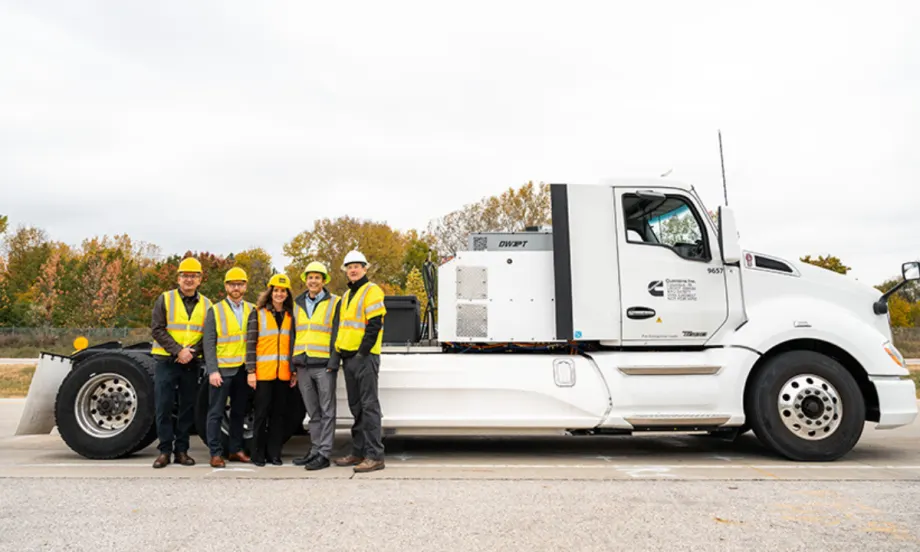
Purdue researchers and industry partners stand alongside a Class 8 electric truck equipped with receiver coils for dynamic wireless charging tests.
Photo: Purdue University
3 min to read
- Purdue researchers demonstrated a high-power wireless charging system for electric trucks.
- The prototype system charges heavy-duty vehicles while in motion on highways.
- Charging while driving would reduce the need for large battery packs on trucks.
*Summarized by AI
Purdue University researchers have demonstrated a high-power wireless charging system capable of delivering significantly more energy to electric vehicles than previously tested systems in the U.S. During testing on a roadway segment in West Lafayette, Indiana, the system transferred 190 kilowatts to a Class 8 battery-electric truck traveling at 65 mph.
“To put that in perspective, 200 kilowatts is roughly the power demand of about 100 homes,” said Steve Pekarek, professor of electrical and computer engineering at Purdue.
High-Power Wireless Charging Focused On Trucks
The system was designed to meet the power requirements of heavy-duty trucks first, with the ability to support lower-power vehicles as well.
“This design supports everything from the heaviest trucks to passenger vehicles,” said Aaron Brovont, research assistant professor in Purdue’s Elmore Family School of Electrical and Computer Engineering.
Because trucking contributes more to U.S. gross domestic product than other freight modes, researchers say reducing operating costs for electric trucks could help accelerate investment in electrified highways. If trucks can charge while driving, battery sizes could be reduced, allowing for higher payload capacity and lower vehicle costs.
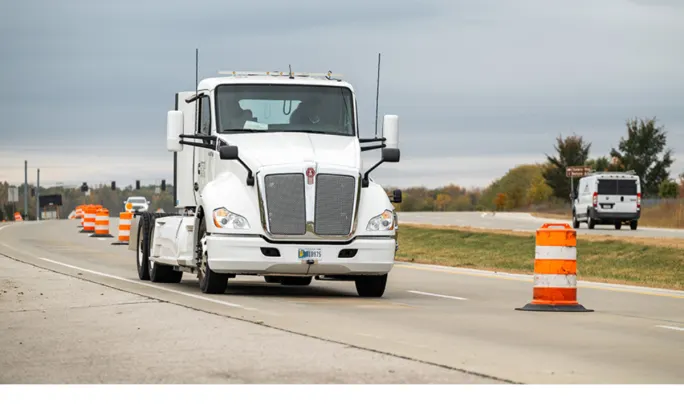
A Class 8 electric truck travels over a wireless charging test lane while receiving power during on-road testing in Indiana.
Photo: Purdue University
Electrified highways could also enable smaller battery packs for passenger vehicles, addressing range anxiety and vehicle cost concerns.
“Battery size drives much of the cost in electric vehicles,” said John Haddock, professor in Purdue’s Lyles School of Civil and Construction Engineering. “Charging while driving would reduce the need for large battery packs.”
System Design And On-Road Testing
The Purdue system uses embedded transmitter coils installed in dedicated highway lanes. These coils send power wirelessly to receiver coils mounted underneath the vehicle, similar in concept to smartphone wireless charging but at much higher power levels.
“Wireless power transfer at these distances is challenging, especially for heavy-duty vehicles operating at very high power,” said Dionysios Aliprantis, professor of electrical and computer engineering at Purdue.
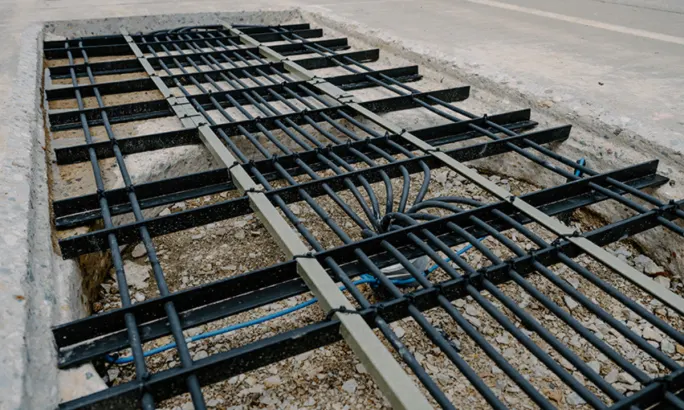
Transmitter coils installed beneath concrete pavement deliver wireless power to electric vehicles through magnetic fields as they drive over the roadway.
Photo: Purdue University
Cummins collaborated with Purdue to adapt a prototype Class 8 battery-electric truck for the on-road testing.
“The testing demonstrated strong performance and collaboration,” said John Kresse, chief technology engineer at Cummins. “The power levels and cost structure show potential for on-highway commercial transportation.”
Unlike other systems that require multiple low-power receiver coils, the Purdue design uses a single receiver assembly mounted under the tractor, simplifying system integration.
Infrastructure Integration And Industry Collaboration
The Indiana Department of Transportation embedded the transmitter coils into concrete pavement, which carries the heaviest traffic despite representing only about 20% of the interstate system.
Most U.S. wireless charging roadway projects are led by members of Aspire, a national consortium focused on electrified transportation. Purdue is a founding member of Aspire, which is headquartered at Utah State University and includes 10 partner universities and more than 70 industry, government, and nonprofit organizations.
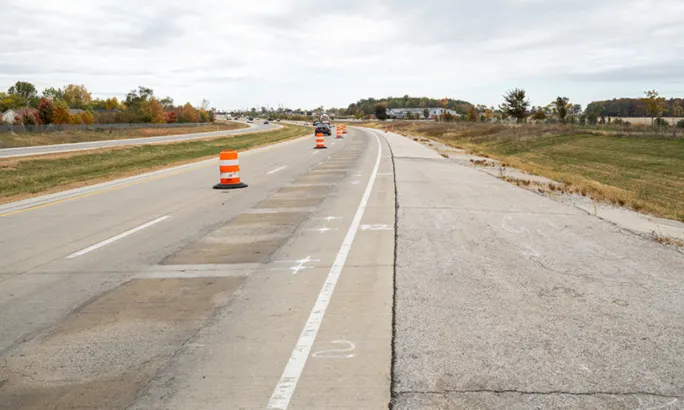
A test segment of highway near Purdue University was modified to support dynamic wireless charging for electric trucks traveling at highway speeds.
Photo: Purdue University
“This work shows how collaboration across public agencies, industry, and academia can advance electrified transportation,” said Don Linford, director of industry and ecosystem engagement for ASPIRE.
Toward Industry Standards For Electrified Highways
The system is also being used to support the development of industry standards for dynamic wireless power transfer. Researchers say standardized designs would be critical for departments of transportation considering roadway-based charging infrastructure.
Future demonstrations are planned for additional vehicle classes, including light-duty vehicles.
In April, the Purdue team received the Technology Innovation Award at the IEEE PES Energy and Policy Forum Innovation Showcase.
“This project shows how research can move from the lab to real-world infrastructure,” said Gkritza.
More Fuel Smarts

How Volvo Updated Its D13 for EPA 2027 [Watch]
Volvo’s updated D13 promises lower emissions without sacrificing performance or fuel economy. Take a closer look at what changed inside the engine in this HDT Spotlight video.
Read More →
Diesel Price Spike Shortens Payback for Natural Gas Trucks, Report Says
Energy Vision estimates fleets could recover the higher purchase price of an RNG-fueled Class 8 tractor in 1.3 to 2.8 years under current fuel-price scenarios.
Read More →
Calstart Becomes Catalyst Mobility, Reflecting Broader Focus
Calstart is now Catalyst Mobility, reflecting the nonprofit’s growing national role in clean transportation, including zero-emission trucks, infrastructure and incentive programs.
Read More →

Record Diesel Prices Squeeze Trucking Fleets
Average U.S. diesel prices have climbed to nearly $6 a gallon, surpassing the 2022 record as tight refinery capacity and Middle East disruptions keep fuel costs elevated.
Read More →
Sponsored•September 9, 2026
How Fuel Delivery Shapes Engine Performance
Fuel delivery depends on more than what happens at the injector. For fleet, maintenance and technical professionals, looking at the full path from pump to injector can provide useful context for understanding engine performance.
Read More →
East Coast Port Launches $45M Electric Truck Push
The Port Authority of New York and New Jersey announced millions in incentives for zero-emission drayage trucks, yard tractors, and new charging hubs near the port.
Read More →
California Bill Could Shed Light on Electric Truck Prices
Why do battery-electric Class 8 trucks remain so expensive? A California bill headed to Gov. Gavin Newsom would give fleets and state agencies more visibility into what manufacturers charge.
Read More →
Detroit Opens Orders for EPA 2027 Engines
Detroit isn’t starting from scratch to meet EPA 2027 diesel emissions standards. Its Gen 6 DD13 and DD15 engines keep much of today’s platform while updating the fuel and aftertreatment systems.
Read More →
Zero-Emission Truck Corridor Planned for West Coast
California, Oregon, Washington, British Columbia and Baja California are coordinating plans for truck charging and hydrogen fueling from Canada to Mexico.
Read More →
A Closer Look at Kenworth’s Electric T880E Vocational Truck [Video]
Learn more about Kenworth's T880E battery-electric vocational truck at the Paccar Technical Center, including its range, applications, upfitting considerations, and PTO options, in this HDT Spotlight video.
Read More →