




New Research Hub Supports Higher Quality Electric Recharging infrastructure
And new research institute founded by EPRI, Calstart and eTRUC will serve as a testing hub and development center for heavy-duty electric truck charging technologies.

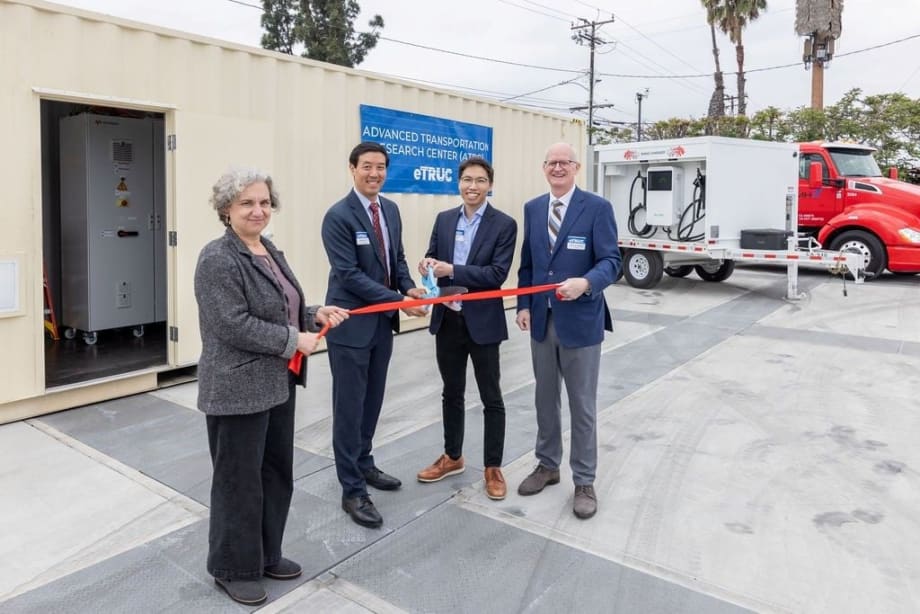
Jasna Tomic (left) and officials from EPRI and ATRC open a new high-power charging lab in Pomona, California on May 8.
Photo: Doug Cupid Photography
EPRI and Calstart have unveiled the Advanced Transportation Research Center (ATRC). The new facility is part of the Electric Truck Research and Utilization Center (eTRUC) initiative.
The new research center was made possible with funding support from the California Energy Commission (CEC) through the Electric Program Investment Charge Program.
Advancing High-Power Charging Infrastructure
The new facility is located within Southern California Edison’s (SCE) High-Power Charging Lab at their Electric Vehicle Technical Center (EVTC) campus in Pomona, California.
The lab marks a major milestone in advancing high-power charging infrastructure and zero-emission freight solutions for heavy-duty vehicles, Calstart said.
Leaders from the project emphasized the ATRC’s critical role in accelerating transportation electrification.
“The Advanced Transportation Research Center provides unique capabilities for testing heavy-duty electric vehicle charging,” said Watson Collins, EPRI’s senior technical executive and co-principal investigator on the project. “The lab’s plug-and-play connectivity and readiness for a high-power grid connection enables users to test charging systems in a matter of weeks, making it an important resource to advance the evolution of EV charging.”
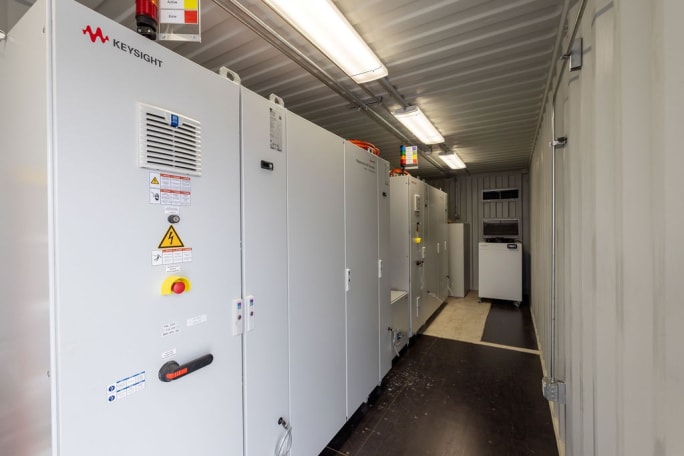
The Keysight SL1800A Series Scienlab Regenerative DC Emulator is just one of the cutting-edge research systems employed by the new lab.
Photo: Doug Cupid Photography
“This new lab represents a major step forward in accelerating zero-emission freight technologies,” said Jasna Tomic, Calstart vice president. “It’s exciting to see such strong collaboration across industry, government, and research partners—all coming together to drive real progress in high-power charging and commercial vehicle innovation.”
“We are working with many stakeholders to make it easier for everyone to use and benefit from electric vehicles and electric technologies,” said Brian Chen, SCE vice president of project and field engineering. “The High-Power Charging Lab is set to play a big role in speeding the testing and development for heavy-duty truck charging at megawatt (MW) power levels, which will significantly reduce charging times of electric trucks.”
A Collaborative Research Effort
The eTRUC project is a collaborative effort focused on innovation to support the deployment of high-powered infrastructure among key freight corridors to address the charging infrastructure needs required to propel Class 7 and 8 battery-electric truck adoption.
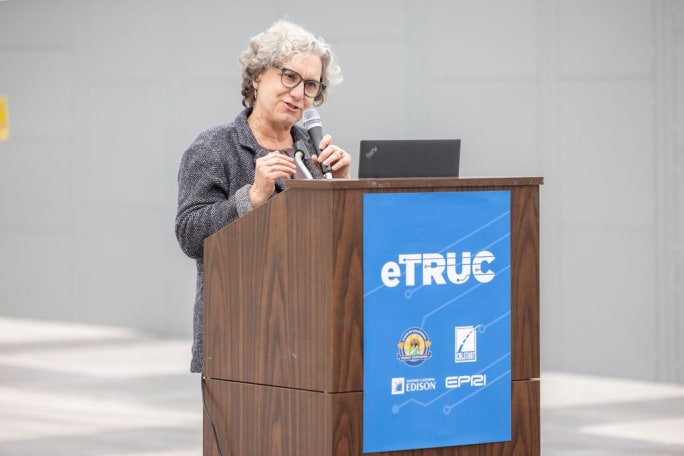
Jasna Tomic, vice president, Calstart, said the new lab represents a major step forward in accelerating zero-emission freight technologies.
Photo: Doug Cupid Photography
The ATRC is a key component of this effort. It offers a shared, high power-testing environment to evaluate charging systems, reduce implementation timelines, and inform future standards for megawatt-level charging.
The Center supports the testing of HD trucks at megawatt levels and serves as a user facility to third parties including vehicle/charging industry manufacturers.
The lab offers:
System-level functional and grid integration testing,
Use of commercially available test instruments designed for the SAE J1772 Combined Charging System (CCS) standards,
Testing and validation of HD vehicles and their charging systems using the CCS connector,
An open process for manufacturers to apply for testing resources,
Hardware-in-the-loop testing and laboratory connectivity between project partners and other relevant research facilities
This year, it will deploy instruments and resources supporting one MW charging.
Additionally, eTRUC is helping to develop two pilot demonstration sites in Ontario and Carson, California.
The data from these sites will access the benefits of high-power charging infrastructure in commercial HD trucks viewed from technical and business perspectives.
More Fuel Smarts

How Volvo Updated Its D13 for EPA 2027 [Watch]
Volvo’s updated D13 promises lower emissions without sacrificing performance or fuel economy. Take a closer look at what changed inside the engine in this HDT Spotlight video.
Read More →
Diesel Price Spike Shortens Payback for Natural Gas Trucks, Report Says
Energy Vision estimates fleets could recover the higher purchase price of an RNG-fueled Class 8 tractor in 1.3 to 2.8 years under current fuel-price scenarios.
Read More →
Calstart Becomes Catalyst Mobility, Reflecting Broader Focus
Calstart is now Catalyst Mobility, reflecting the nonprofit’s growing national role in clean transportation, including zero-emission trucks, infrastructure and incentive programs.
Read More →

Record Diesel Prices Squeeze Trucking Fleets
Average U.S. diesel prices have climbed to nearly $6 a gallon, surpassing the 2022 record as tight refinery capacity and Middle East disruptions keep fuel costs elevated.
Read More →
How Fuel Delivery Shapes Engine Performance
Fuel delivery depends on more than what happens at the injector. For fleet, maintenance and technical professionals, looking at the full path from pump to injector can provide useful context for understanding engine performance.
Read More →
East Coast Port Launches $45M Electric Truck Push
The Port Authority of New York and New Jersey announced millions in incentives for zero-emission drayage trucks, yard tractors, and new charging hubs near the port.
Read More →
California Bill Could Shed Light on Electric Truck Prices
Why do battery-electric Class 8 trucks remain so expensive? A California bill headed to Gov. Gavin Newsom would give fleets and state agencies more visibility into what manufacturers charge.
Read More →
Detroit Opens Orders for EPA 2027 Engines
Detroit isn’t starting from scratch to meet EPA 2027 diesel emissions standards. Its Gen 6 DD13 and DD15 engines keep much of today’s platform while updating the fuel and aftertreatment systems.
Read More →
Zero-Emission Truck Corridor Planned for West Coast
California, Oregon, Washington, British Columbia and Baja California are coordinating plans for truck charging and hydrogen fueling from Canada to Mexico.
Read More →
A Closer Look at Kenworth’s Electric T880E Vocational Truck [Video]
Learn more about Kenworth's T880E battery-electric vocational truck at the Paccar Technical Center, including its range, applications, upfitting considerations, and PTO options, in this HDT Spotlight video.
Read More →