




Leadership Shakeup at Nikola as Company Reports Q2 Progress
Nikola announced that Michael Lohscheller will step down as president and CEO of the battery-electric and hydrogen-fuel-cell-electric truck maker.

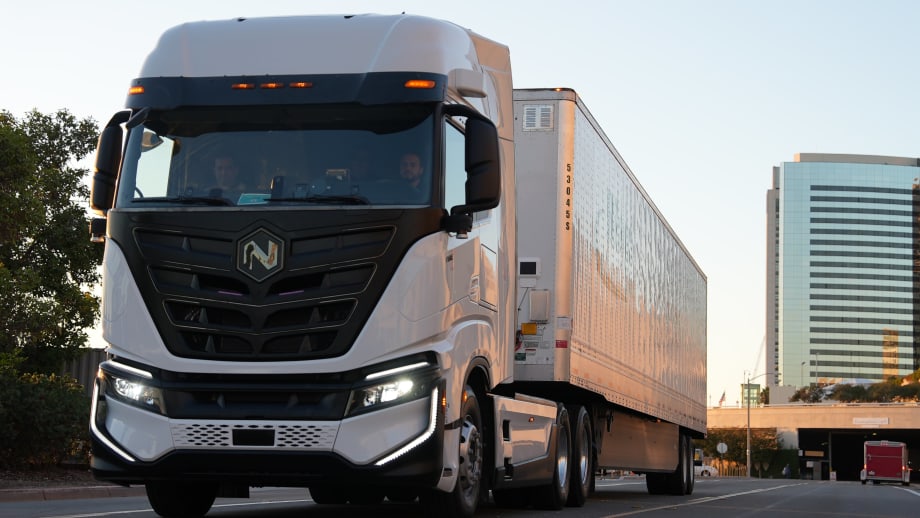
A otherwise positive Nikola shareholder meeting on August 4 was dampened by news of another management shakeup at the OEM.
Photo: Nikola
Michael Lohscheller will step down as president and chief executive officer of Nikola Corp. effectively immediately and as a member of the board of directors effective Aug. 31.
Steve Girsky, chairman of the board since September 2020, has been named CEO of Nikola.
Lohscheller decided to step down due to a family health matter and will be returning to Europe, according to the company. He will remain at Nikola in an advisory capacity through the end of September to help in the leadership transition.
According to Nikola, Lohscheller has led the OEM to a more focused business plan to advance the company’s goal to be a leader in zero-emissions transportation. Nikola said his key accomplishments include:
Driving sales momentum of the battery-electric truck, doubling retail sales from Q1 to Q2 2023.
Supporting the launch of the Class 8 hydrogen fuel cell electric truck and generating customer demand.
Further advancing the organization’s production capabilities in Coolidge, Arizona.
Nikola also credits Lohscheller with substantially reducing the cash burn by more than 30% from the first quarter of 2023 to the second quarter through re-focusing the business and concentrating on the core North American marketplace as well as creating a new global hydrogen energy brand, Hyla.
“The board respects Michael’s decision to be with his family during this time and thanks him for his hard work, dedication, and contributions to Nikola,” Girsky said in a statement. “I am grateful for all that Michael was able to accomplish to move our company forward during his tenure.”
“I feel privileged and honored to have served as Nikola’s CEO and to have worked with so many inspiring colleagues who are relentlessly focused on advancing Nikola’s position as a leader in zero-emissions transportation. I am incredibly confident in Nikola’s future,” said Lohscheller.
New Nikola Chairman
Girsky has more than 30 years of experience working with corporate board executives, labor leaders, OEM leaders, suppliers, dealers, and national policymakers, according to Nikola.

Steve Grimes will replace the outgoing Michael Lohscheller as Nikola CEO on August 31.
Photo: Nikola
“Since Nikola’s inception, I have been a champion of its mission. I am energized to take on this role and build upon the work of Michael and the team,” Girsky said in a release.
In connection with his appointment as CEO, Girsky will remain on the board of directors and Steve Shindler, a director since October 2020, will serve as chairman of the board.
Shindler is a veteran executive who has significant corporate financial management and strategic planning experience, according to the company, most recently as CEO of NII from 2012 until 2017, as well as from 2000 to 2008, where he transformed the company from a start-up into a leading wireless provider, according to the news release.
An OEM on the Mend
At a shareholder’s meeting on Aug. 4, the outgoing Lohscheller outlined where Nikola stands today as it seeks to correct course after years of turmoil. Overall, he painted a rosy picture of Nikola’s current finances, noting several successes along with several business moves that have improved the company’s overall financial situation.
"Nikola has turned the corner and is well on the way to executing our business plan and achieving profitability," Lohscheller told investors. "We have nearly doubled our unrestricted cash position while also substantially reducing our spending. We continue to drive forward in our mission to decarbonize heavy-duty trucking and ensure Nikola is successful for the long haul. Our management team is highly focused on delivering trucks to customers at scale and making the most of our first mover advantage in the hydrogen refueling ecosystem.”
Execution of Strategic Priorities
During the second quarter, Lohschelller said Nikola made substantial progress on the realignment of resources with strategic priorities. These include:
Continued building sales momentum, delivering 45 wholesale and 66 retail battery-electric trucks, the best retail quarter to date.
Increasing unrestricted cash position by $107 million while substantially reducing adjusted free cash flow to below a $150 million target for the quarter.
Raising $233 million through capital raise and asset monetization, and improved visibility into future capital needs to fully fund the business model.
Closing down battery production operations of Romeo Power Inc. and establishing a battery pack line in Coolidge, Arizona for battery-electric trucks.
Completing the sale of European joint venture to Iveco.
Making substantial progress in the development of the hydrogen refueling ecosystem with partners.
Hydrogen Fuel Cell Electric Truck Production Begins
Lohscheller also noted that on July 31, Nikola officially began serial production of the hydrogen fuel cell electric version of the Tre. The first customer deliveries are expected to take place in September. To date, he said, 18 customers have placed orders for more than 200 hydrogen fuel cell electric trucks with Nikola and its dealers.
During the second quarter, the rest of the 10 gamma trucks were fully built and commissioned. Gamma trucks will be used in final vehicle validation and customer pilot testing.
“We expect sales momentum to continue building as customers realize the total cost of ownership benefits of zero-emissions trucks and additional government support is introduced to accelerate the transition to zero-emissions,” he noted.
Expansion into Energy Infrastructure Markets
Another positive for Nikola is its recent moves into energy infrastructure markets, Lohscheller said.
“Our Hyla team is focused on ensuring there is adequate hydrogen supply to meet truck sales volumes in 2023 and beyond,” he said. “We continue to move the hydrogen refueling ecosystem forward with well-capitalized partners that align with our capital-efficient strategy.”
Voltera and Nikola are collaborating on the recently announced partnership, Lohscheller said. He noted that the two companies have begun the station development process for eight initial stations.
The first station, in Ontario, California, is expected to go into operation by the end of 2023. Nikola has also secured over $50 million in grant funding from various California agencies, reducing the capital costs for hydrogen stations.
On July 19, Nikola also announced that Fortescue Future Industries acquired the Phoenix Hydrogen Hub project. Lohscheller said Nikola is currently negotiating an agreement with FFI to support hydrogen demand from Nikola truck customers starting in 2025.
“In the near term as permanent station infrastructure is built, we are securing adequate fueling solutions to enable trucking operations for early customers,” Lohscheller said. “We expect to deploy nine hydrogen mobile fuelers at several locations in California by the end of 2023 to support zero-emissions trucking operations.”
Arizona Manufacturing Facility Expands
In Coolidge, Lohscheller said, the Phase 2 assembly expansion has been completed, resulting in a new, mixed-model assembly line capable of building both battery-electric and hydrogen fuel cell electric trucks. The current production capacity of the facility is 2,400 trucks a year on three work shifts.
Progress continues on the fuel cell power module assembly line in Coolidge.
“We expect the fuel cell power module assembly line to be completed in Q4 of this year,” he said. “Progress also continues on the battery pack line installation in Coolidge. When we resume battery-electric truck production, the battery packs utilized will be built at our facility in Coolidge.”
More Equipment

How Volvo Updated Its D13 for EPA 2027 [Watch]
Volvo’s updated D13 promises lower emissions without sacrificing performance or fuel economy. Take a closer look at what changed inside the engine in this HDT Spotlight video.
Read More →
Michelin Tire Improves Efficiency and Durability for Regional Fleets
The Michelin X Multi Energy D2 is a regional haul drive tire engineered to help fleets improve fuel efficiency, durability and traction in demanding stop-and-go operations.
Read More →
ZF Expands Commercial Vehicle Push in North America
ZF is expanding its North American commercial-vehicle presence with new transmission applications, electrification, trailer technology and autonomous-driving systems.
Read More →
Tesla Wants a Self-Driving Semi. Are Cameras Enough?
Could Tesla’s camera-only autonomous driving technology work on an 80,000-pound Semi? In this commentary, HDT's Deborah Lockridge takes a look at Tesla, Cybercab, and how autonomous trucks see the road.
Read More →
Kodiak: Driverless Long-Haul Truck Launch on Track for 2026
Kodiak AI says its driverless long-haul safety case is 93% complete and it remains on track to begin commercial operations by year-end 2026.
Read More →
What DOT’s Automated Vehicle Strategy Means for Trucking
The U.S. Department of Transportation issued a new automated-vehicle strategy that outlines plans for driverless-truck regulations, cross-state freight corridors, and federal safety standards.
Read More →
East Coast Port Launches $45M Electric Truck Push
The Port Authority of New York and New Jersey announced millions in incentives for zero-emission drayage trucks, yard tractors, and new charging hubs near the port.
Read More →
PlusAI Going Public to Fund Autonomous Truck Launch
A SPAC deal could provide PlusAI with up to $300 million as it works toward a 2027 commercial launch of factory-built autonomous trucks.
Read More →
NHTSA Moves to Rewrite Truck Fuel-Economy Rules
The National Highway Traffic Safety Administration says it lacks authority to regulate medium- and heavy-duty truck engines separately from complete vehicles, but the existing standards have not yet been eliminated.
Read More →
Detroit Opens Orders for EPA 2027 Engines
Detroit isn’t starting from scratch to meet EPA 2027 diesel emissions standards. Its Gen 6 DD13 and DD15 engines keep much of today’s platform while updating the fuel and aftertreatment systems.
Read More →