





Related: HDT Test-Drives the 5th Generation Freightliner Cascadia
Freightliner Cascadia Receives Prestigious Design Award
Freightliner’s fifth-generation Cascadia earned a 2025 Red Dot Design Award for its aerodynamic design and functional updates developed through close collaboration between designers and engineers.
January 13, 2026
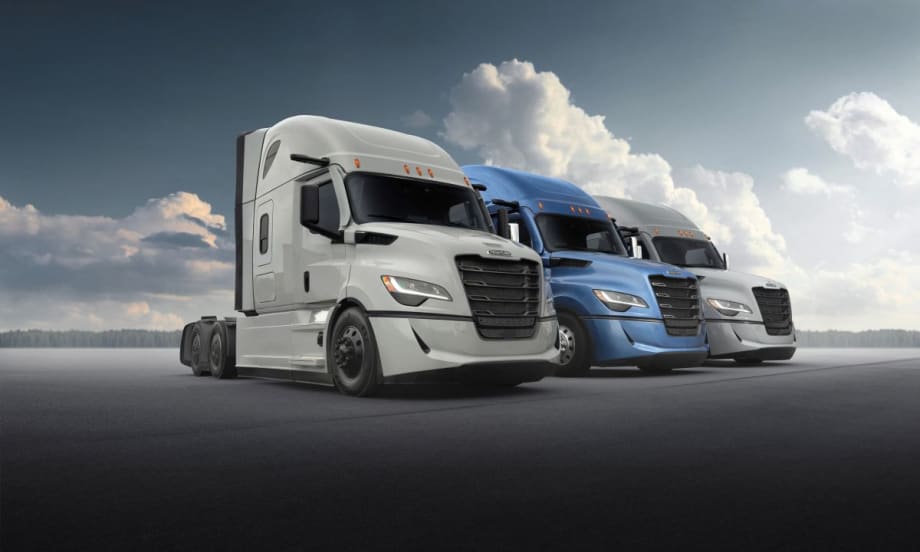
Freightliner’s fifth-generation Cascadia was recognized with a 2025 Red Dot Design Award for product design, highlighting aerodynamic improvements and integrated functional features.
Photo: Daimler Truck North America
2 min to read
Freightliner, a brand of Daimler Truck North America, announced that the fifth-generation Freightliner Cascadia has received a 2025 Red Dot Design Award. The international award recognizes excellence in product design, evaluating aesthetics, functionality, sustainability, and innovation.
Collaborative Design Process
The Cascadia’s design was developed through close collaboration between Daimler Truck North America designers and engineers. From early concept sketches through production, teams focused on balancing aerodynamics, functionality, and visual clarity.
The design draws inspiration from natural airflow patterns, particularly how wind shapes landscapes. That approach informed the truck’s exterior surfaces and aerodynamic form.
“To express efficiency, we focused on forms shaped by wind,” said Jeff Cotner, chief designer at Daimler Truck North America. “The goal was a clean design that supports performance.”
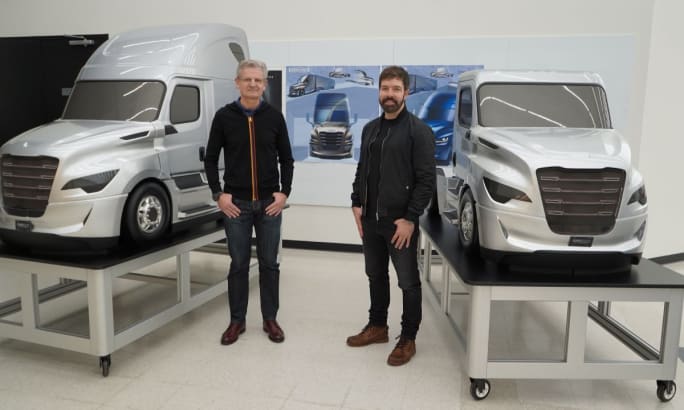
Freightliner design leaders stand with scale models of the fifth-generation Cascadia, which received a 2025 Red Dot Design Award for product design.
Photo: Daimler Truck North America
Aerodynamics And Functional Details
That collaboration is reflected in several exterior updates, including the redesigned hood, A-pillar deflectors, and wheel-well closeouts. Each component was refined through iterative design and engineering work to improve airflow and efficiency.
The fifth-generation Cascadia also features new dual-stage intelligent LED headlights. The headlights were engineered to improve durability, reduce ice buildup and condensation, and provide a wider beam pattern to enhance driver visibility.
Design Center And Brand Continuity
Daimler Truck North America’s Design Center Studio in Portland, Oregon, houses designers, modelers, fabricators, and studio engineers responsible for the company’s commercial vehicle designs. The Cascadia project reflects the studio’s integrated approach to design and engineering.
“Innovation is central to Freightliner’s identity,” said Martin Kreidl, design director at Daimler Truck North America. “This award reflects our effort to evolve the brand while building on its design heritage.”
The Red Dot Design Award recognizes the Cascadia’s design but also reflects Freightliner’s broader focus on efficiency, safety, and performance. Daimler Truck North America continues to integrate aerodynamics, powertrain technologies, and functional design across its Freightliner lineup, with the Cascadia serving as the latest example of that approach.
More Equipment

How Volvo Updated Its D13 for EPA 2027 [Watch]
Volvo’s updated D13 promises lower emissions without sacrificing performance or fuel economy. Take a closer look at what changed inside the engine in this HDT Spotlight video.
Read More →
Michelin Tire Improves Efficiency and Durability for Regional Fleets
The Michelin X Multi Energy D2 is a regional haul drive tire engineered to help fleets improve fuel efficiency, durability and traction in demanding stop-and-go operations.
Read More →
ZF Expands Commercial Vehicle Push in North America
ZF is expanding its North American commercial-vehicle presence with new transmission applications, electrification, trailer technology and autonomous-driving systems.
Read More →
Tesla Wants a Self-Driving Semi. Are Cameras Enough?
Could Tesla’s camera-only autonomous driving technology work on an 80,000-pound Semi? In this commentary, HDT's Deborah Lockridge takes a look at Tesla, Cybercab, and how autonomous trucks see the road.
Read More →
Kodiak: Driverless Long-Haul Truck Launch on Track for 2026
Kodiak AI says its driverless long-haul safety case is 93% complete and it remains on track to begin commercial operations by year-end 2026.
Read More →
What DOT’s Automated Vehicle Strategy Means for Trucking
The U.S. Department of Transportation issued a new automated-vehicle strategy that outlines plans for driverless-truck regulations, cross-state freight corridors, and federal safety standards.
Read More →
East Coast Port Launches $45M Electric Truck Push
The Port Authority of New York and New Jersey announced millions in incentives for zero-emission drayage trucks, yard tractors, and new charging hubs near the port.
Read More →
PlusAI Going Public to Fund Autonomous Truck Launch
A SPAC deal could provide PlusAI with up to $300 million as it works toward a 2027 commercial launch of factory-built autonomous trucks.
Read More →
NHTSA Moves to Rewrite Truck Fuel-Economy Rules
The National Highway Traffic Safety Administration says it lacks authority to regulate medium- and heavy-duty truck engines separately from complete vehicles, but the existing standards have not yet been eliminated.
Read More →
Detroit Opens Orders for EPA 2027 Engines
Detroit isn’t starting from scratch to meet EPA 2027 diesel emissions standards. Its Gen 6 DD13 and DD15 engines keep much of today’s platform while updating the fuel and aftertreatment systems.
Read More →