




Nikola Flips Battery Woes into Goodwill Gesture
Nikola says it has resolved its battery problems and begun returning recalled to trucks to customers, with upgraded battery packs, software upgrades and new features.

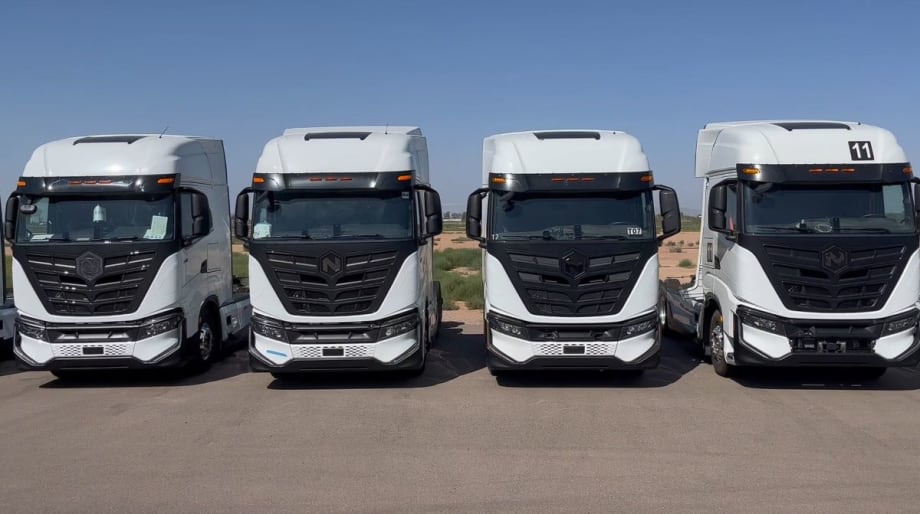
In its battery recall, prompted by a fire that damaged battery-electric trucks at it Coolidge, Arizona, plant last year, Nikola has switched battery suppliers and upgraded its operating system software.
Photo: Jim Park
Nikola appears to have turned what could have been PR disaster into some genuine benefits for fleet customers. Last year, Nikola recalled more than 200 battery-electric trucks after seveal trucks caught fire. After identifying the cause of the battery fires at its Coolidge, Arizona factory, Nikola has switched battery suppliers and now uses a completely new battery design.
"We've moved entirely on by essentially using a different battery system altogether," Christian Appel, Nikola's global head of program and product management," told Heavy Duty Trucking.
"We now have a different supplier and a completely different design, different cells. There's no risk attached to that any longer."
Arson was initially suspected in the battery fire that started in a parked Nikola BEV. Subsequent investigation, both internally and by a reputable third-party investigator, revealed a coolant leak inside a single battery pack was the probable cause of the fire.
"Only two battery packs have experienced a thermal event, out of more than 3,100 packs on trucks produced to date," Nikola said in a statement last year.
Nikola began returning affected trucks to customers in March and will continue deliveries through the remainder of the year.
"All of the old batteries have already been removed from the trucks, and we're now installing a new system and making all of the other upgrades," Appel told HDT.
Nikola Battery-Electric Truck Version BEV 2.0 Emerges
Nikola turned potential disaster into an opportunity by making a number of improvements to the trucks while they were sidelined in addition to the new battery system.
The Tre BEV launched with the Gen 1 control system. With the launch of the fuel-cell version of the Tre came the second-generation control system, which included many software improvements.
"We essentially upgraded the whole operating system," Appel said. "We call it our Gen 2 software, and we have now ported the battery-electric truck over to that as well. With the development of this new variant, we're naming it BEV 2.0."
Upgrades include improvements to the instrument cluster, many of which came as a result of customer feedback.
"Our approach to instrumentation was very minimalistic, but customers told us some critical information was missing," Appel said.
"They wanted to see a temperature gauge for the batteries, for example, and we added some low-voltage information as well so you can identify a dead battery."
The charging and scheduled departure feature was also overhauled, Appel said. The scheduled departure feature allows the user to set a departure time, and the charging and battery conditioning system will have the batteries charged and at operating temperature when the driver is ready to begin the trip.
"We made improvements to things like Bluetooth and connectivity in general, and also made improvements to the back end of it," he pointed out. "There's more information available to the user through the fleet command system."
Fleets can now view faults and run various diagnostic routines all from the in-cab display screen, without the use of a diagnostic tool plugged into the OBD port.
They also added more functionality and features to the app.
The new battery pack comes with slight performance improvements as well.
"We don't necessarily advertise it, but the usable capacity is slightly better, and our regenerative braking performance is also improved," Appel said. "That goes hand in hand with some of the software upgrades that I mentioned."
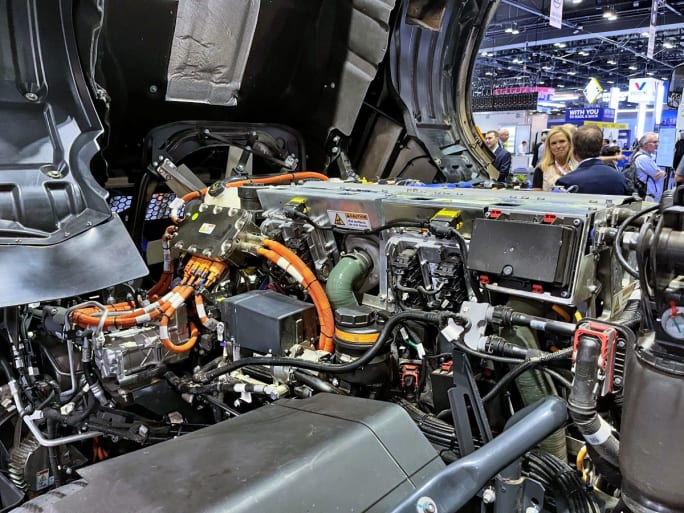
With its battery recall behind it, Nikola remains bullish on fuel cells and has no plans for an H2 ICE offering.
Photo: Jim Park
Customers who had truck recalled for the battery issues will get their trucks back with the new battery packs and the software updates free of charge. Nikola even took it upon itself to fix a few broken windshields and make a few minor repairs.
"You know how trucks look when they're in operation," Appel joked. "We found a few little things here and there. We obviously made sure we gave them back a good truck."
Looking to the Future
Last year, when I interviewed Nikola's then-CEO, Michael Lohscheller, I asked if the company had any plans to develop an internal combustion hydrogen engine.
"There's more to come," he answered with a wry smile.
So, at ACT Expo this year, I asked Appel the same question.
"No," he said, without hesitation. "We see that only as a bridge technology if nothing else."
He said H2 engines are less efficient than fuel cells, by as much as 10-20%, but noted they could be less expensive upfront because an ICE is less complex than a fuel cell system and easier for the OEM to integrate into the chassis.
With a more traditional ICE, you also have the heat rejection to deal with, and it will require an aftertreatment system to knock down the NOx emissions. There will be some trade-offs between the higher fuel consumption of the ICE versus the lower up front cost, but that delta would likely evaporate within a year or two, he suggested.
"I would say the only advantage to the ICE would be that you could use less pure hydrogen in an internal combustion engine," he said. "I can see it working in the short term for specific markets and some off-highway applications, but I don't see large-scale adoption in the U.S. at all.
"For us it's clear, the fuel cell system is the way to go," he said, with a wry smile.
More Fuel Smarts

How Volvo Updated Its D13 for EPA 2027 [Watch]
Volvo’s updated D13 promises lower emissions without sacrificing performance or fuel economy. Take a closer look at what changed inside the engine in this HDT Spotlight video.
Read More →
Diesel Price Spike Shortens Payback for Natural Gas Trucks, Report Says
Energy Vision estimates fleets could recover the higher purchase price of an RNG-fueled Class 8 tractor in 1.3 to 2.8 years under current fuel-price scenarios.
Read More →
Calstart Becomes Catalyst Mobility, Reflecting Broader Focus
Calstart is now Catalyst Mobility, reflecting the nonprofit’s growing national role in clean transportation, including zero-emission trucks, infrastructure and incentive programs.
Read More →

Record Diesel Prices Squeeze Trucking Fleets
Average U.S. diesel prices have climbed to nearly $6 a gallon, surpassing the 2022 record as tight refinery capacity and Middle East disruptions keep fuel costs elevated.
Read More →
How Fuel Delivery Shapes Engine Performance
Fuel delivery depends on more than what happens at the injector. For fleet, maintenance and technical professionals, looking at the full path from pump to injector can provide useful context for understanding engine performance.
Read More →
East Coast Port Launches $45M Electric Truck Push
The Port Authority of New York and New Jersey announced millions in incentives for zero-emission drayage trucks, yard tractors, and new charging hubs near the port.
Read More →
California Bill Could Shed Light on Electric Truck Prices
Why do battery-electric Class 8 trucks remain so expensive? A California bill headed to Gov. Gavin Newsom would give fleets and state agencies more visibility into what manufacturers charge.
Read More →
Detroit Opens Orders for EPA 2027 Engines
Detroit isn’t starting from scratch to meet EPA 2027 diesel emissions standards. Its Gen 6 DD13 and DD15 engines keep much of today’s platform while updating the fuel and aftertreatment systems.
Read More →
Zero-Emission Truck Corridor Planned for West Coast
California, Oregon, Washington, British Columbia and Baja California are coordinating plans for truck charging and hydrogen fueling from Canada to Mexico.
Read More →
A Closer Look at Kenworth’s Electric T880E Vocational Truck [Video]
Learn more about Kenworth's T880E battery-electric vocational truck at the Paccar Technical Center, including its range, applications, upfitting considerations, and PTO options, in this HDT Spotlight video.
Read More →