





Two Hyundai Xcient Fuel Cell trucks in two different fleets will participate in NACFE's Run on Less - Messy Middle demonstration project later this year.
Hyundai Announces FCEV Class 8 Xcient, Hydrogen/Electric Fueling Station
Hyundai introduced the new Xcient Fuel Cell Class 8 heavy-duty truck at the Advanced Clean Transportation Expo, as well as plans for a hydrogen production and dispensing facility in Georgia.
April 30, 2025
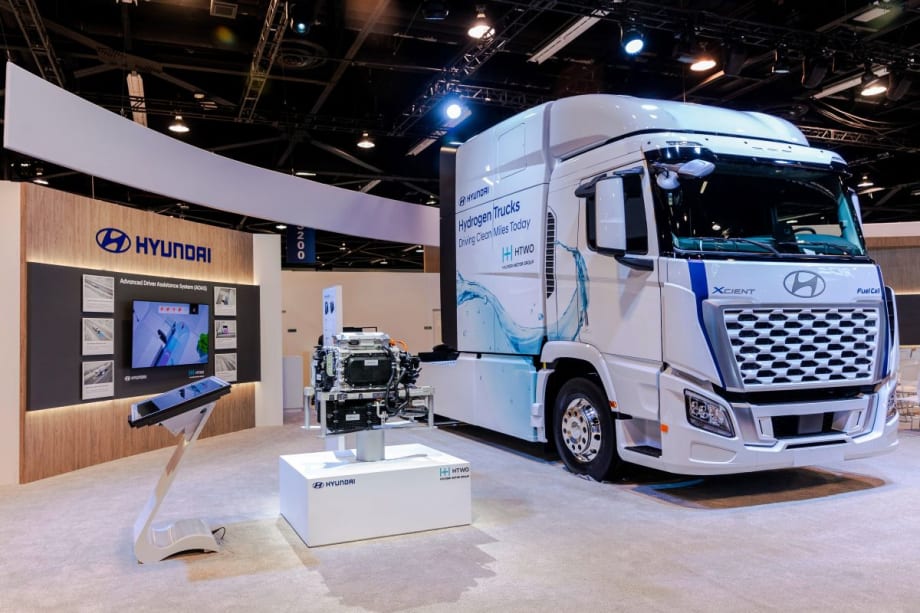
At ACT Expo, Hyundai Motor showed off its latest hydrogen-fuel-cell technology and the Xcient FCEV truck.
Photo: Hyundai Motor
4 min to read
Hyundai introduced the new Xcient Fuel Cell Class 8 heavy-duty truck for North America at the Advanced Clean Transportation (ACT) Expo 2025 in Anaheim, California, as well as plans to launch a scalable hydrogen production and dispensing facility for heavy-duty vehicles in Georgia.
The announcements, the company said, showcase its ongoing commitment to expanding its hydrogen business in North America.
New Hyundai Xcient Hydrogen Fuel Cell Heavy-Duty Truck for North America
At ACT Expo, Hyundai displayed an advanced production model of its Xcient Fuel Cell heavy-duty truck. Designed specifically for the North American Market, the truck has appeared as a concept vehicle at previous ACT Expos.
Hyundai said the Xcient Fuel Cell is the world’s first mass-produced hydrogen-powered heavy-duty truck. Launched in 2020, it has been deployed in 13 countries, logging more than 13 million kilometers of cumulative driving in Switzerland, where it was initially launched.
The new Xcient features an upgraded hydrogen fuel cell system. Since 2021 it has undergone rigorous testing across diverse climates and use cases in North America.
Hyundai Xcient Fuel Cell specifications:
A 180 kW hydrogen fuel cell system.
Two 90 kW stacks for reliable energy generation.
A 72 kWh battery pack.
A 350 kW e-motor, providing maximum torque of 2,237 Nm, or about 1,650 pounds-feet.
Maximum driving range of 450 miles under optimal conditions.
10 hydrogen tanks (total combined capacity of approximately 68 kg or 150 pounds.)
Gross combination weight of up to 82,000 lbs., suitable for heavy-duty applications
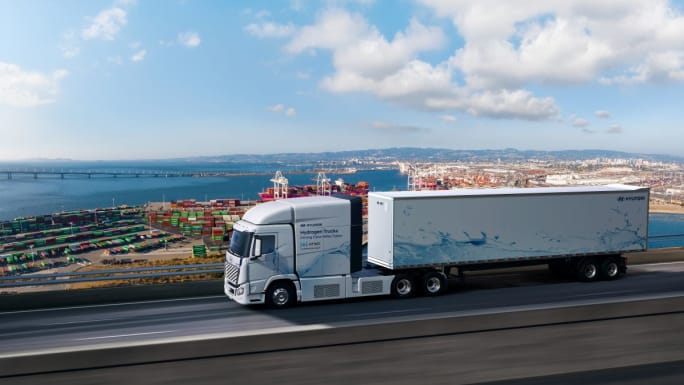
Photo: Hyundai Motor
The interior design has been improved for driver convenience and comfort. Interior enhancements include a 12.3-inch fully digital instrument cluster, offering drivers clear and concise information at a glance, and a 12.3-inch touchscreen infotainment system featuring physical buttons integrated into the center console for driver convenience and ergonomics.
The new model is also equipped with a comprehensive suite of Advanced Driver-Assistance Systems (ADAS) designed to improve safety and minimize driver fatigue. These enhancements include:
Forward Collision-Avoidance Assist (FCA)
Lane Departure Warning (LDW)
Smart Cruise Control (SCC)
Blind-Spot Collision Warning (BCW)
Blind-Spot Collision Warning-Near (BCW-NEAR)
Forward Collision Warning-Near (FCW-NEAR)
Hyundai Also Providing Hydrogen Fueling Infrastructure
At ACT Expo, Hyundai Motor also introduced the expansion of the Group’s HTWO hydrogen business brand into an open platform, bringing together partners, investors, and industries.
The company announced plans to launch HTWO Energy Savannah, a Class-8 heavy-duty truck hydrogen refueling and electric recharging station near the Port of Savannah, Georgia, and close to the Hyundai Motor Group Metaplant America (HMGMA).
The station is scheduled to begin operations by the end of 2025, in collaboration with HydroFleet and Capital Development Partners.
The HTWO Logistics initiative, first announced at ACT Expo 2024, is a partnership with Glovis focusing on decarbonizing logistics around Hyundai Motor Group Metaplant America. Hydrogen is produced and consumed on-site, and 21 Xcient fuel cell trucks are now responsible for nearly half of the plant’s inbound and outbound delivery logistics.
Since the launch of operations in October 2024, the partners have outlined a plan to replicate this successful hydrogen-powered business operation globally.
It’s the latest in the company’s partnership approach to the challenge of providing hydrogen fueling infrastructure for its FCEV trucks and others.
For instance, through the NorCAL Zero Project, a total of 30 Xcient Fuel Cell trucks at the Ports of Oakland and Richmond are being operated, marking the largest single commercial deployment of hydrogen trucks in North America.
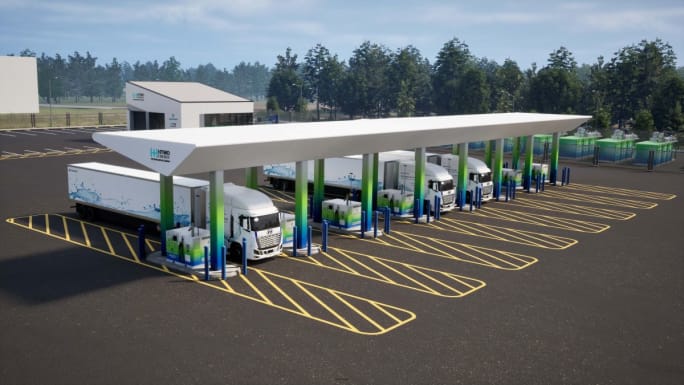
HTWO Energy Savannah is building a truck hydrogen refueling and electric recharging station near the Port of Savannah, Georgia.
Photo: Hyundai Motor
More About New Savannah ZEV Class 8 Fueling Station
The scalable hydrogen production and dispensing facility for Class-8 heavy-duty zero-emission vehicles station will be located just 10 miles from the Port of Savannah, Georgia, within one of the nation’s busiest freight hubs.
HTWO Energy Savannah development is a collaboration between HTWO Logistics, HydroFleet, and Capital Development Partners, and is scheduled to begin operations by the end of this year.
“HTWO Energy Savannah is a breakthrough hydrogen production and refueling station for the heavy-duty trucking industry, allowing zero-emissions trucks to quickly and easily refuel at a single convenient location in the Savannah region,” said Jim Park, SVP, commercial vehicle and hydrogen fuel cell business, Hyundai Motor North America.
“The HTWO Energy Savannah hydrogen station will also truly fulfill our vision for HMGMA Clean Logistics, allowing our innovative new electric vehicle plant to transport plant shipments within a clean, zero-emissions ecosystem.”
On the HTWO Energy Savannah site, hydrogen production and refueling stations generating 1,200 kilograms of hydrogen per day will support fast-fill zero-emissions heavy-duty trucking operations in the region.
Moving forward, available infrastructure can be scaled to support up to 4,200 kilograms of hydrogen per day to meet future demand.
More Fuel Smarts

How Volvo Updated Its D13 for EPA 2027 [Watch]
Volvo’s updated D13 promises lower emissions without sacrificing performance or fuel economy. Take a closer look at what changed inside the engine in this HDT Spotlight video.
Read More →
Diesel Price Spike Shortens Payback for Natural Gas Trucks, Report Says
Energy Vision estimates fleets could recover the higher purchase price of an RNG-fueled Class 8 tractor in 1.3 to 2.8 years under current fuel-price scenarios.
Read More →
Calstart Becomes Catalyst Mobility, Reflecting Broader Focus
Calstart is now Catalyst Mobility, reflecting the nonprofit’s growing national role in clean transportation, including zero-emission trucks, infrastructure and incentive programs.
Read More →

Record Diesel Prices Squeeze Trucking Fleets
Average U.S. diesel prices have climbed to nearly $6 a gallon, surpassing the 2022 record as tight refinery capacity and Middle East disruptions keep fuel costs elevated.
Read More →
Sponsored•September 9, 2026
How Fuel Delivery Shapes Engine Performance
Fuel delivery depends on more than what happens at the injector. For fleet, maintenance and technical professionals, looking at the full path from pump to injector can provide useful context for understanding engine performance.
Read More →
East Coast Port Launches $45M Electric Truck Push
The Port Authority of New York and New Jersey announced millions in incentives for zero-emission drayage trucks, yard tractors, and new charging hubs near the port.
Read More →
California Bill Could Shed Light on Electric Truck Prices
Why do battery-electric Class 8 trucks remain so expensive? A California bill headed to Gov. Gavin Newsom would give fleets and state agencies more visibility into what manufacturers charge.
Read More →
Detroit Opens Orders for EPA 2027 Engines
Detroit isn’t starting from scratch to meet EPA 2027 diesel emissions standards. Its Gen 6 DD13 and DD15 engines keep much of today’s platform while updating the fuel and aftertreatment systems.
Read More →
Zero-Emission Truck Corridor Planned for West Coast
California, Oregon, Washington, British Columbia and Baja California are coordinating plans for truck charging and hydrogen fueling from Canada to Mexico.
Read More →
A Closer Look at Kenworth’s Electric T880E Vocational Truck [Video]
Learn more about Kenworth's T880E battery-electric vocational truck at the Paccar Technical Center, including its range, applications, upfitting considerations, and PTO options, in this HDT Spotlight video.
Read More →