





New Federal Strategy to Develop Zero-Emission Infrastructure Along Freight Corridors
High-Capacity Hydrogen Truck Fueling Station Opens in Oakland, California
The new FirstElement Hydrogen Refueling Station in West Oakland, California, is using new technology that allows fueling of hydrogen-fuel-cell trucks in about the same amount of time it takes to refuel a diesel truck.
May 3, 2024
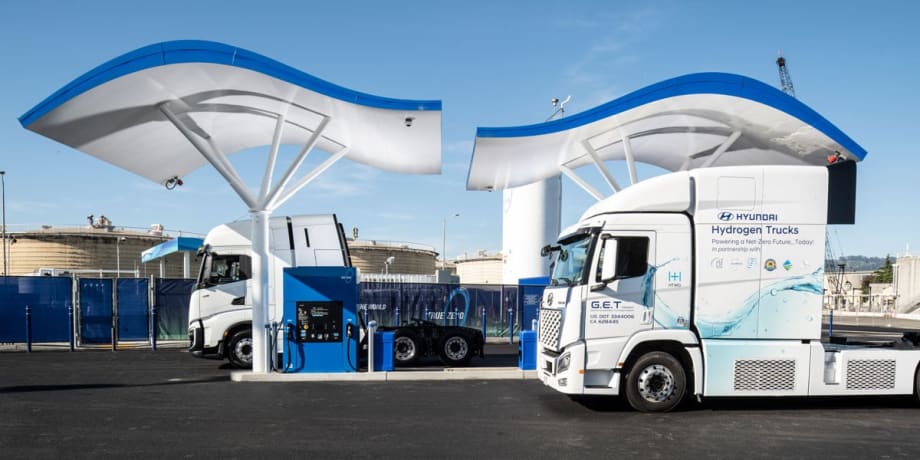
GET Trucking will be fueling 30 Hyundai Xcient Fuel Cell trucks at the First Element Fuel hydrogen refueling station.
Photo: First Element Fuels
4 min to read
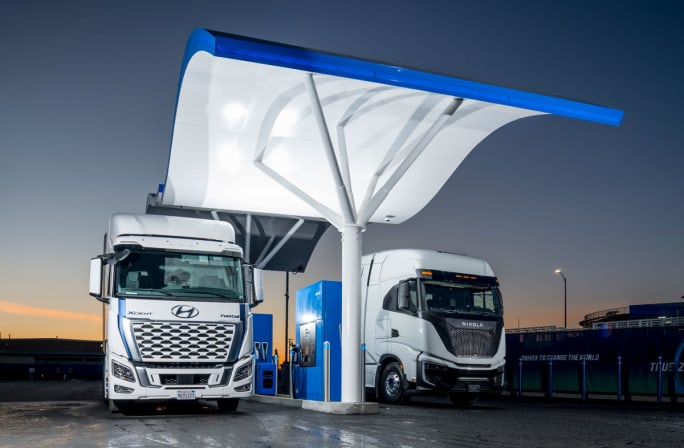
Hyundai and Nikola have committed approximately 90 trucks to use the station regularly, and a number of truck manufacturers are expected to add to the growing fleet of hydrogen-powered, fuel cell trucks.
Photo: First Element Fuels
The new FirstElement Hydrogen Refueling Station in West Oakland, California, is using new technology that allows fueling of hydrogen-fuel-cell trucks in about the same amount of time it takes to refuel a diesel truck.
It’s the country’s first commercial hydrogen truck stop, according to FirstElement Fuel, and the largest in the world. It potentially triples the amount of hydrogen used in on-road transportation today.
The station will be able to support up to 200 trucks and back-to-back refueling.
It’s designed to move up to 18,000 kilograms of hydrogen daily and 6.3 million kilograms of hydrogen annually. In comparison, all of the hydrogen passenger vehicles in the United States consumed approximately 2 million kilograms of hydrogen in 2023.
Hyundai and Nikola have committed approximately 90 trucks to use the station regularly, and a number of truck manufacturers are expected to add to the growing fleet of hydrogen-powered, fuel cell trucks.
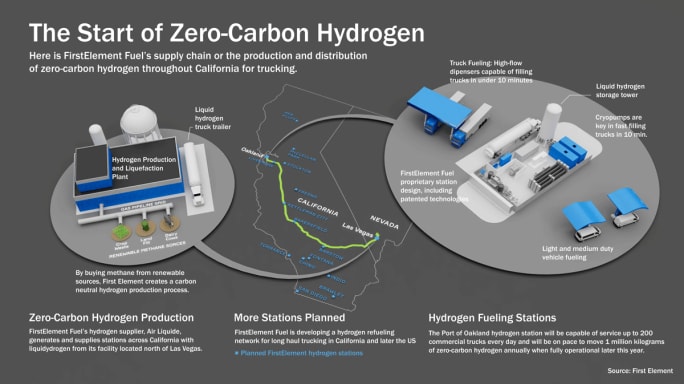
The Port of Oakland station is the first of 15 hydrogen truck stations FEF plans to open in California to create a hydrogen infrastructure along major trucking routes.
Photo: First Element Fuels
New Cryo-Pump Hydrogen Fueling Tech
Shane Stephens, FEF co-founder and chief development officer, credits a collaboration with automotive supplier Bosch for creating a new “cryo-pump” that will enable the company to pump hydrogen at 10 times the capacity of current methods.
“It’s a game-changer,” Stephens said in a news release. “This liquid hydrogen pump developed between Bosch-Rexroth and FirstElement Fuel represents a leap forward in the ability to efficiently and economically fill hydrogen-powered vehicles at this scale. And it’s being done in collaboration with a company that knows how to manufacture equipment for the trucking industry.”
The Port of Oakland station is the first of 15 hydrogen truck stations FEF plans to open in California to create a hydrogen infrastructure along the major trucking routes. Plans are underway to open two more stations in California next year.

First Element Fuels says new tech developed with Bosch allows hydrogen refueling in 10 minutes.
Photo: First Element Fuels
Hyundai Xcient FCEVs and NorCal Zero
The Hyundai trucks are part of a program called NorCal Zero, a project bringing zero-emission freight transportation to the Bay Area and Central Valley.
It’s a $53 million collaborative effort to deploy 30 of Hyundai’s Class 8 Xcient Fuel Cell electric trucks, supporting Hyundai Motor's entry into the U.S. market for Class 8 hydrogen fuel cell electric trucks. Hyundai unveiled the truck for the North American market at last year's ACT Expo.
According to the Center for Transportation and the Environment, the NorCal ZERO project has the potential to avoid 24.4 metric tons of carbon-dioxide emissions, equivalent to 2.4 million gallons of diesel consumed, over the six-year operation of these trucks.
GET Freight, the trucking subsidiary of Glovis America, is operating the Hyundai Xcient hydrogen-fuel cell trucks, hauling containers from the Port of Oakland and cars from the Port of Richmond.
The trucks will provide Glovis with a total cost of ownership over six years that is nearly equivalent to the ownership cost of Glovis’ diesel trucks, with cost savings thereafter, according to an announcement.
Glovis America was founded by people from the logistics departments of Hyundai Motor America and Kia Motors America who wanted to improve the efficiency of their auto supply chains. In 2019, the company expanded its U.S. footprint by launching GET, Global Expedited Transportation, which transports finished automobile parts by truck.
The trucks, which have a range of more than 450 miles on a single fill of hydrogen, have primarily operated in drayage service, hauling freight and cars to destinations in the Bay Area and the Central Valley.
Papé Group maintains the trucks at its San Leandro facility, where technicians receive in-depth training from Hyundai on how to service the trucks. With engineering and design support from the Fiedler Group, Papé Group also upgraded its maintenance facility with hydrogen detection and ventilation equipment to safely service the trucks.
It Takes a Village to Decarbonize Trucking
The dedication event demonstrated the array of government and private partners it will take to decarbonize heavy-duty trucking:
FirstElement Fuel
Hyundai Motor
The Center for Transportation and the Environment
Glovis America
East Bay Municipal Utilities District
Papé Group
The University of California
The Port of Oakland
The City of Oakland and the community of West Oakland represented by the West Oakland Environmental Indicators Project (WOEIP).
The Alameda County Transportation Commission
The Bay Area Air Quality Management District
The California Air Resources Board
The California Energy Commission
The University of California Berkeley and the West Oakland Environmental Indicators Project are assisting with data collection, community outreach efforts, and communication.
The project is funded in part with $11.98 million from CARB’s California Climate Investments Program, $9.89 million from the CEC’s Clean Transportation Program, $3.64 million from Alameda CTC’s Clean Freight Program, $3.36 million from BAAQMD, and $24 million from project partners.
“This project is a true trailblazer on so many levels, and a head start on the future we plan to build through the Alliance for Renewable Clean Hydrogen Energy Systems (ARCHES) federal hydrogen hub,” said Tyson Eckerle, senior advisor for clean infrastructure & mobility at the California Governor’s Office of Business and Economic Development.
More Fuel Smarts

How Volvo Updated Its D13 for EPA 2027 [Watch]
Volvo’s updated D13 promises lower emissions without sacrificing performance or fuel economy. Take a closer look at what changed inside the engine in this HDT Spotlight video.
Read More →
Diesel Price Spike Shortens Payback for Natural Gas Trucks, Report Says
Energy Vision estimates fleets could recover the higher purchase price of an RNG-fueled Class 8 tractor in 1.3 to 2.8 years under current fuel-price scenarios.
Read More →
Calstart Becomes Catalyst Mobility, Reflecting Broader Focus
Calstart is now Catalyst Mobility, reflecting the nonprofit’s growing national role in clean transportation, including zero-emission trucks, infrastructure and incentive programs.
Read More →

Record Diesel Prices Squeeze Trucking Fleets
Average U.S. diesel prices have climbed to nearly $6 a gallon, surpassing the 2022 record as tight refinery capacity and Middle East disruptions keep fuel costs elevated.
Read More →
Sponsored•September 9, 2026
How Fuel Delivery Shapes Engine Performance
Fuel delivery depends on more than what happens at the injector. For fleet, maintenance and technical professionals, looking at the full path from pump to injector can provide useful context for understanding engine performance.
Read More →
East Coast Port Launches $45M Electric Truck Push
The Port Authority of New York and New Jersey announced millions in incentives for zero-emission drayage trucks, yard tractors, and new charging hubs near the port.
Read More →
California Bill Could Shed Light on Electric Truck Prices
Why do battery-electric Class 8 trucks remain so expensive? A California bill headed to Gov. Gavin Newsom would give fleets and state agencies more visibility into what manufacturers charge.
Read More →
Detroit Opens Orders for EPA 2027 Engines
Detroit isn’t starting from scratch to meet EPA 2027 diesel emissions standards. Its Gen 6 DD13 and DD15 engines keep much of today’s platform while updating the fuel and aftertreatment systems.
Read More →
Zero-Emission Truck Corridor Planned for West Coast
California, Oregon, Washington, British Columbia and Baja California are coordinating plans for truck charging and hydrogen fueling from Canada to Mexico.
Read More →
A Closer Look at Kenworth’s Electric T880E Vocational Truck [Video]
Learn more about Kenworth's T880E battery-electric vocational truck at the Paccar Technical Center, including its range, applications, upfitting considerations, and PTO options, in this HDT Spotlight video.
Read More →