




Fuel Cell Trucks: Is Liquid Hydrogen the Way to Go?
Daimler Truck and industrial gas producer Linde have developed a liquid hydrogen storage and fueling technology that will cut weight and add range to hydrogen powered trucks.

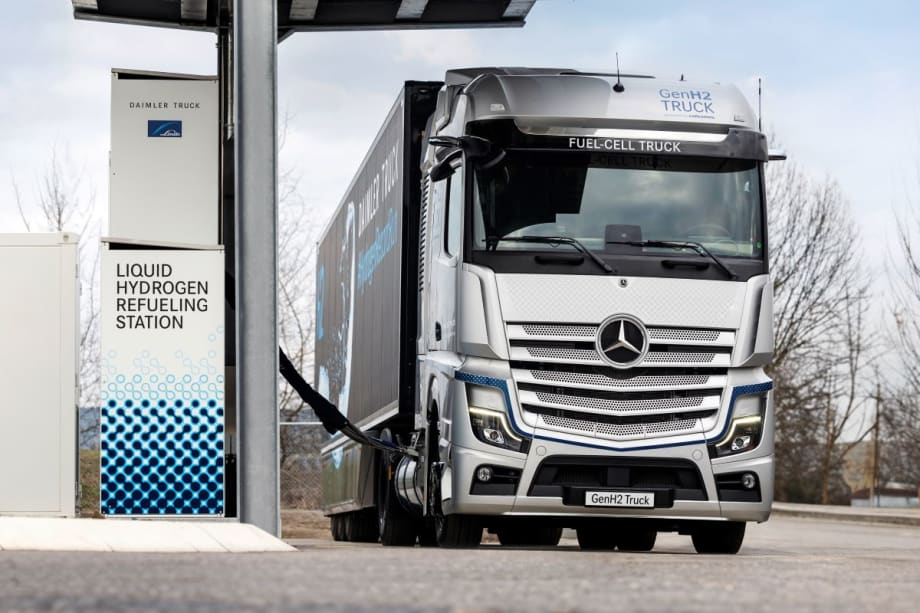
Liquid hydrogen fueling is completely automated after the driver connects the fill hose to the receptacle on the truck.
Photo: Daimler Truck
The battle for electric truck range supremacy is heating up — or should we say cooling down? A liquid hydrogen fuel system now in fleet trials in Germany boasts a range of 650 miles at a gross weight of 80,000 pound and a payload of about 45,000 pounds.
That leaves the Tesla Semi in the dust on weight and range.
Daimler Truck and Linde Engineering have jointly developed a storage and truck refueling technology using subcooled liquid hydrogen (sLH2). In February, Linde installed the world’s first public sLH2 truck refueling station next to the Daimler Truck factory in Wörth am Rhein, Germany.
It's now being used for initial customer trials with the Mercedes-Benz GenH2 Truck.
According to Daimler Truck, sLH2 allows for higher storage density, greater range, faster refueling, lower costs, and superior energy efficiency.
That's a pretty tall order, but it all pencils out.
The sLH2 Math
We are now used to seeing a rack of bulky, heavy compressed gas hydrogen storage tanks mounted behind the cabs of fuel cell trucks. These configurations hold about 70-80 kg (150-175 lb) of hydrogen compressed to 700 bar (10,000 psi).
The liquid hydrogen onboard storage system holds 80 kg of H2 cooled to -253°C (-425°F). This is roughly equivalent to 300 US gallons. The tanks are vacuum insulated and mount on the truck as saddle tanks behind the cab, much like traditional diesel tanks.
While actual range numbers for the current crop of fuel cell trucks are still a bit hard to come by, a Daimler competitor advertises 500 miles of range on 70 kg of gaseous hydrogen stored at 700 bar.
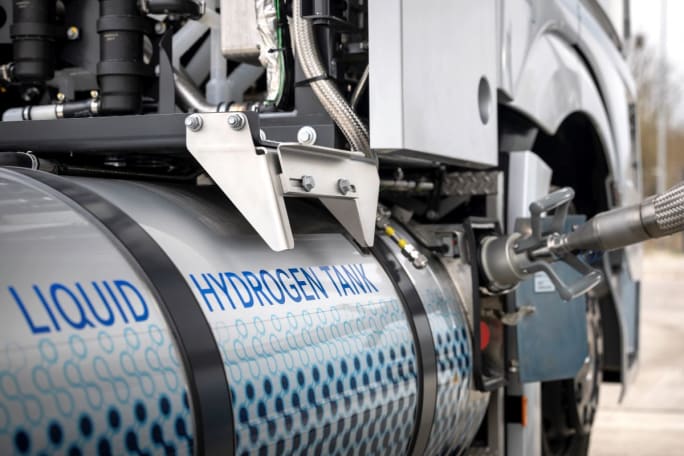
The liquid storage tanks replace the heavy and bulky carbon-fiber high-pressure storage tanks. The tanks are about the same size as a 150-gallon diesel tank.
Photo: Hydrogen Trucks
"Last fall, we drove a Mercedes-Benz GenH2 fully loaded at 40 tons from biggest plant in the Wörth am Rhein in the southwest of Germany, via Hamburg to Berlin, a distance of 1047 kilometers (650 miles) on a single hydrogen fill," said Steffen Maus, head of zero emission technology and simulation at Daimler Truck.
"We proved this truck works in real life, in traffic jams, cities and towns, and on the German Autobahn. And the truck still had a useable quantity of hydrogen in the tanks when we completed the trip."
Maus spoke during a webinar hosted by Mission Hydrogen, a German company promoting the use of hydrogen in a variety of applications.
Greater Range, Less Weight
On-board fuel storage is a real challenge with European truck chassis. Frame space for storage is extremely limited by restrictive vehicle length regulations. The opportunity to store up to 30 kg (66 pounds) of additional usable fuel capacity is a huge advantage.
In an academic paper,"Subcooled Liquid Hydrogen Technology for Heavy-Duty Trucks" published in the World Electric Vehicle Journal in January, author Enrico Pizzutilo notes sLH2 has approximately 50% higher energy density compared to gaseous hydrogen at 700 bar stored in onboard tanks of similar physical dimensions.
"This results in lighter (appx. 20–30% less weight per stored kilogram of hydrogen) and cheaper (approximately 40–50% lower cost per stored kilogram of hydrogen) tanks," he writes.
And significantly, subcooled liquid hydrogen offers a 50% increase in range from 700 km (435 miles) on a full charge at 700 bar for gaseous hydrogen compared to more than 1,000 km, (600 miles) on 80 kg of sLH2.
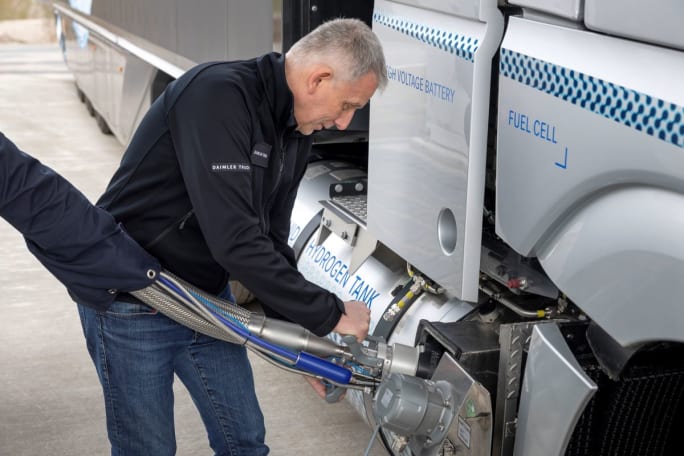
Drivers are not required to wear any personal protective equipment. The process is much the same as filling a diesel truck with fuel.
Photo: Daimler Truck
"Overall, we conclude that the sLH2 technology has clear advantages in terms of range, vehicle investment costs and payloads compared to the more common CHG 700 bar compressed H2 gas) technology," the author noted.
"Furthermore, despite being a novel technology, the necessary know-how to develop sLH2 tanks is quite similar to the wide-spread liquid natural gas (LNG) tank, resulting in multiple potential suppliers and/or manufacturers that can scale-up and industrially produce such tank systems."
The Truck Side of the Equation
Daimler’s test truck is little different from its compressed gas counterparts, except for the storage tanks. It still has a battery and of course the fuel cell stack.
The fuel cell still runs on hydrogen gas, as before. There's a heat exchanger in line between the liquid storage tanks and the fuel cell to gasify the hydrogen before it's fed to the fuel cell or the hydrogen engine.
Gone are the big bulky and heavy carbon fiber wrapped high-pressure storage tanks, typically mounted on rack behind the cab. Since these are stacked vertically, they do not occupy a great deal of frame space, but they are heavy.
Replacing the high-pressure tanks are two frame-mounted stainless steel saddle tanks with a capacity equal to roughly 150 US gallons each. There's a cross-feed tube between the tanks that enables fueling from a single connection on one of the tanks.
The tanks on the prototype Mercedes Bens Actros tractor occupy the space where the diesel tanks once hung, and where the battery box and the exhaust aftertreatment system once lived.
The tanks are basically a tank within a tank. The inner tanks hold the hydrogen, the outer shell provides insulation for the inner tank to keep the liquid cold. The tanks are vacuum insulated to maintain the hydrogen in a liquid state.
Liquid Hydrogen Fueling Procedures
Industrial gas producer Linde built and opened the first commercial liquid hydrogen fuel station in February at a site next to Daimler's plant in Wörth am Rhein. For the time being, it's the fueling site for the fleet trial Daimler is currently conducting. Plans are in the works for additional fuel sites as the need arises.
It's a surprisingly simple facility with a cryogenic hydrogen storage tank with a capacity of 4,000 kg, and pump for transferring the liquid from the storage tank to the truck's tanks, and dispenser for filling the truck.
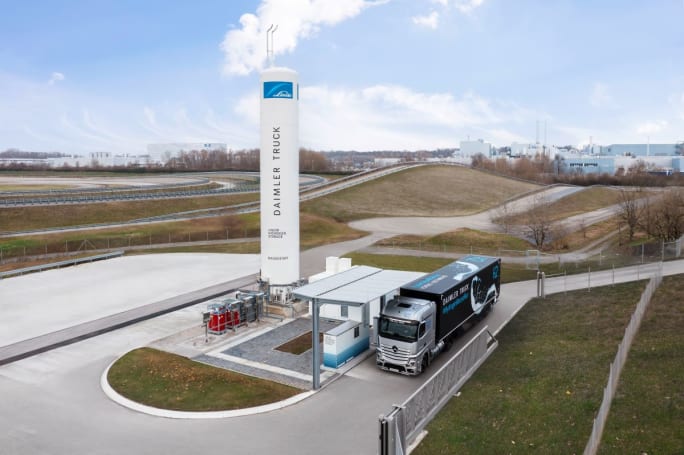
A liquid hydrogen fueling facility located near Daimler's truck plant in Wörth am Rhein, Germany. It's footprint isn't much bigger than a typical gas station.
Daimler Truck
"The system has a flow rate of between 400-500 kg/hour, and we can safely and securely fill 80 kg truck storage tanks is 12-15 minutes with no special training or handling requirements for the operator — the driver," said Dr. Simon Schaefer, project engineer at Linde Engineering, speaking on the webinar noted earlier.
"The fueling process is completely automated after the manual coupling of the dispenser to the truck. The site is emissions free and produces almost no noise."
Schaefer compared this fueling site to a high-pressure gas transfer facility. Hoe noted the need for more pumps and big compressors, and all the energy and noise assiciated with such an operation.
"These are, let's say, soft factors but they are really important and show that this technology has a huge potential," he said. "And our TCO targets with this equipment are absolutely validated now. This is another sign that we are here on a very, very good track."
Transportation and Distribution of Liquid Hydrogen for Trucks
There appear to be multiple advantages to fueling hydrogen power trucks with liquid hydrogen rather than gaseous, but perhaps the biggest advantage is distribution.
Liquified hydrogen is currently transported all over the country in cryogenic tank trucks. That means liquid hydrogen could be conveniently delivered to any location as easily as diesel fuel is trucked in today.
With the fueling stations developed by Linde (they plan to share the technology openly with other industrial gas producers, by the way), fleets anywhere, or even truck stops, could simply and quickly have hydrogen fueling outlets up and running. Behind the fence fuel facilities could also be built at any truck terminal.
Such fuel stations are much less complicated than high-pressure gas storage and transfer facilities, and they have a much smaller footprint.
One of the concerns with such a storage and delivery method is "boil-off." The super-cold liquid hydrogen in the truck's storage tanks will eventually begin to warm, and begin boiling off into a gas. That would require the resulting gas to be vented to atmosphere to prevent the tanks for becoming over pressurized.
Research has shown that with full tanks, boil-off begins to occur after about 10 hours, but the interval is considerably longer, on the order of 100+ hours when tanks are half full or less. This is due to the volume of "empty" space in the tank being larger and able to accommodate a greater volume of gas.
But since the truck would be working and consuming fuel for a large portion of the time, the likely hood of boil-off becoming a problem is low. Even trucks parked over a weekend would experience minimal boil-off if they were parked with nearly empty tanks.
So far, these developments are limited to Daimler's operations in Germany, but Daimler Trucks North America plans to include the technology in its SuperTruck III project, slated for completion in 2027.
More Fuel Smarts

How Volvo Updated Its D13 for EPA 2027 [Watch]
Volvo’s updated D13 promises lower emissions without sacrificing performance or fuel economy. Take a closer look at what changed inside the engine in this HDT Spotlight video.
Read More →
Diesel Price Spike Shortens Payback for Natural Gas Trucks, Report Says
Energy Vision estimates fleets could recover the higher purchase price of an RNG-fueled Class 8 tractor in 1.3 to 2.8 years under current fuel-price scenarios.
Read More →
Calstart Becomes Catalyst Mobility, Reflecting Broader Focus
Calstart is now Catalyst Mobility, reflecting the nonprofit’s growing national role in clean transportation, including zero-emission trucks, infrastructure and incentive programs.
Read More →

Record Diesel Prices Squeeze Trucking Fleets
Average U.S. diesel prices have climbed to nearly $6 a gallon, surpassing the 2022 record as tight refinery capacity and Middle East disruptions keep fuel costs elevated.
Read More →
How Fuel Delivery Shapes Engine Performance
Fuel delivery depends on more than what happens at the injector. For fleet, maintenance and technical professionals, looking at the full path from pump to injector can provide useful context for understanding engine performance.
Read More →
East Coast Port Launches $45M Electric Truck Push
The Port Authority of New York and New Jersey announced millions in incentives for zero-emission drayage trucks, yard tractors, and new charging hubs near the port.
Read More →
California Bill Could Shed Light on Electric Truck Prices
Why do battery-electric Class 8 trucks remain so expensive? A California bill headed to Gov. Gavin Newsom would give fleets and state agencies more visibility into what manufacturers charge.
Read More →
Detroit Opens Orders for EPA 2027 Engines
Detroit isn’t starting from scratch to meet EPA 2027 diesel emissions standards. Its Gen 6 DD13 and DD15 engines keep much of today’s platform while updating the fuel and aftertreatment systems.
Read More →
Zero-Emission Truck Corridor Planned for West Coast
California, Oregon, Washington, British Columbia and Baja California are coordinating plans for truck charging and hydrogen fueling from Canada to Mexico.
Read More →
A Closer Look at Kenworth’s Electric T880E Vocational Truck [Video]
Learn more about Kenworth's T880E battery-electric vocational truck at the Paccar Technical Center, including its range, applications, upfitting considerations, and PTO options, in this HDT Spotlight video.
Read More →