





Why are Long-Time Rivals Like Daimler and Volvo Working Together on Zero-Emission Trucks?
Daimler Fuel Cell Truck Logs 1,000-Kilometer Run on Single Tank of Hydrogen
A prototype Mercedes-Benz GenH2 fuel-cell-electric truck covered a distance of 1,047 km between Woerth am Rhein and Berlin, Germany, on a single tank of hydrogen.
September 28, 2023
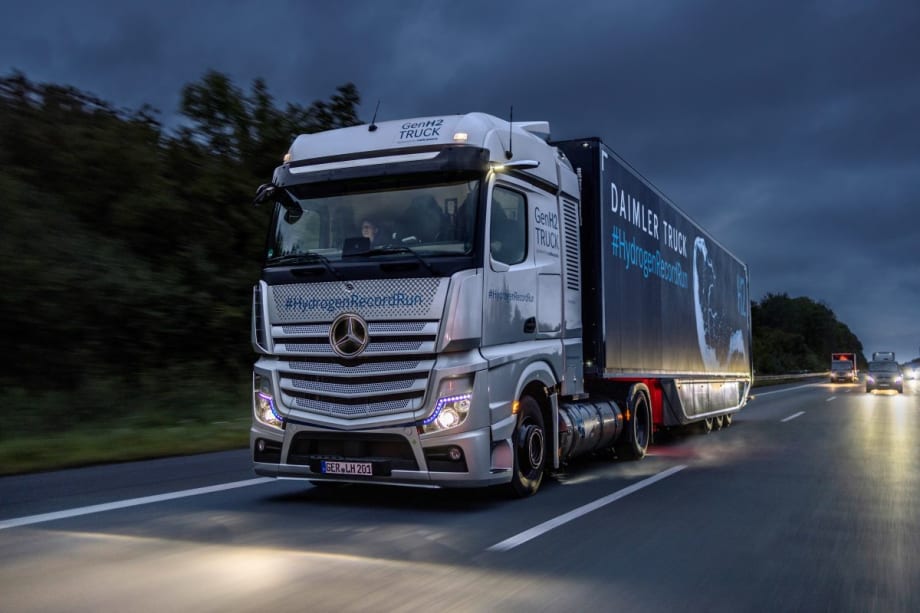
A Mercedes GenH2 hydrogen fuel cell truck logged 1,047 km on an overnight drive to Berlin, Germany on September 25th.
Photo: Daimler Truck
4 min to read
Daimler Truck said it has successfully demonstrated that hydrogen fuel-cell technology can be the right solution to decarbonize long-haul road transportation.
The OEM announced that a public road-approved prototype of its Mercedes-Benz GenH2 truck completed Daimler Truck’s #HydrogenRecordRun covering 1,047 km driven with one tank of liquid hydrogen.
Powered by a cellcentric fuel-cell system and equipped with a liquid hydrogen fuel tank system, the run started on September 25, 2023, at Mercedes-Benz Truck’s Customer Center in Woerth am Rhein, Germany and finished on the morning of September 26 in Germany’s capital city Berlin.
The truck completed the run fully loaded with a gross combined vehicle weight of 40 tons under real-life conditions, without emitting any CO2.
The record drive with sealed tanks and controlled mileage was independently confirmed by an inspection document from TÜV Rheinland.
Not Just “Hot Air”
Together with Rainer Müller-Finkeldei, head of Mercedes-Benz Trucks product development, Rhineland-Palatinate's secretary of state for economic affairs Petra Dick-Walther, sent the hydrogen truck on its journey in front of international media.
“Today is a great day!” Müller-Finkeldei said. “A hydrogen-powered truck is taking off from Rhineland-Palatinate all the way to Berlin. It marks a milestone in the transformation and decarbonization of the transport sector — thanks to new technologies. The journey of the GenH2 Truck from Rhineland-Palatinate to Berlin makes this tangible.”
After the successful record run, Andreas Gorbach, member of the board of management of Daimler Truck and head of truck technology, drove the truck across the finish line in the Ministergarten in Berlin.
“To decarbonize transport, we need both battery-electric and hydrogen-powered drive technologies,” Gorbach said. “The sweet spot for fuel cell trucks lies in flexible and demanding long-haul transportation tasks. By cracking the 1,000-kilometer mark with one fill, we have now impressively demonstrated.
"Hydrogen in trucks is anything but hot air, and we are making very good progress on the road to series production. At the same time, our record run today is a reminder that decarbonizing transportation requires two other factors in addition to the right drive technologies: a green energy infrastructure and competitive costs compared to conventional vehicles."
A Renewable Hydrogen Run
Ahead of the drive, the Mercedes-Benz GenH2 Truck was fueled with liquid hydrogen at Daimler Truck’s filling station at the company’s development and testing center in Woerth. The hydrogen supplied by Air Liquide is of renewable origin, as it has been produced from biomethane with guarantees of sustainable origin and production.
During the refueling process, cryogenic liquid hydrogen at minus 253 degrees Celsius was filled into two 40 kg tanks mounted on either side of the truck chassis. Thanks to the insulation of the vehicle tanks, the hydrogen can be kept at low temperatures for a sufficiently long time without active cooling. Both tanks were sealed before the start of the #HydrogenRecordRun by TÜV Rheinland.
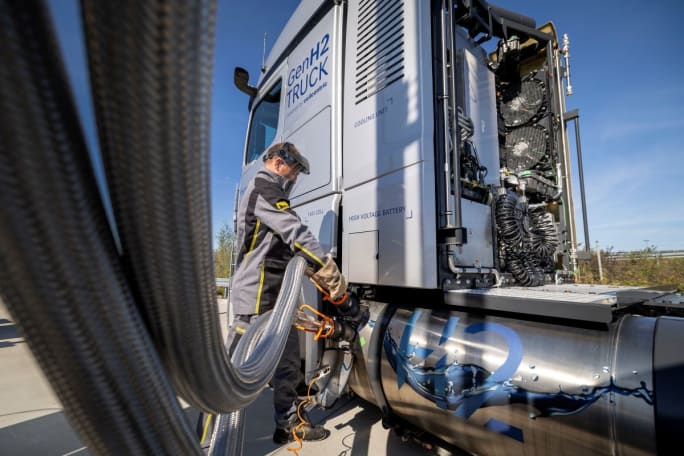
The Mercedes GenH2 tractor completed its 1,000 km run from Woerth to Berlin drive on a single tank of liquid hydrogen.
Photo: Daimler Truck
Daimler Truck prefers liquid hydrogen in the development of hydrogen-based drives, the company said. In this aggregate state the energy carrier has a significantly higher energy density in relation to volume compared to gaseous hydrogen. As a result, more hydrogen can be carried, which significantly increases the range and enables comparable performance of the vehicle with that of a conventional diesel truck.
Daimler's Dual-Track Strategy
As one of the world’s largest commercial vehicle manufacturers, Daimler Truck has committed itself to the Paris Climate Agreement. Its objective is to offer new vehicles that are CO2-neutral in driving operation in global core markets (Europe, USA, Japan) by 2039.
Daimler said that battery-electric trucks are the ideal choice for distribution haulage as well as for long-distance haulage with regular deployment on plannable routes with suitable distances and charging options. However, in some applications, Daimler said, hydrogen-based drives could be a better solution. This is especially true for very flexible and particularly demanding deployments in heavy-duty transport and long-distance haulage.
In addition, the availability of appropriate infrastructure and sufficient green electricity are crucial for a successful transition to emission-free technologies. Daimler Truck is convinced that rapid and cost-optimized coverage of this energy demand can only be achieved with both technologies.
Three Years of Hydrogen-Powered Trucking
Three years ago, on September 16, 2020, Daimler announced in Berlin the commitment to invest in hydrogen technology on a grand scale. CEO Martin Daum presented the Mercedes-Benz GenH2 concept truck to the public for the first time to underline the company’s technology strategy.
This was followed up by establishing cellcentric, a joint venture with Volvo Group, which will put one of Europe’s largest production facilities for fuel-cells in operation.
The first prototypes of the Mercedes-Benz GenH2 truck are undergoing testing and have most recently demonstrated their capabilities at the Brenner Pass, one of Europe's busiest and most challenging transit routes.
The successful #HydrogenRecordRun now marks a further milestone on the road to sustainable transportation, Daimler said.
The first Daimler fuel-cell trucks are expected to be tested in customer hands in the coming years, while the goal remains firmly set to introduce the series version of the Mercedes-Benz GenH2 Truck in the second half of the decade.
More Fuel Smarts

How Volvo Updated Its D13 for EPA 2027 [Watch]
Volvo’s updated D13 promises lower emissions without sacrificing performance or fuel economy. Take a closer look at what changed inside the engine in this HDT Spotlight video.
Read More →
Diesel Price Spike Shortens Payback for Natural Gas Trucks, Report Says
Energy Vision estimates fleets could recover the higher purchase price of an RNG-fueled Class 8 tractor in 1.3 to 2.8 years under current fuel-price scenarios.
Read More →
Calstart Becomes Catalyst Mobility, Reflecting Broader Focus
Calstart is now Catalyst Mobility, reflecting the nonprofit’s growing national role in clean transportation, including zero-emission trucks, infrastructure and incentive programs.
Read More →

Record Diesel Prices Squeeze Trucking Fleets
Average U.S. diesel prices have climbed to nearly $6 a gallon, surpassing the 2022 record as tight refinery capacity and Middle East disruptions keep fuel costs elevated.
Read More →
Sponsored•September 9, 2026
How Fuel Delivery Shapes Engine Performance
Fuel delivery depends on more than what happens at the injector. For fleet, maintenance and technical professionals, looking at the full path from pump to injector can provide useful context for understanding engine performance.
Read More →
East Coast Port Launches $45M Electric Truck Push
The Port Authority of New York and New Jersey announced millions in incentives for zero-emission drayage trucks, yard tractors, and new charging hubs near the port.
Read More →
California Bill Could Shed Light on Electric Truck Prices
Why do battery-electric Class 8 trucks remain so expensive? A California bill headed to Gov. Gavin Newsom would give fleets and state agencies more visibility into what manufacturers charge.
Read More →
Detroit Opens Orders for EPA 2027 Engines
Detroit isn’t starting from scratch to meet EPA 2027 diesel emissions standards. Its Gen 6 DD13 and DD15 engines keep much of today’s platform while updating the fuel and aftertreatment systems.
Read More →
Zero-Emission Truck Corridor Planned for West Coast
California, Oregon, Washington, British Columbia and Baja California are coordinating plans for truck charging and hydrogen fueling from Canada to Mexico.
Read More →
A Closer Look at Kenworth’s Electric T880E Vocational Truck [Video]
Learn more about Kenworth's T880E battery-electric vocational truck at the Paccar Technical Center, including its range, applications, upfitting considerations, and PTO options, in this HDT Spotlight video.
Read More →