




Finally! Trucking Conditions Showed Signs of Life in August
Both ATA and FTR are reporting that August showed a rare second straight month of gains for North American trucking activity.

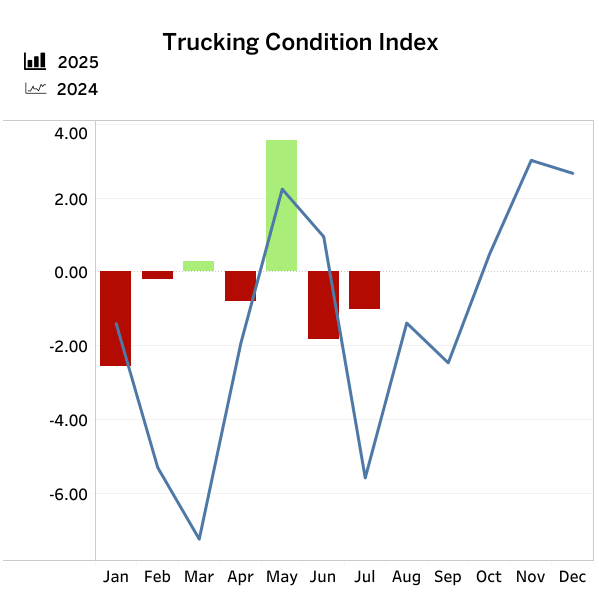
FTR’s Trucking Conditions Index (TCI) for July improved marginally to a reading of -1.03 from June’s -1.83 even though all freight-related factors were weaker than they were the month before.
Graphic: FTR
Trucking activity in the United States increased again in August. That is according to analysts from both the American Trucking Associations and FTR Transportation Intelligence.
A Strong Rebound Remains Elusive
According to ATA, trucking activity rose to its highest point since December 2023.
Specifically, truck freight tonnage rose 0.9% after gaining 1.1% in July, according to the American Trucking Associations’ advanced seasonally adjusted For-Hire Truck Tonnage Index.
“The good news is that truck freight volumes had a nice end of the summer,” said ATA Chief Economist Bob Costello. “However, while I’d like to predict a strong rebound in freight levels through the upcoming holidays, I can’t. I believe traditional seasonal patterns are off this year as shippers adjust to tariffs. Plus, housing remains soft, the slowing labor market is likely to show up in consumer spending at some point, and most manufacturing metrics are either decelerating or declining.”
In August, the ATA advanced seasonally adjusted For-Hire Truck Tonnage Index equaled 115.3, up from 114.3 in July. The index, which is based on 2015 as 100, rose 0.4% from the same month last year after increasing 0.5% in July. Year-to-date, compared with the same period in 2024, tonnage was up 0.1%.
July’s SA increase was larger than first reported in ATA’s August 19 press release, Cosetello noted.
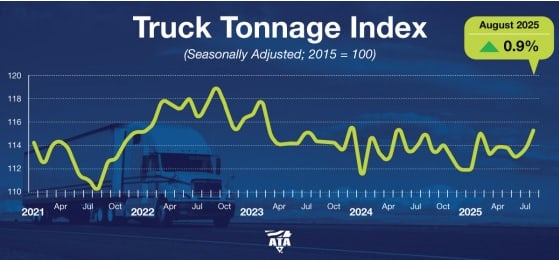
Although the summer ended on a strong note, ATA has yet to see signs of a sustained recovery for trucking conditions.
Graphic: ATA
The not seasonally adjusted index, which calculates raw changes in tonnage hauled, equaled 117.7 in August, 0.3% above July’s reading of 117.4.
FTR Tracks ‘Marginal’ Improvement
FTR’s Trucking Conditions Index (TCI) for July improved marginally to a reading of -1.03 from June’s -1.83 even though all freight-related factors were weaker than they were the month before.
Offsetting that deterioration was a considerable slowing of diesel price increases after a big jump in June. Trucking is still in the doldrums, but the outlook is somewhat more favorable for carriers.
“We do not see the market any stronger for carriers soon in the areas that matter most to them – freight rates and volume – but a recent preliminary revision of trucking employment estimates suggests tighter capacity than previously indicated, noted Avery Vise, FTR’s vice president of trucking. “Meanwhile, other potential capacity stresses loom, including rising truck insurance costs and pressure on foreign drivers. Although our utilization forecast is still basically flat, the prospects have risen for improved freight volume to strengthen the truck freight market noticeably.”
Details of the July TCI are found in the September issue of FTR’s Trucking Update, published August 29.
The September issue also revisits the potential for English language proficiency (ELP) and related issues to affect capacity in the wake of an August crash in Florida that has ratcheted up scrutiny.
The Trucking Update includes data and analysis on load volumes, the capacity environment, rates, and the economy.
The TCI tracks the changes representing five major conditions in the U.S. truck market. These conditions are: freight volumes, freight rates, fleet capacity, fuel prices, and financing costs. The individual metrics are combined into a single index indicating the industry’s overall health.
A positive score represents good, optimistic conditions. Conversely, a negative score represents bad, pessimistic conditions.
Readings near zero are consistent with a neutral operating environment, and double-digit readings in either direction suggest significant operating changes are likely.
More Fleet Management

Color Match Smarter: Tools That Restore & Perform
For fleet managers and collision repair professionals keeping heavy-duty trucks on the road, getting the color right the first time isn't just about appearance — it's about efficiency, turnaround time, and bottom-line results. Discover how today's digital color tools are transforming the repair process from guesswork to precision.
Read More →
FMCSA Pauses Biennial-Update Enforcement Amid Motus Transition
Carriers whose updates were due on or after June 1 have more time, while FMCSA works to stabilize its new registration system and warns of phishing sites impersonating its new carrier registration system, Motus.
Read More →
2026 Blueprint for Countering Smarter Supply Chain Theft
Cargo theft is no longer just the cost of doing business. It's a multi-billion-dollar criminal enterprise exploiting vulnerabilities across your fleet, drivers, and supply chain.
Read More →


How Telematics Improves Visibility, Control, and Performance in Refrigerated Fleets
Explore how telematics help refrigerated fleets improve visibility, uptime, efficiency, compliance, and cargo protection across connected cold chain operations.
Read More →
What the U.S.-Canada Trade War Means for Trucking
Escalating U.S.-Canada tariffs could disrupt cross-border freight, reduce truck volumes, raise costs, and create new uncertainty for carriers on both sides of the border.
Read More →
What Are Trucking’s Top Concerns for 2026?
The American Transportation Research Institute wants to know what's worrying trucking fleet managers, drivers, and other stakeholders in its annual Industry Issues survey.
Read More →
American Trucking Associations Looks for a New Leader
ATA President and CEO Chris Spear abruptly left his job at the association on August 21, at a pivotal time for the trucking industry.
Read More →
Public Wi-Fi Cybersecurity Risks: How Truck Drivers and Fleets Can Protect Their Data
Public Wi-Fi can expose truck drivers and fleets to credential theft, malware, and other cyber threats. Here’s how to reduce the risk on the road.
Read More →
For Nicky Cupp, Fleet Innovation Starts With Frustration
HDT Truck Fleet Innovator Nicky Cupp turns everyday pain points at Fraley & Schilling into opportunities for better technology and smarter processes.
Read More →
Adam Buttgenbach’s Approach to Electric Trucks: Start With Where They Fit
HDT Truck Fleet Innovator Adam Buttgenbach helped PepsiCo build one of North America’s largest EV fleets by focusing on where electric trucks make operational sense.
Read More →