




Fleet Margins Fall as Trucking Costs Set New Records in ATRI’s 2025 Report
Driver Pay Trends: Fragile Gains in Face of Freight Market Uncertainty
As trucking staggers into the fourth year of the lingering trough, drivers’ mileage pay has been showing surprising slow-but-steady upward movement since late 2024, but pay gains remained restrained by market malaise.
by James Jaillet, National Transportation Institute
August 27, 2025
The slow-but-steady momentum of driver pay increases has been showing surprising resilience despite ongoing uncertainty in the freight market and the broader economy.
Image: HDT
6 min to read
The hinge moment for the current exhausting freight cycle — when trucking’s supply and demand reach a better equilibrium to support desperately needed growth in freight rates — remains elusive.
That’s even as 2025 marks the third year, if not the fourth calendar year, that fleets have contended with a nagging downturn that’s crippled rates while costs soared across the board.
Three years (and counting) is a historically long downturn. Most trucking up-and-down cycles play out completely in that timeframe, if not less, from peak to trough of freight rates and back to peak.
In this drawn-out freight recession, driver pay has obviously followed motor carriers’ fortunes. Historically strong pay gains seen in 2021 and into 2022 slowed, then stalled, leading to about 18 months of stagnation from early 2023 through the middle of last year.
However, starting in late summer of 2024, that narrative shifted. Data we compile and analyze at The National Transportation Institute (NTI), based on ongoing surveys of motor carriers, shows driver wage growth stopped declining.
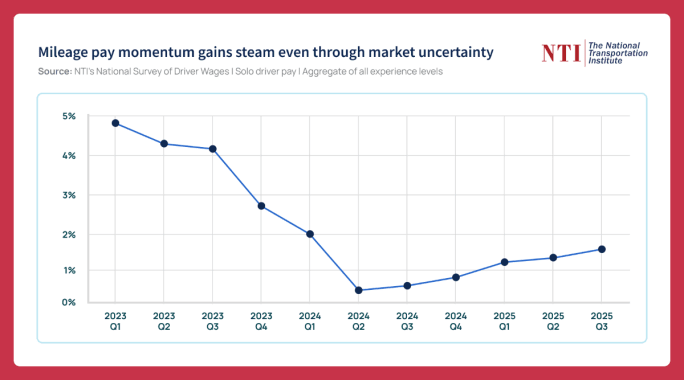
In fact, it has over the past rolling 12 months been slowing climbing year over year, with the slow-but-steady momentum showing surprising resilience despite ongoing uncertainty in the freight market and the broader economy.
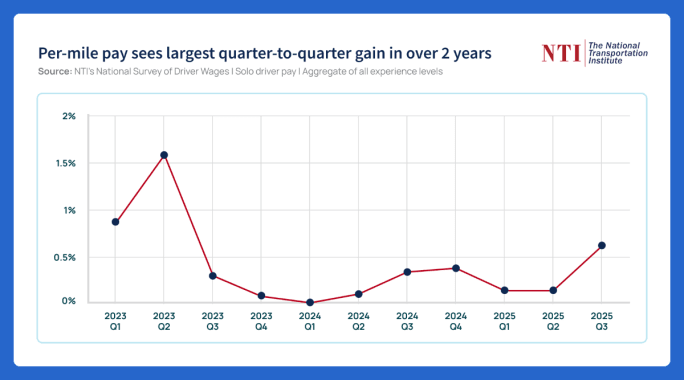
The 2025 third quarter saw the largest quarter-to-quarter movement in base mileage pay at for-hire OTR fleets in over two years, and the biggest year-over-year change in per-mile pay since the start of 2024.
‘Driver Pay Has Shaken Loose’
Let me be clear: Truck driver wages never declined or went in reverse. Instead, it’s the rate of growth in pay we’re talking about.
Per-mile pay at for-hire over-the-road and regional fleets, accounting for across experience levels (drivers with one year of experience and higher), is 1.4% higher than a year ago, including a 0.6% boost from spring of this year into summer.
While those numbers are a far cry from the multi-percent quarter-to-quarter increases and the 8-10% annual jumps seen in boom times like 2018 and 2021, driver pay has shaken loose from an ebb that spanned from late 2023 through the first half of 2024, at least for now.
2025’s changes are also notable compared to periods of stagnation from freight recessions past, such as three straight quarters in 2016 when pay didn’t move, and nearly all of 2019, when base mileage pay barely budged.
And today’s wages landscape is worlds away from 2008-2009’s Great Recession, when wages fell by a couple percentage points each of those years.
Driver Turnover and Driver Pay Increases
Annual earnings, meanwhile, have shown smaller increases year over year, climbing a little more than half a percent from the same time a year ago. This is likely due to productivity constraints that have limited take-home earnings as the prevalence of layovers climbed and fleets simply had fewer loads overall.
That trend also underlies one of the key factors that have nudged base pay increases amid an otherwise stalled freight market: Driver churn remains elevated, and fleets are still struggling with retention.
Base pay adjustments and per-mile rates are more go-to recruiting marketing plays, unlike annual pay. And base pay adjustments could be implemented as one offset to lagging availability in productivity in the form of miles, hours, loads, etc.
What Do These Driver Wage Trends Mean for Fleets and the Freight Market?
Right now, it’s too hazy to tell. The current sustained pick-up in wage growth rests on shaky ground and likely isn’t indicative of freight market supply and demand dynamics, but rather driver supply and demand dynamics.
Graph: National Transport Institute
So, whether the resilience in the current upward movement continues remains to be seen.
Of the market dynamics supporting any upward pressure on freight rates (and driver pay), capacity has been shaking out of the market and continues to do so.
The for-hire interstate carrier population has shrunk by more than 13% since the end of 2022, according to U.S. DOT data compiled and analyzed by NTI.
The Shrinking Driver Population
While the driver population hasn’t declined as much as the carrier pool, it’s shrinking, too. This year alone, the for-hire interstate driver population has fallen by more than 5%, according to U.S. DOT data.
The driver population is also being thinned out by regulatory and policy changes, and age and health factors.
The average driver age continues to climb, without much replacement coming in on the other side of the funnel. This increasingly limits the driver pool and puts upward pressure on wages, too.
According to NTI surveys of driver age, 57% of drivers in 2024 were over the age 45, up from 51% in 2019 and 42% in 1994. Younger drivers are rapidly losing representation. Last year, just 12.6% of drivers were between the ages of 25 and 34, compared to nearly 1 in 4 (24%) in 1994.
Trucking Fleet Growth ... or Driver Churn?
Despite the ongoing freight market malaise, fleets are hiring drivers at a faster clip.
Data from the U.S. DOT compiled and analyzed by NTI show 2025 as the strongest hiring year since DOT began tracking that data in January 2020. April and March both rank in the Top 5 months since January 2020 for number of driver hires, and 2025 through June is outpacing 2024 by about 12,000 hires a month (5%).
It's our contention at NTI that indicates driver turnover, not fleet growth. But it’s still one of the factors likely underlying wage movement.
How Does Economic Uncertainty Affect Truck Driver Pay?
But backdropping those trends that would put upward pressure on both freight rates and driver pay swirls uncertainty in the economy and with freight demand.
There’s been no meaningful change in freight volumes, and no indication there will be in the foreseeable months.
Economic uncertainty from a lack of policy clarity has been one of the biggest setbacks this year as businesses grapple with navigating those changes or being paralyzed.
Lingering effects from climbing interest rates in 2022 and 2023 to fight inflation have also been an economic drag. Sluggish consumer confidence and gridlock in the housing market have created headwinds. The labor market, while still historically strong, increasingly feels weaker. And residual effects from years of persistent inflation have chipped away at spending power.
All of these constraints cuff a freight economy still beset by too much capacity and flat-lined demand.
What Does All This Have to Do with Driver Wages?
Freight rates are the ultimate gatekeeper for truck driver pay. Without a shift in balance between the industry’s supply and demand dynamics, freight rates won’t move, and driver wages will follow suit.
Graph: National Transport Institute
But like other upcycles past, it can happen quickly.
One trend to watch for: There's pent-up demand among drivers to make a job switch if fleets start ramping up hiring — for either higher base wages or stronger take-home earnings in the form of better productivity, but especially for both in one job. Increased churn would then also put upward pressure on wages, especially if rates can justify those increases.
About the Author: James Jaillet is Chief Intelligence Officer at The National Transportation Institute. NTI has tracked and analyzed professional driver and technician compensation and benefits data since 1995 using proprietary research and surveys of for-hire motor carriers and private fleets. James can be reached at jjaillet@driverwages.com
Subscribe to Our Newsletter
More Drivers
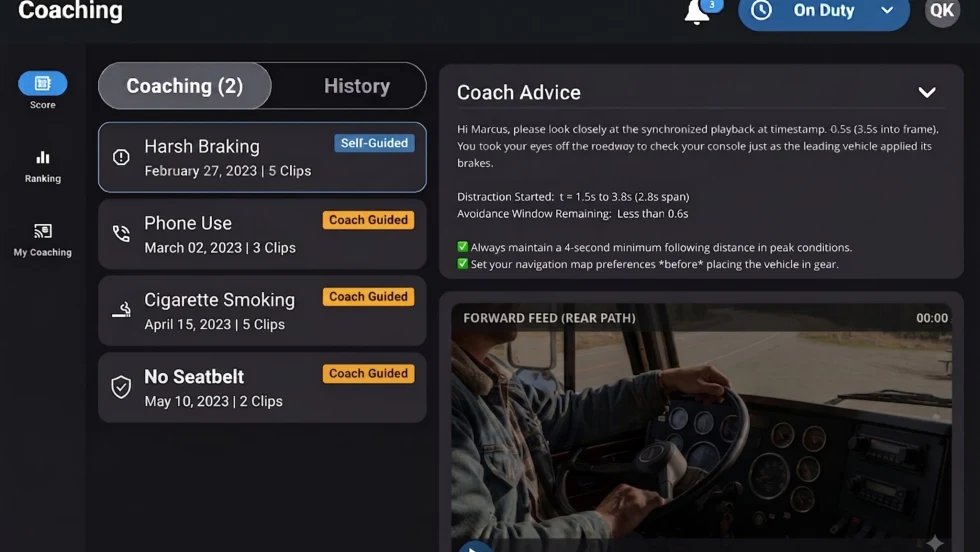
Platform Science Adds Dispatch and Safety Tools
Four additions to PS Fleet help fleets monitor loads, manage driver coaching, share truck locations and adjust video system settings.
Read More →
When Language Stops the Truck: The Return of ELP Out-of-Service Orders
English language proficiency rules for commercial drivers aren’t new, but renewed out-of-service enforcement has raised the stakes. Here’s what carriers need to know before a driver reaches a roadside inspection.
Read More →
Samsara Launches Custom AI Agent Builder
Agent Studio lets fleets create AI tools for hours-of-service monitoring, reporting and driver support, including agents that communicate by phone.
Read More →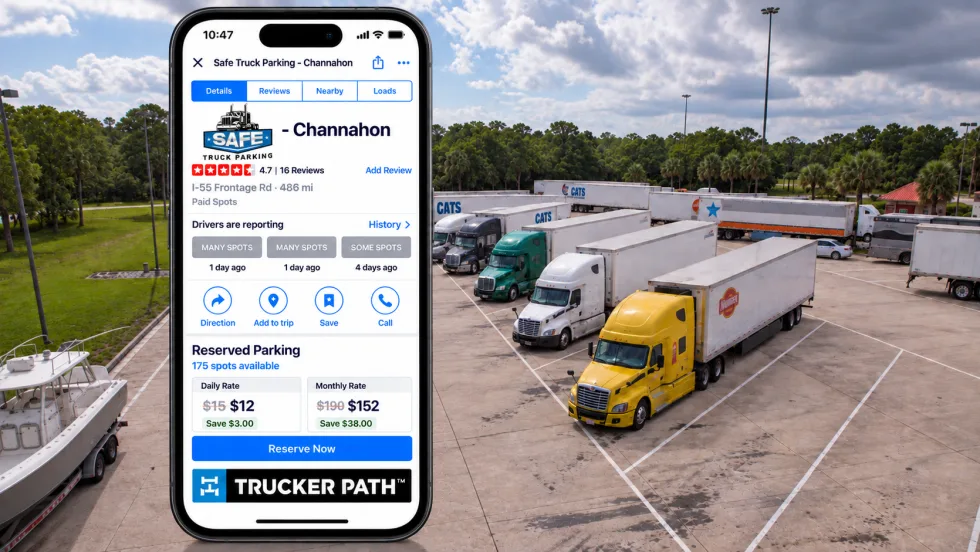
Trucker Path Expands Reserved Parking Network
Trucker Path has added close to 6,000 more truck parking spaces to its Trucker Path Reserved Parking Network with the addition of Safe Truck Parking.
Read More →
EEOC Sues Texas Trucking Company Over Driver Age Limits
The agency says Trancasa USA rejected applicants over 65 and applied tougher driving-record standards to those over 60.
Read More →
Nussbaum, Roehl Announce Second Driver Pay Increase This Year
This year has seen a swath of major truck driver pay increases as freight capacity has tightened.
Read More →
From One Generation to the Next: How Mentorship Builds Safer Truck Drivers
After three decades in trucking, Harold Perry shares what he's learned about driver safety, mentorship, and helping the next generation build confidence behind the wheel.
Read More →
Truck Drivers Need More Than Another Alert
Fleets have more visibility into truck health, safety events, and driver activity than ever. The next challenge is turning all that information into useful guidance for the person who has to decide what to do next.
Read More →
FMCSA Removes 110 Truck Driver Training Schools from Certified ELDT List
Federal regulators also are targeting more than 160 additional training providers and launching a nationwide audit of third-party CDL skills testers as part of a broader crackdown on trucking fraud.
Read More →
Hours of Service Pilot Programs: FMCSA Readies for 2027 Rollout
Two pilot programs could eventually reshape hours-of-service rules, giving truck drivers options to pause their 14-hour clock or use longer split sleeper rest periods.
Read More →