





ZF Highlights Progress on Automated, Electric Vehicle Technology Future
Wabco, ZF Unveil Advanced Braking and Steering Technology [VIDEO]
Automated collision avoidance is several steps closer to reality. At a demonstration event in Germany, ZF and Wabco revealed a prototype collision-avoidance technology for commercial vehicles called Evasive Maneuver Assist.
June 30, 2016
![Wabco, ZF Unveil Advanced Braking and Steering Technology [VIDEO]](https://assets.bobitstudios.com/image/upload/f_auto,q_auto,dpr_auto,c_limit,w_920/EMA-ZF_1768150000338_oflxvh.jpg)
Evasive Maneuver Assist first warns the driver of an impending and will take automonous evasive action if the driver fails to do so.
Credit:
Jim Park
3 min to read
Automated collision avoidance is several steps closer to reality. At a demonstration event in Aachen, Germany, ZF Friedrichshafen AG and Wabco Holdings unveiled a prototype collision-avoidance technology for commercial vehicles called Evasive Maneuver Assist.
EMA leverages the combined capabilities of Wabco's OnGuardActive radar-only collision mitigation system along with its proven electronic braking system (EBS), advanced emergency braking system (AEBS), electronic stability control (ESC) and vehicle dynamics control systems, with ZF's electro-hydraulic ReAx power steering system.
A radar sensor identifies moving or stationary vehicles ahead and alerts the driver via visual, audio and haptic signals (moderate brake applications) of an impending rear-end collision.
If the driver determines that the system cannot avoid a rear-end collision by driver-initiated or autonomous braking alone, EMA engages to help the driver steer safely around the obstructing vehicle and to bring truck and trailer to a safe and complete stop.
"Today's Evasive Maneuver Assist prototype demonstration is a powerful example of Wabco's and ZF's leadership in developing advanced safety technologies for commercial vehicles," said Jacques Esculier, chairman and CEO of Wabco.
"EMA connects Wabco's braking and stability control systems with ZF's active steering solution for the first time and marks an important step toward realizing the transportation industry's vision of autonomous driving."
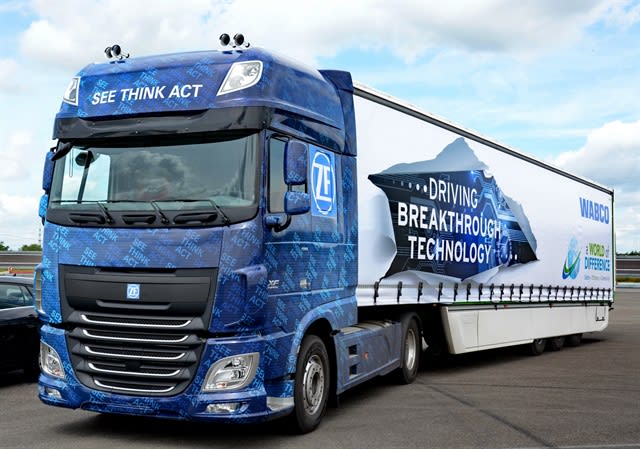
ZF's Innovation Truck 2016 boasts multiple safety systems incorporating electronic control of mechanical driving functions.
Credit:
Jim Park
European Union regulations now require newly registered trucks to be fitted with Electronic Stability Control, Advanced Emergency Braking Systems and Lane Departure Warning systems (LDW).
ZF believes that the more closely systems and functions are networked and automated, and as more passenger car technologies transfer to the commercial vehicle sector, the greater the potential for safety improvements that will quickly and effectively protect drivers and other road users.
Steps Closer to Autonomous Driving
ZF says the megatrends of automation, networking, safety and the electrification of formerly mechanical control components are changing the world of mobility.
Instead of developing stand-alone solutions, ZF is integrating intelligent systems.
The demonstration day at Aachen included ride and drive demonstrations for the global trucking trade press of various technologies that will bring heavy trucks closer to being fully autonomous in certain situations.
ZF demonstrated a truck that can back itself into an alley dock with the combined use of GPS for positioning and a camera and target arrangement that provides guidance for the truck's controllers.
The driver passively assists the maneuver by walking alongside the vehicle, holding a button down on a tablet that keeps the truck in motion. The truck and camera system have sensors that can detect pedestrians or cars coming into the truck's path.
Another feature demonstrated was a fully self-steering truck equipped with a hybrid electric powertrain. It operates on electric motors at low speed, up to 30 km/h, before switching to diesel. It also has a version of adaptive cruise control that maintains a safe following distance at all times, even at low speeds.
The features (on their own) and others are individual systems that are combined into what ZF calls Innovation Truck 2016, which will appear at this year’s IAA Commercial Vehicles show in Hannover, Germany, in September.
More Safety & Compliance

FMCSA Pauses Biennial-Update Enforcement Amid Motus Transition
Carriers whose updates were due on or after June 1 have more time, while FMCSA works to stabilize its new registration system and warns of phishing sites impersonating its new carrier registration system, Motus.
Read More →
ZF Expands Commercial Vehicle Push in North America
ZF is expanding its North American commercial-vehicle presence with new transmission applications, electrification, trailer technology and autonomous-driving systems.
Read More →
Truck Drivers Need More Than Another Alert
Fleets have more visibility into truck health, safety events, and driver activity than ever. The next challenge is turning all that information into useful guidance for the person who has to decide what to do next.
Read More →
Tesla Wants a Self-Driving Semi. Are Cameras Enough?
Could Tesla’s camera-only autonomous driving technology work on an 80,000-pound Semi? In this commentary, HDT's Deborah Lockridge takes a look at Tesla, Cybercab, and how autonomous trucks see the road.
Read More →
What DOT’s Automated Vehicle Strategy Means for Trucking
The U.S. Department of Transportation issued a new automated-vehicle strategy that outlines plans for driverless-truck regulations, cross-state freight corridors, and federal safety standards.
Read More →
NYC Expands Speed, Pedestrian Safety Tech Across Fleet
New York City is expanding intelligent speed assistance and pedestrian-alert systems across its municipal fleet, moving the technologies from pilot programs into vehicle procurement and retrofit requirements.
Read More →
FMCSA Removes 110 Truck Driver Training Schools from Certified ELDT List
Federal regulators also are targeting more than 160 additional training providers and launching a nationwide audit of third-party CDL skills testers as part of a broader crackdown on trucking fraud.
Read More →
Beyond DOT Compliance: What Makes a Trucking Fleet Truly Safe?
A trucking fleet can follow every rule and still make unsafe decisions. The real test comes when safety conflicts with freight, productivity, or cost.
Read More →
Hours of Service Pilot Programs: FMCSA Readies for 2027 Rollout
Two pilot programs could eventually reshape hours-of-service rules, giving truck drivers options to pause their 14-hour clock or use longer split sleeper rest periods.
Read More →
New Guide Offers Pet Safety Tips for Truck Drivers
Hundreds of thousands of pets travel in truck cabs. A new safety guide from Volvo Trucks and the Center for Pet Safety offers practical advice for truck drivers who bring dogs and cats along for the ride.
Read More →