




Hyzon Fuel Cell Truck Logs 540-Mile Delivery Run
Performance Food Group completed a 16-hour, eight-customer, delivery run with a Hyzon Motors truck powered by a liquid hydrogen fuel cell.

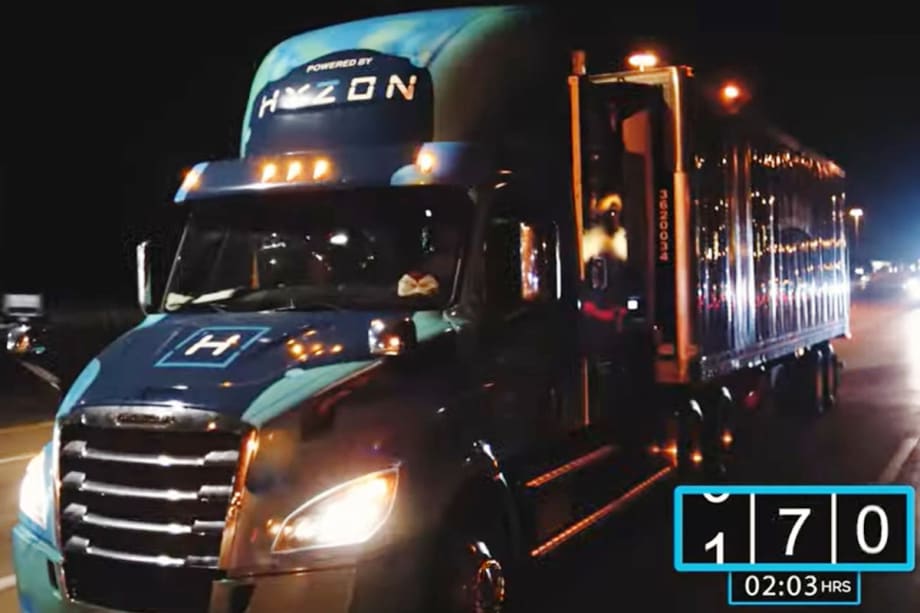
A Hyzon Motors liquid hydrogen fuel-cell electric truck runs a delivery route for Performance Food Group.
Source: Screenshot of Hyzon Motors video
Performance Food Group completed a 16-hour, eight-customer, delivery run with a Hyzon Motors truck powered by a liquid hydrogen fuel cell. Starting in Temple, Texas, the truck completed deliveries to customers near Dallas, traveling more than 540 miles on a continuous run.
"With increased range and no added weight in comparison to our gaseous hydrogen trucks, we believe this liquid hydrogen demo run has demonstrated potential viability for the future of liquid hydrogen in commercial trucking," said Parker Meeks, Hyzon CEO.
"The results we captured in the strenuous demo through Central Texas's diverse terrain and summer heat make us optimistic that, once commercialized, our liquid hydrogen vehicle powered by our proprietary 200kW fuel cell system should be able to provide long-distance range between 650 and 800 miles, on par with many diesel truck range requirements,” he added.
Liquid Hydrogen Fuel
Compared to gaseous hydrogen, the current industry standard, Hyzon said liquid hydrogen allows it to increase the amount of fuel on board significantly, thanks to increased energy density, with no changes to vehicle weight or payload.
To maintain the energy-dense liquid state, hydrogen requires cold temperatures of negative 400 degrees Fahrenheit. Hyzon partnered with Chart Industries to develop a tank system capable of storing liquid hydrogen at extremely cold temperatures and delivering it to the fuel cell system at the necessary pressure.
"This is a meaningful accomplishment for the hydrogen ecosystem, as long-haul and heavy-duty transportation is a key end-use for liquid hydrogen," said Jill Evanko, Chart's CEO and president. "Our investment in our unique cryogenic liquid hydrogen onboard tank and our liquid hydrogen test facility support progress in the hydrogen industry, with the Hyzon and PFG road demonstration another key step in the evolution of hydrogen commercialization."
Hyzon reported liquid hydrogen as a fuel source has been estimated to be up to $5 per kilogram less expensive to dispense than high-pressure gaseous hydrogen1, which would provide meaningful benefits to fleet owners.
"Simply put, we see liquid hydrogen as the economical approach to long range zero-emission trucking,” said Meeks.
For vehicle testing and the demo run, liquid hydrogen transportation, storage and dispensing was provided by Certarus with liquid hydrogen produced by Air Liquide.
More Liquid-Hydrogen Truck Research
Daimler Truck also has been testing liquid hydrogen to power fuel-cell-electric trucks. The company has said liquid hydrogen has a significantly higher energy density than gaseous hydrogen. That means more hydrogen can be carried on board, which significantly increases the range of an FCEV truck.
More Fuel Smarts

How Volvo Updated Its D13 for EPA 2027 [Watch]
Volvo’s updated D13 promises lower emissions without sacrificing performance or fuel economy. Take a closer look at what changed inside the engine in this HDT Spotlight video.
Read More →
Diesel Price Spike Shortens Payback for Natural Gas Trucks, Report Says
Energy Vision estimates fleets could recover the higher purchase price of an RNG-fueled Class 8 tractor in 1.3 to 2.8 years under current fuel-price scenarios.
Read More →
Calstart Becomes Catalyst Mobility, Reflecting Broader Focus
Calstart is now Catalyst Mobility, reflecting the nonprofit’s growing national role in clean transportation, including zero-emission trucks, infrastructure and incentive programs.
Read More →

Record Diesel Prices Squeeze Trucking Fleets
Average U.S. diesel prices have climbed to nearly $6 a gallon, surpassing the 2022 record as tight refinery capacity and Middle East disruptions keep fuel costs elevated.
Read More →
How Fuel Delivery Shapes Engine Performance
Fuel delivery depends on more than what happens at the injector. For fleet, maintenance and technical professionals, looking at the full path from pump to injector can provide useful context for understanding engine performance.
Read More →
East Coast Port Launches $45M Electric Truck Push
The Port Authority of New York and New Jersey announced millions in incentives for zero-emission drayage trucks, yard tractors, and new charging hubs near the port.
Read More →
California Bill Could Shed Light on Electric Truck Prices
Why do battery-electric Class 8 trucks remain so expensive? A California bill headed to Gov. Gavin Newsom would give fleets and state agencies more visibility into what manufacturers charge.
Read More →
Detroit Opens Orders for EPA 2027 Engines
Detroit isn’t starting from scratch to meet EPA 2027 diesel emissions standards. Its Gen 6 DD13 and DD15 engines keep much of today’s platform while updating the fuel and aftertreatment systems.
Read More →
Zero-Emission Truck Corridor Planned for West Coast
California, Oregon, Washington, British Columbia and Baja California are coordinating plans for truck charging and hydrogen fueling from Canada to Mexico.
Read More →
A Closer Look at Kenworth’s Electric T880E Vocational Truck [Video]
Learn more about Kenworth's T880E battery-electric vocational truck at the Paccar Technical Center, including its range, applications, upfitting considerations, and PTO options, in this HDT Spotlight video.
Read More →