




Hyzon Looks to Liquid Hydrogen for up to 1,000-mile ZEV Range
Hyzon Motors is betting on liquid hydrogen to power its trucks, rather than the gaseous hydrogen being used by most fuel-cell-electric truck developers, saying it will enable an up to 1,000-mile range.
July 29, 2021

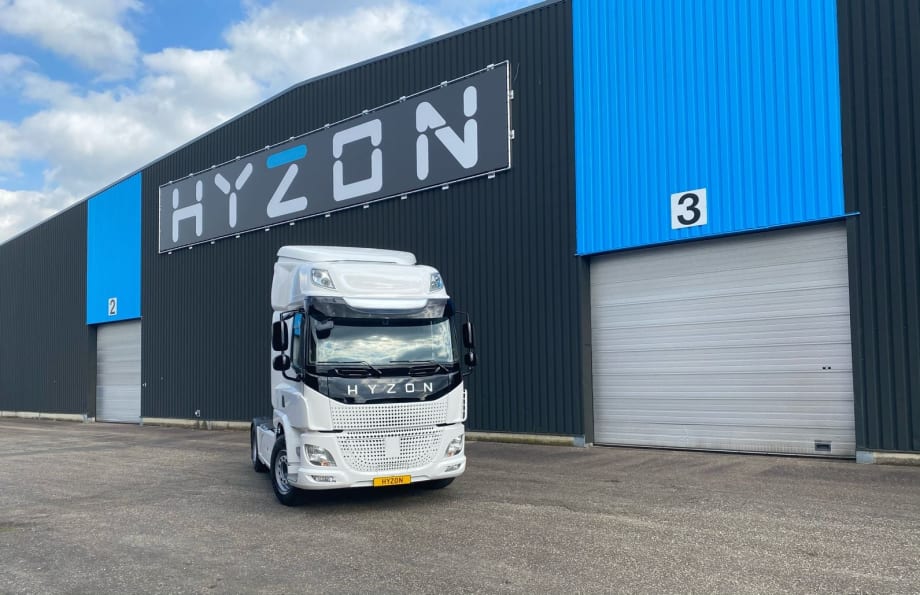
Hyzon recently announced it will work with Chart Industries to produce a liquid hydrogen-powered heavy-duty commercial vehicle with a range of up to 1,000 miles.
Photo: Hyzon Motors
4 min to read
Hyzon Motors is betting on liquid hydrogen to power its fuel-cell-electric trucks, rather than the gaseous hydrogen being used by most FCE truck developers, saying it will enable an up to 1,000-mile range, among other advantages.
Hyzon recently announced it will work with Chart Industries to produce a liquid hydrogen-powered heavy-duty commercial vehicle with a range of up to 1,000 miles. Chart is an independent global manufacturer of liquid hydrogen equipment.
Hyzon Motors is a relatively new hydrogen-fuel-cell truck maker, developed as an offshoot of a fuel-cell technology company. It’s headquartered in Rochester, New York, but thus far most of its hydrogen-fuel-cell truck orders have been in Europe and Australia. The vehicles are being built on chasses from existing truck-makers such as DAF. The latest announcements indicate we'll see Hyzon trucks in North America, as well. In addition to partnerships with Chart Industries, Raven SR, and Renew H2, the first vehicle trials with U.S. fleet operators will start in the fourth quarter of this year in California.
Why Liquid Hydrogen?
Because liquid hydrogen storage is twice as dense as the current 700 bar gaseous storage, a tank of liquid hydrogen fuels a vehicle for nearly twice the distance, according to an announcement from the two companies. Liquid hydrogen also improves a truck's payload capacity, because the storage tanks weigh less than the 700-bar tanks.
One of the challenges, however, is integrating mobile tanks that store liquid hydrogen, which require temperatures of minus 423 degrees, with a vehicle's fuel cell, which requires ambient-temperature hydrogen gas. The partnership creates an opportunity to address this challenge, by combining Chart's liquid hydrogen equipment expertise with Hyzon's experience manufacturing heavy-duty hydrogen vehicles.
The number of heavy-duty refueling stations needed for these trucks becomes significantly less than the number needed for trucks using gas storage tank systems, as the driving range can match that of heavy-duty diesel trucks. In addition, the refueling infrastructure capital and operating costs are reduced with the elimination of the compression and refrigeration equipment needed for 700 bar vehicles, according to the announcement.
Fewer stations also would reduce the need to transport hydrogen to refilling locations. Instead, large-scale, low-cost, green hydrogen production facilities could be built near the stations, relying on locally abundant resources such as solar, wind or hydropower. In the early hydrogen adoption phase, the 1,000-mile range could enable coast-to-coast routes with only four mega-hubs.
"With the current technology, fuel cell electric vehicles provide solutions for back-to-base trucking models," said Hyzon CEO Craig Knight. "The extended range would significantly accelerate the adoption of hydrogen FCEV over-the-road transport solutions, given the reduced infrastructure needs and increased refueling hub utilization."
Making Liquid H2 Fueling Possible
Hyzon followed up the Chart agreement with a deal with RenewH2 to collaborate on the supply and demand side of liquid hydrogen production.
RenewH2 is a U.S.-based sustainable hydrogen production, liquefaction, distribution and dispensing company. The company plans to reform biogenic methane gas to generate hydrogen. The hydrogen would then be liquefied and delivered to hydrogen fueling stations, which are expected to be developed in collaboration with Hyzon. Through this collaboration, the stations can be located near Hyzon customers to help provide consistent demand for the fuel.
"By aligning the production of hydrogen with the fueling infrastructure and the end-consumer — hydrogen-powered trucks — this partnership addresses the chicken-and-egg problem that has prevented broad-scale hydrogen adoption," said Knight. "This type of collaboration is crucial to accelerating decarbonization."
RenewH2 is expected to begin producing hydrogen in its Wyoming facility in 2023, with ultimate capacity of 300 tons per day using steam methane reformer units. In addition to producing liquid hydrogen, RenewH2 expects to store and deliver the fuel. Per the agreement, the fuel could be delivered by a fleet of Class 8 Hyzon trucks owned and operated by RenewH2.
Daimler Pushing for Liquid H2, too
Hyzon isn’t the only company working on liquid-hydrogen technology for its fuel-cell-electric commercial trucks.
Earlier this year, Daimler Truck began rigorous testing of its second-generation hydrogen fuel cell prototype. Although initial testing is being done with gaseous hydrogen, its plan is to be testing with liquid hydrogen by the end of the year.
Daimler officials have said they prefer liquid hydrogen because of its higher energy density in relation to volume than gaseous hydrogen. As a result, the tanks of a fuel-cell truck using liquid hydrogen are much smaller and, due to the lower pressure, significantly lighter, according to the truck maker. This gives the trucks more cargo space and a higher payload. At the same time, more hydrogen can be carried, which significantly increases the trucks’ range.
A 2020 paper by researchers in China, comparing compressed gaseous hydrogen systems and liquid hydrogen systems, concluded that on-board liquid hydrogen systems are the most economical and efficient and environmentally friendly choice for heavy-duty trucks that are running continuously at high speed and long distance.
More Fuel Smarts

How Volvo Updated Its D13 for EPA 2027 [Watch]
Volvo’s updated D13 promises lower emissions without sacrificing performance or fuel economy. Take a closer look at what changed inside the engine in this HDT Spotlight video.
Read More →
Diesel Price Spike Shortens Payback for Natural Gas Trucks, Report Says
Energy Vision estimates fleets could recover the higher purchase price of an RNG-fueled Class 8 tractor in 1.3 to 2.8 years under current fuel-price scenarios.
Read More →
Calstart Becomes Catalyst Mobility, Reflecting Broader Focus
Calstart is now Catalyst Mobility, reflecting the nonprofit’s growing national role in clean transportation, including zero-emission trucks, infrastructure and incentive programs.
Read More →

Record Diesel Prices Squeeze Trucking Fleets
Average U.S. diesel prices have climbed to nearly $6 a gallon, surpassing the 2022 record as tight refinery capacity and Middle East disruptions keep fuel costs elevated.
Read More →
Sponsored•September 9, 2026
How Fuel Delivery Shapes Engine Performance
Fuel delivery depends on more than what happens at the injector. For fleet, maintenance and technical professionals, looking at the full path from pump to injector can provide useful context for understanding engine performance.
Read More →
East Coast Port Launches $45M Electric Truck Push
The Port Authority of New York and New Jersey announced millions in incentives for zero-emission drayage trucks, yard tractors, and new charging hubs near the port.
Read More →
California Bill Could Shed Light on Electric Truck Prices
Why do battery-electric Class 8 trucks remain so expensive? A California bill headed to Gov. Gavin Newsom would give fleets and state agencies more visibility into what manufacturers charge.
Read More →
Detroit Opens Orders for EPA 2027 Engines
Detroit isn’t starting from scratch to meet EPA 2027 diesel emissions standards. Its Gen 6 DD13 and DD15 engines keep much of today’s platform while updating the fuel and aftertreatment systems.
Read More →
Zero-Emission Truck Corridor Planned for West Coast
California, Oregon, Washington, British Columbia and Baja California are coordinating plans for truck charging and hydrogen fueling from Canada to Mexico.
Read More →
A Closer Look at Kenworth’s Electric T880E Vocational Truck [Video]
Learn more about Kenworth's T880E battery-electric vocational truck at the Paccar Technical Center, including its range, applications, upfitting considerations, and PTO options, in this HDT Spotlight video.
Read More →