




Related: Breaking the 10 MPG Barrier
The Future of Fuel Economy
A fundamental shift in thinking has transformed the trucking industry and ushered in a new era of highly advanced vehicles delivering unprecedented fuel savings. But it’s only the beginning.
by Jack Roberts
June 21, 2016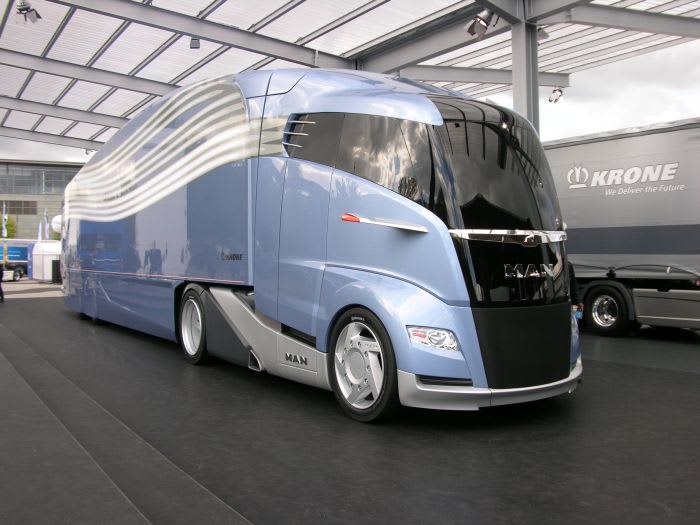
This “aerodynamically optimized road train” concept truck from MAN and Krone, both prominent vehicle builders in Europe, was showcased at the 2012 IAA commercial truck show in Hanover, Germany. The builders said it could save 25% in fuel and carbon dioxide emissions. Photo: Jim Park
12 min to read

This “aerodynamically optimized road train” concept truck from MAN and Krone, both prominent vehicle builders in Europe, was showcased at the 2012 IAA commercial truck show in Hanover, Germany. The builders said it could save 25% in fuel and carbon dioxide emissions.Photo: Jim Park
The trucking industry is undergoing profound shifts and changes. In fact, you could argue that we haven’t seen this kind of all-encompassing change since the industry made a wholesale move to diesel power in the late 1940s. But long before that technological revolution took place, trucking’s mission was carved in stone: The load would always go through and arrive on time.
It was a mantra that defined all aspects of trucking and led to the distinctly American-style swagger that lingers to this day. Everything in trucking, including vehicle design, was set around the concept of freight getting through, No Matter What. Vehicle design, driver comfort, hours of service and yes, even fuel economy, were all simply means to an end in achieving that overriding goal.
It was an article of faith in trucking that one day — far off in the future — fuel prices would rise. They had been doing so for years, in fact. But the process had been slow and almost predictable. The industry watched, aghast, as trucking companies —many small fleets, but also longtime, nationally recognized names — went out of business by the thousands because they couldn’t weather the storm.
Today, truck fleets understand that fuel prices can swing wildly with little warning. And the trucking industry itself has undergone a sea change over the past decade: Today, fuel economy is a priority on par with delivering goods in a safe and timely fashion. Vehicle and component manufacturers have responded to these new market forces (and more than a little prodding from the government) to create a whole new generation of trucks capable of delivering fuel economy numbers thought impossible just a decade ago.
The changes in fuel economy have been so profound that many in the industry wonder if there is any blood left in that turnip. But experts we talked to say yes: There is still plenty of room left in Class 8 vehicle and powertrain design to boost fuel economy performance even more. And many of those changes will be coming your way soon.
Blood in the turnip
Even with the many changes taking place today, Class 8 truck design has not changed dramatically in the past 20 years. While trucks today are far more aerodynamic, the overall vehicle and powertrain configuration remain pretty much the same and will likely remain so for the foreseeable future. Given those constraints, how beneficial are any upcoming fuel economy enhancement efforts likely to be?
Mike Roeth is executive director for the North American Council for Freight Efficiency, a non-profit group that helps fleets evaluate and adopt emerging technology to reduce emissions and boost fuel economy. He says the industry has squeezed so much additional performance out of its designs over the past decade, that it’s only natural to assume there’s little room left for improvement.
“I recall when we first started NACFE and suggested that the efficiency of tractor-trailers could be doubled,” Roeth says. “And some laughed at us. Most thought us naïve.”

The Walmart Advanced Vehicle Experience, or WAVE, was a futuristically styled concept truck put together with Peterbilt, Capstone Turbine, Great Dane and other suppliers, powered by a microturbine-electric hybrid drive system and a trailer made of lightweight carbon fiber.Photo: Walmart
At the time, in 2009, tractor-trailers were averaging 6 mpg in linehaul applications. Today, Roeth notes that new trucks routinely log 8 mpg. “On top of that, we have various SuperTruck concept vehicles undergoing testing today. Much of that technology is not yet practical or affordable. But we’re seeing 12 mpg consistently, which gives us a strong indication of where we’re headed.”
In fact, the commercial-vehicle industry is a blank canvas compared to light vehicles, says Steve Wesolowski, senior director of global advanced engineering for Dana Holding Corp. The Detroit Big Three carmakers are each defining their own strategies on how to integrate connected vehicles to boost fuel efficiency, which leads to limited scope.
“But when it comes to trucking,” he explains, “there are more players involved. Original equipment manufacturers, component suppliers, telematics suppliers, fleets, and other invested parties generate a more competitive marketplace for connected solutions. This will create a more technologically driven market segment in the commercial-vehicle space over the next 10 years.”
As OEMs continue the integration, Wesolowski thinks there will be other
efficiency opportunities to be harnessed, such as disconnect axle technology, which will combine the traction and dependability offered by a 6x4 configuration with the reduced drivetrain losses and improved fuel economy of a 6x2 configuration. Dana is already moving forward with plans to integrate axles featuring this technology into manufacturers’ chassis for field testing.
“I think there’s a lot of blood left in that tractor-trailer turnip,” quips Mihai Dorobantu, director, technology planning and government affairs for Eaton. Dorobantu agrees with Roeth, noting that as recently as 2007, the standard spec for a linehaul tractor was a 450- or 500-horsepower engine showing 1,450 rpm on the tach at highway cruise speeds. “Those trucks averaged around 5.2 mpg,” Dorobantu says. “But when you look at how far this industry has come in engine speeds in those few short years, you really begin to appreciate the fuel economy potential that’s still out there.”
Moving engine speeds down to 1,350 rpm at cruise speed was considered a bold move just a few years ago, Dorobantu notes. Yet today, no one looks twice at a truck turning 1,150 rpm on the highway — and recent SuperTruck concept vehicles cruise at a mere 900 rpm. “That’s merely one isolated area of improvement in engine efficiency,” Dorobantu says. “Modern trucks today are getting around 7 mpg — which is a tremendous increase in fuel efficiency. And there’s still room to go.”
The SuperTruck Program — a joint government-private industry research project to determine the potential for future heavy truck fuel and emissions standards — has provided OEMs and component suppliers with a roadmap to fuel economy standards that would have seemed impossible less than a decade ago.
“With the SuperTruck program, we achieved a 75% increase in fuel economy [and] a 43% reduction in greenhouse gas emissions,” explains Ken Damon, manager of vehicle performance for Peterbilt. “All told, the project confirmed an 86% gain in freight efficiency.”
Damon says some of the advanced technologies “harvested” from the SuperTruck project have already found their way onto Peterbilt’s fuel economy-optimized Model 579 Epiq tractor, increasing its fuel economy by up to 14% over a standard-spec Model 579.
Straight mechanical efficiencies are getting close to the practical limit, but there is definitely energy being wasted in the form of heat or just being used when it doesn’t need to be, adds Kevin Baney, chief engineer for Kenworth. He says new — and even old — powertrain concepts will be applied as vehicle design matures, offering new ways of enhancing vehicle efficiencies. One example he points to are hybrid electric-diesel drivetrains, which will likely find their first viable place in the Class 8 over-the-road market in the form of electrification of engine accessories.
“Today, hybrid powertrains are currently directly tied to the speed of the engine, and can be disconnected and only run when they need to be or when the truck has extra energy, such as when descending a hill,” Baney explains. “Currently, full hybrids require such large batteries that they are commercially still unviable. But that could change when the integration of predictive technologies and advanced engine architecture comes into play.”

Daimler Trucks recently unveiled the Highway Pilot Connect, a truck platooning system that has already been approved for use in a limited area in Germany. The company said the new platooning system offers up to 7% lower fuel consumption and uses only half of the previously required traffic space.Photo: Daimler
A global effort
The movement to significantly improve truck fuel economy has generated unprecedented cooperation between government and industry here in North America. But it is a true global effort as well.
Several truck OEMs are headquartered overseas and faced with a slate of global emissions and fuel economy standards phasing in at different times around the planet. Although the scheduling of these emissions standards is uncoordinated, the end results are very similar. Therefore, it makes sense for companies such as Daimler, Volvo and Paccar (which owns Dutch truck maker DAF), to develop their fuel economy strategies on a global scale. Which means that in trucking today, Europe is very much the go-to place for emerging heavy truck technology.
Tony Pain is an engineer retired from DAF Trucks who works with the Centre for Sustainable Road Freight, a U.K.-based nonprofit group with a mission similar to NACFE’s here in North America. Pain says while there is still more to be done in enhancing fuel economy of Class 8 rigs, fuel economy from engine development alone has practical limits. He says major reductions in fuel usage and CO2 must come from a whole series of sources. “Today, it’s really all about carrying more load more efficiently using less fossil-based fuel,” Pain explains.
Breaking it down, Pain says currently, diesel engines account for only about 15% of the total productivity improvement in trucks. “Aerodynamics, telematics, light-weighting, driver training and intelligent automated transmissions will need to deliver the rest,” he says. “Today’s modern diesel engines at Euro 6 emissions standards achieve about 45% thermal efficiency, with the next generation of engine’s reaching 48%.”
To achieve even that modest increase in efficiency, Pain says trucks will soon rely on increased downspeeding, friction reduction, variable valve timing, downsizing to reduce pumping losses, reducing use of EGR in favor of advanced SCR systems, higher fuel injection pressures with multiple injections, as well as reduced parasitic losses through variable speed oil and water pumps. A bit further out, waste heat recovery systems will turn thermal exhaust energy into practical, on-board, electrical power.
Iveco, which makes diesel-powered trucks in Europe, is looking at a host of ways to refine and rethink tractor-trailer fuel economy, from exotic technologies down to simple truck design. Laura Overall, Iveco’s communications director, says currently these efforts include improving the efficiency of air handling systems and engine auxiliaries such as water and oil pumps, reducing friction in the piston group, and even dynamic switching between different combustion types. She says Iveco engineers are also looking at vastly improving tractor- trailer aerodynamics, which can bring about big gains in fuel efficiency.
“Trucks traditionally are very complex and patchy, with many add-on parts,” Overall explains. “The more that we can streamline those parts into the main body shape, the better our results will be.”
One interesting area Overall points to is the development of intelligent aerodynamics systems, which use variable spoilers that deploy or retract according to vehicle speeds. Perhaps the greatest impact of this technology would be in the trailer gap area.
In addition, in the future, variable fifth wheels could draw the tractor and trailer closer together at highway speeds to greatly improve the rig’s fuel economy, then move apart at slower speeds to facilitate steering and maneuvering.
Closer to home, new approaches to aerodynamic design have pushed the familiar boundaries of what a truck is “supposed” to look like while providing a glimpse into future vehicle design. “The Walmart Advanced Vehicle Experience that was exhibited at several trade shows and events last year turned a lot of heads and made a lot of headlines,” says Bill Kahn, principal engineer and manager for advanced concepts for Peterbilt.
Kahn says the truck’s futuristic design was a departure from anything the industry had seen before. Moreover, its conception was a new concept: a joint venture between an OEM and leading private fleet — which highlights just how inclusive the effort to boost truck fuel economy has become.
“The resulting design is a concept vehicle,” Kahn explains. “But its design reduced aerodynamic drag by 20%. And while it may never be a production vehicle, elements of it may be incorporated into future vehicle platforms. Its futuristic design tapped leading-edge ideas in advanced aerodynamics, futuristic powertrains, renewable fuels, a human-center design interior and wireless connectivity. The Peterbilt truck of the future will exist somewhere between these two domains.”

The Freightliner SuperTruck, a demonstration research project funded in part by the Energy Department, achieved an average of 12.2 mpg on a five-day, 312-mile round trip on Interstate 35 between San Antonio and Dallas, at a weight of 65,000 lbs GVWR at a speed of 65 mph.Photo: Daimler
Electronic convoys
Simultaneously, engineers around the world have been getting creative to identify efficiency gains using more unconventional methods, says Derek Rotz, director of advanced engineering for Daimler Trucks North America.
“Vehicle controls systems certainly show promise for improving fuel economy, Rotz notes, pointing to the use of GPS and 3D digital maps to control the vehicle predictively across hilly terrain while adjusting the cruise control speed and making “intelligent” gear selections to cross hills in the most fuel efficient manner. When tied in with vehicle safety systems, such as lane departure- and blind spot-warning systems, camera systems and
emerging vehicle-to-vehicle (V2V) communication systems, Rotz says combining and integrating these systems to work together is the logical next step as a source for tractor-trailer fuel savings.
The concept is called platooning and the way it saves fuel is familiar to race fans across the globe: Trucks use V2V communications to fully coordinate their road speeds, braking actions and safety systems in order to safely maintain close following distances. Once electronically tethered together, the trucks can draft with one another in a tight convoy formation, taking advantage of extremely efficient aerodynamics, which can boost overall truck fuel efficiency to a surprising degree.
“Platooning sounds futuristic, but it’s not,” says Steve Boyd, public affairs consultant for Peloton Technologies, a transportation tech company developing platooning systems in North America. “Almost all of the safety systems used on platooning trucks are available commercially — and in use by fleets — today. The only difference is that we’re using V2V communications to fully integrate the systems on different trucks, so they perform seamlessly together.”
Boyd says Peloton has tested truck platoons with following distances as close as 20 feet between vehicles, although a high-profile demonstration by Daimler outside of Dusseldorf, Germany, earlier this year used intervals of 15 meters, or 40 feet, between trucks. Even at those increased distances, Rotz says in a three-truck platoon, the lead vehicle gets a fuel economy boost of around 3%. The second trailer vehicle gets a 7% fuel economy increase, while the third truck (and any subsequent trucks in a platoon) receive a 9% increase.
Some current cost estimates for platooning technology are as high as $30,000 per truck. But Boyd says Peloton believes those are wildly inflated. “Our numbers aren’t finalized yet,” he says. “But we think fleets will be looking at $1,500 to $2,000 for platooning equipment — much of which will be federally mandated on trucks by the time we’re ready to go to market.”
Based on those numbers, Boyd says trucks running 180,000 miles or more a year will see overall fuel savings of around 4 cents a mile while platooning. “Right now, we’re estimating fuel savings from $3,000 to $11,000 per year for fleets.”

When the U.S. Department of Energy in 2010 first announced its SuperTruck funding for the development and demonstration of advanced technologies to improve the efficiency of long-haul Class 8 trucks, the 10.7 mpg achieved by the Cummins/Peterbilt SuperTruck was almost unheard of.Photo: Peterbilt
Platooning may seem far-fetched — and there are many in trucking today who question its safety and effect on drivers — but Rotz, Boyd and other experts point to recent high-profile demonstrations in Europe and say it will likely appear in North America sooner, rather than later.
“Without a doubt, there are still many engineering hurdles to overcome at this early point in the development,” Rotz says. “Still, the aerodynamic benefits of driving in a platooning formation are promising and worth exploring.”
Volvo Trucks North America, for instance, is scheduled to run a platooning test/demonstration this month with the University of California-Berkeley. Claes Nilsson, president of Volvo Trucks, told reporters last month that “the problem is not really the technology in the truck; I think we could be ready within some few years. I think the challenge is going to be when you put those trucks on public roads.”
Volvo Trucks North America President Göran Nyberg agreed, noting that the legal situation is more of a stumbling block than the actual technology. He speculated that we initially could see platoons in specific transport corridors, with limitations on working hours, etc. “I think there are different ways to step by step introduce this technology.”
In trucking today, it seems nothing is off the table when it comes to enhancing vehicle fuel efficiencies. Old technologies are being reexamined, while new ones are studied and tested. A new era of ultra-clean, ultra-efficient trucks is just around the corner, likely putting old-style, long-nosed, slab-grilled rigs out to pasture once and for all.
Subscribe to Our Newsletter
More Fuel Smarts

How Volvo Updated Its D13 for EPA 2027 [Watch]
Volvo’s updated D13 promises lower emissions without sacrificing performance or fuel economy. Take a closer look at what changed inside the engine in this HDT Spotlight video.
Read More →
Diesel Price Spike Shortens Payback for Natural Gas Trucks, Report Says
Energy Vision estimates fleets could recover the higher purchase price of an RNG-fueled Class 8 tractor in 1.3 to 2.8 years under current fuel-price scenarios.
Read More →
Calstart Becomes Catalyst Mobility, Reflecting Broader Focus
Calstart is now Catalyst Mobility, reflecting the nonprofit’s growing national role in clean transportation, including zero-emission trucks, infrastructure and incentive programs.
Read More →

Record Diesel Prices Squeeze Trucking Fleets
Average U.S. diesel prices have climbed to nearly $6 a gallon, surpassing the 2022 record as tight refinery capacity and Middle East disruptions keep fuel costs elevated.
Read More →
Sponsored•September 9, 2026
How Fuel Delivery Shapes Engine Performance
Fuel delivery depends on more than what happens at the injector. For fleet, maintenance and technical professionals, looking at the full path from pump to injector can provide useful context for understanding engine performance.
Read More →
East Coast Port Launches $45M Electric Truck Push
The Port Authority of New York and New Jersey announced millions in incentives for zero-emission drayage trucks, yard tractors, and new charging hubs near the port.
Read More →
California Bill Could Shed Light on Electric Truck Prices
Why do battery-electric Class 8 trucks remain so expensive? A California bill headed to Gov. Gavin Newsom would give fleets and state agencies more visibility into what manufacturers charge.
Read More →
Detroit Opens Orders for EPA 2027 Engines
Detroit isn’t starting from scratch to meet EPA 2027 diesel emissions standards. Its Gen 6 DD13 and DD15 engines keep much of today’s platform while updating the fuel and aftertreatment systems.
Read More →
Zero-Emission Truck Corridor Planned for West Coast
California, Oregon, Washington, British Columbia and Baja California are coordinating plans for truck charging and hydrogen fueling from Canada to Mexico.
Read More →
A Closer Look at Kenworth’s Electric T880E Vocational Truck [Video]
Learn more about Kenworth's T880E battery-electric vocational truck at the Paccar Technical Center, including its range, applications, upfitting considerations, and PTO options, in this HDT Spotlight video.
Read More →