




SuperTruck Program Aims to Improve Economy by 50 Percent
The Department of Energy is backing development of clean-burning, more fuel-efficient vehicles with cold cash, including $115 million for the Super Truck program. Announced earlier this year, the program is awarding grants to three teams, headed by Daimler Trucks North America, Navistar International and Cummins

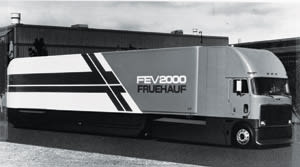
In 1981, the radical aerodynamics of Fruehauf's FEV (fuel-efficient van) 2000 got 7.4 mpg -- 72 percent better than a baseline tractor-trailer.
The Department of Energy is backing development of clean-burning, more fuel-efficient vehicles with cold cash, including $115 million for the Super Truck program. Announced earlier this year, the program is awarding grants to three teams, headed by Daimler Trucks North America, Navistar International and Cummins.
Each will invest matching sums to develop high-tech demonstration vehicles that will attempt to lower emissions of greenhouse gases and improve fuel economy by half again over today's levels.
The funding is part of a larger effort to spend $187 million in nine projects to increase fuel efficiency in heavy-duty trucks and passenger vehicles.
The manufacturers say they will explore improved aerodynamics, advanced combustion techniques and waste heat recovery, powertrain hybridization, reduced engine idling and smaller engine size, among other things, to increase fuel economy. Each team will build vehicle prototypes that can efficiently move large amounts of freight. They will use an "integrated" approach that pairs tractors with trailers, particularly by designing complementary streamlining.
DTNA, which builds Freightliner and Western Star trucks, will receive about $40 million. It will work with sister company Detroit Diesel, "to undertake a broad research program toward the objectives of improving freight efficiency 50 percent over the current state-of-the-art and reaching 50 percent brake thermal efficiency," the company states in an abstract to a project summary with which it successfully applied for its grant.
Thermal efficiency of diesels is now in the mid-40-percent range, meaning more than half the energy in diesel fuel is now consumed by internal friction and wasted as heat. All engine systems, including turbocharging, cooling and accessory drives, will be improved by DDC's research, and use of a downsized engine is among the routes to explore.
Work will be done by about 40 employees in Portland, Ore., and Detroit, Mich. Partners will include Oak Ridge National Laboratory, Delphi, Oregon State University, BAE Systems, ArvinMeritor and Schneider National.
Navistar will get $37.3 million to develop and demonstrate fuel-efficient technologies, including aerodynamics, combustion efficiency, waste heat recovery, hybridization, idle reduction and reduced rolling resistance tires. It will in effect expand work already done on the company's engines and road tractors, the firm said.
Cummins will receive $54 million to work on both the Super Truck and a light-duty project. Partnering with Peterbilt and Eaton, Cummins will use $39 million to develop a clean diesel engine, an advanced waste heat recovery system, an aerodynamic Peterbilt tractor using an advanced automated mechanical transmission and a fuel cell auxiliary power unit to reduce engine idling. An aerodynamic van trailer will complement the tractor.
The DOE initiative echoes development work done by manufacturers more than a quarter century ago. Shortly after the Arab oil embargo of 1979, Navistar, Peterbilt and now-defunct Fruehauf Trailer experimented with integrated tractor-trailer combinations that achieved high-mpg figures, in two cases with vehicles that were practical enough for everyday use.
Freuhauf's futuristic FEV2000, designed by Airflow Sciences Corp., was made up of an International cabover tractor and a skirted, boat-tailed van trailer with virtually no gap between them. It achieved 7.4 mpg compared to 4.3 mpg for a baseline vehicle typical of the early '80s.
Peterbilt showed that an aerodynamic van with a belly skirts and a "truncated boat tail" alone improved the efficiency of a modified Model 372 cabover by 1.5 mpg.
Navistar advertised that an aero-improved daycab tractor with a Cummins L10 engine had delivered 8.3 mpg in a highly controlled cross-country run.
Few of the demo rigs' designs were embraced by truckers, because more stable oil supplies and cheaper fuel prices encouraged them to continue with status quo equipment. Recent world economic and geopolitical changes and increasingly expensive fuel might make lessons from Super Truck, born of an activist administration and Congress in Washington, more enduring.
From the June 2010 issue of Heavy Duty Trucking.
More Fuel Smarts

How Volvo Updated Its D13 for EPA 2027 [Watch]
Volvo’s updated D13 promises lower emissions without sacrificing performance or fuel economy. Take a closer look at what changed inside the engine in this HDT Spotlight video.
Read More →
Diesel Price Spike Shortens Payback for Natural Gas Trucks, Report Says
Energy Vision estimates fleets could recover the higher purchase price of an RNG-fueled Class 8 tractor in 1.3 to 2.8 years under current fuel-price scenarios.
Read More →
Calstart Becomes Catalyst Mobility, Reflecting Broader Focus
Calstart is now Catalyst Mobility, reflecting the nonprofit’s growing national role in clean transportation, including zero-emission trucks, infrastructure and incentive programs.
Read More →

Record Diesel Prices Squeeze Trucking Fleets
Average U.S. diesel prices have climbed to nearly $6 a gallon, surpassing the 2022 record as tight refinery capacity and Middle East disruptions keep fuel costs elevated.
Read More →
How Fuel Delivery Shapes Engine Performance
Fuel delivery depends on more than what happens at the injector. For fleet, maintenance and technical professionals, looking at the full path from pump to injector can provide useful context for understanding engine performance.
Read More →
East Coast Port Launches $45M Electric Truck Push
The Port Authority of New York and New Jersey announced millions in incentives for zero-emission drayage trucks, yard tractors, and new charging hubs near the port.
Read More →
California Bill Could Shed Light on Electric Truck Prices
Why do battery-electric Class 8 trucks remain so expensive? A California bill headed to Gov. Gavin Newsom would give fleets and state agencies more visibility into what manufacturers charge.
Read More →
Detroit Opens Orders for EPA 2027 Engines
Detroit isn’t starting from scratch to meet EPA 2027 diesel emissions standards. Its Gen 6 DD13 and DD15 engines keep much of today’s platform while updating the fuel and aftertreatment systems.
Read More →
Zero-Emission Truck Corridor Planned for West Coast
California, Oregon, Washington, British Columbia and Baja California are coordinating plans for truck charging and hydrogen fueling from Canada to Mexico.
Read More →
A Closer Look at Kenworth’s Electric T880E Vocational Truck [Video]
Learn more about Kenworth's T880E battery-electric vocational truck at the Paccar Technical Center, including its range, applications, upfitting considerations, and PTO options, in this HDT Spotlight video.
Read More →