





"This is a highly messy thing, and clarity is going to be hard to get — although it will show up for some market segments and some people quicker than others."
Early Insights from NACFE’s ‘Run on Less – Messy Middle’ on Trucking Decarbonization
NACFE has shared early findings from its Run on Less – Messy Middle, gathering data from diesel, natural gas, electric, and hydrogen trucks across 13 fleets. The initial results highlight both progress and challenges in trucking’s decarbonization journey.
October 23, 2025
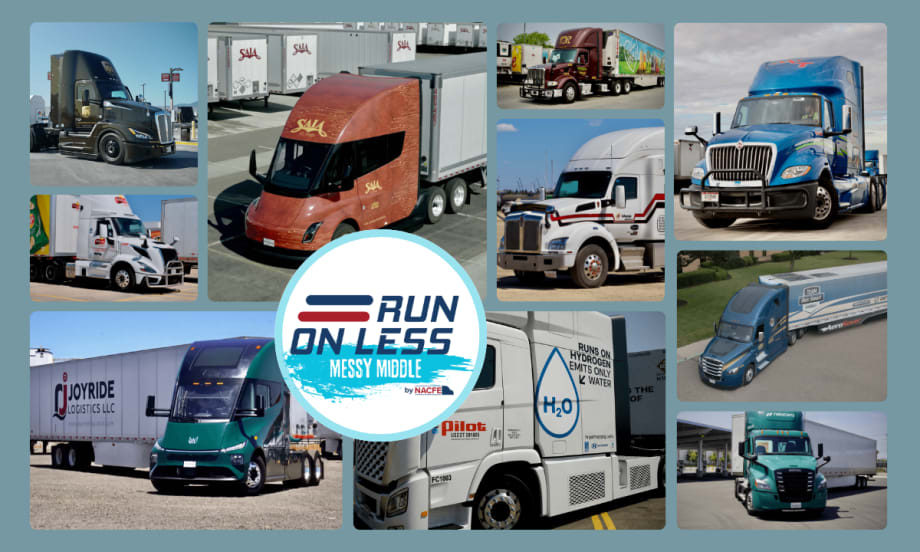
14 trucks from 13 fleets demonstrated multiple transport decarbonization strategies, including diesel, natural gas, and electric trucks.
Credit:
HDT Graphic/NACFE photos
8 min to read
Is the “messy middle” of trucking decarbonization any less messy following the North American Council for Freight Efficiency’s Run On Less – Messy Middle? Well, yes and no, but there will be a lot more data to evaluate before NACFE publishes its full findings next summer.
This was the fifth “Run on Less” project for NACFE, and Executive Director Mike Roeth called it the most comprehensive one yet.
It looked at multiple alternatives for decarbonization across multiple segments of regional and long-haul trucking: Diesel (including bio- and renewable fuel), natural gas, battery-electric, and hydrogen-fuel-cell electric.
Previous editions of the Run focused on fuel efficiency and battery-electric trucks.
“The team has called this four runs in one occasionally,” Roeth said, as NACFE tracked 13 fleets and 14 trucks with four different powertrain options over 18 days.
Leading up to the actual Run were interviews with the participating fleets and multiple online “bootcamp” training sessions.
There’s still a lot of data-crunching and analysis ahead, but NACFE shared some initial findings with reporters in an October 23 video call.
Bringing Clarity to Long-Haul Decarbonization
“Our main objective here was to bring clarity to long-haul decarbonization,” Roeth said, acknowledging that it used a rather broad definition of that for the Run.
Decarbonizing trucking, he said, “might be as simple as improving your diesel efficiency… creating less carbon by burning less diesel, all the way to more significant solutions like battery=electric and hydrogen fuel cell.”
He explained the thinking behind the “messy middle” moniker.
“We truly believe that we'll have battery electric and fuel cell extended range electric trucks from renewable clean energy as the long-term future,” Roeth said. “We think that is achievable given all the work we've done.”
But what happens on the road from here to that long-term future?
“There's a middle here. Some of these solutions in the middle might be an option for a very, very, very long time… But there's also some of these technologies that will, as we're going through this time period, scale and sunset.”
The fleets participating in the Run, Roeth said, are “really the pioneers in this work. These are the fleets out there that are not just studying it and talking about it and hoping that somebody will go do this work. They’re actually doing it.”
Did Run on Less - Messy Middle Make Decarbonization Less Messy?
Roeth was asked by a reporter, “Is the future less messy now than it was when you started, or is this just showing that we still don't know what is going to win out in 2040, 2050?”
After a bit of a chuckle, Roeth shared the story of a quick two-question survey conducted at one of the Messy Middle boot camp sessions, asking whether participants had a clearer understanding of the technology solutions. While he didn’t have the numbers in front of him, he said it was around 70% who felt they knew more about the technologies thanks to the ROL-Messy Middle project.
However, when asked whether they knew what they were going to do about it, he said, it was far fewer, perhaps 40%.
“We'll get more data on that and share that out as we go forward,” he said.
“But you know, this is a highly messy thing, and clarity is going to be hard to get — although it will show up for some market segments and some people quicker than others. But you know, we’re not naive. It’s going to take a while.”
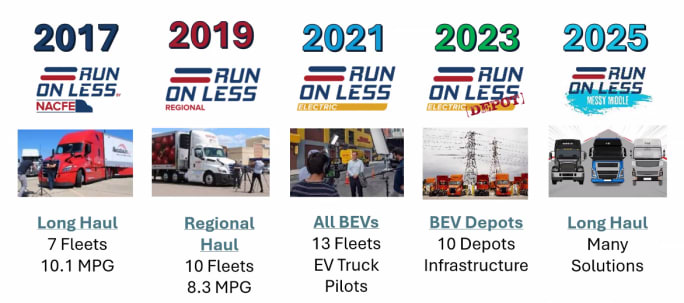
This is the fifth Run on Less for NACFE
Source: NACFE
Run On Less - Messy Middle: Initial Findings
Powertrain technologies in the trucking industry are constantly evolving, yet must compete directly on cost and performance in an environment of shifting regulations and incentives.
Fleet owners, their customers, and the public continue to value sustainability efforts while still looking for good returns on their investments.
Fleets have more powertrain choices from OEMs, which is creating challenges given the increasing segmentation of the truck market.
Recent significant powertrain advancements include a 15L natural gas engine, 400+ mile battery-electric vehicles, high-power fast charging stations, increased availability of renewable natural gas and bio and renewable diesel, and new high-volume OEM entrants.
All the powertrain technologies are improving and revealing new benefits. However, challenges persist, especially with fueling/charging infrastructure, weight, and cost.
Natural gas trucks are satisfying the needs of diesel with more power, torque, range and quick fill times.
Battery electric truck range, weight and costs are becoming more competitive with diesel trucks in similar duty cycles.
While production of renewable fuels is increasing, it remains well below what is needed for wide scale adoption by fleets.
Hydrogen in freight movement is still a nascent technology but is showing promise in certain use cases.
Roeth shared some of the performance data from the run for each of the fuel/powertrain types.
Diesel is Still a Valid Path to Decarbonization
Four trucks were operating on diesel, biodiesel, or renewable diesel and focused on maximizing fuel economy. They were operated by Schneider, Mesilla Valley Transportation, Frito-Lay and owner-operator Henry Albert.
Two diesel trucks traveled a combined 22,550 miles at an overall average of 11.6 mpg. One was operated by a Mesilla Valley team that got into 800-1,000 miles a day, the other by Henry Albert, who’s long been known as a fuel economy guru of sorts.
The Frito-Lay truck used the Optimus system to run on 99% biodiesel. It averaged 9.5 mph on its 5,418 miles during the Run.
New Natural Gas Engines Haul Heavy
The three natural-gas-powered trucks in the Run used the new Cummins X15N, a 15-liter natural gas-powered engine that promises power and torque similar to diesel engines, a shortcoming that has kept more fleets from operating natural gas trucks.
The three natural gas trucks (Wegmans, UPS, and Kleyson) ran challenging routes, heavy with double and sometimes triple trailers over 20,739 miles. A majority of those miles were run over 120,000 GVW.
“We wanted to see if the natural gas trucks could really do the job of some of the harder diesel operations. So we conclude that yes, they can, and it's just not the old lightweight, light, load natural gas duty cycle,” Roeth said.
The fleets are using renewable natural gas contracts with a reduced carbon intensity covering most of these miles.
Surprising Charging Data for Battery-Electric Trucks
There were four fleets running battery-electric trucks. Two, 4 Gen Logistics and Nevoya, were running BEVs from traditional OEMs such as Volvo and Freightliner.
Two were running BEVs from new manufacturers that are building only electric trucks, designed that way from the ground up. Saia ran Tesla Semi trucks, and Joy Ride Logistics ran an even newer brand, Windrose.
“I think we myth busted that it takes six hours of charging,” Roeth said. A Tesla Semi was able to complete 465 miles on a single charge – with less than two hours charging, he said.
That truck was running out of Stockton, California, and was able to use a Tesla charging location within 8 or 9 miles of the facility. The truck ran between Stockton and Bakersfield and back, 465 miles.
That also was a slip seated (dual shift utilization) operation, as it typical of many less-than-truckload operations, with the second driver handling about 100 miles of city deliveries.
That truck covered 3,676 miles over the 18 days with the truck driving 52% and charging only 13% of the time.
The Windrose truck covered 875 miles in a single day and 5,740 miles over 18 days using only public charging. Some of that was at a truck-specific Greenlane charging facility in Colton, California, but much of the rest were Electrify America charging stations at Walmarts intended for light-duty vehicles. Many of them have 350-kilowatt charging, he said, that the truck could use.
“So that's not a sustainable solution, of course, for trucking,” Roeth said. “We can't have all these 18-wheelers sitting trying to get on car chargers at Walmarts. But it's proving that routes can be made with these trucks with public charging.”
Hydrogen Fuel Cell Electric Trucks: Nascent Technology
Two fleets ran Hyundai Xcient hydrogen fuel cell electric trucks.
Pilot was hauling hydrogen around southern California, and Penske was running auto parts around Dallas.
“These were high intensity urban routes,” Roeth explained, compared to the regional and long-haul routes run by most of the rest of the trucks.
“The truck is not really ready for long haul, prime time, for lots of miles at highway speeds,” he said. “But they did a lot of miles in these urban areas of LA and Dallas, and that’s pretty good efficiency.”
A hydrogen fuel cell truck with 100% uptime, covered 4,076 miles over the Run, one day at 411 miles, at 7.8 miles per kg H2.
Shifting Regulatory Environment Impacts on Trucking Decarbonization
Since President Donald Trump took office in January, the EPA has been working on a significant deregulation of emissions, with much still up in the air, and there’s no doubt that will affect the adoption rate of these alternative technologies.
“The marketplace will decide what works,” Roeth said. “So it'll be a cost and performance, reliability, durability, all those things.
"And that will be the case anyway, whether we have regulations or not, but with shifting regulations and incentives that does affect the challenges we have here with these technologies.”
A demand for more sustainable transport is not going away, he said.
“It might be limited a bit as we work through these economic times and these situations,” Roeth said, “But as we heard from the industry throughout the year, on this Run on Less-Messy Middle, that customers and the public continue to drive businesses to be more sustainable.”
Watch our interview with Mike Roeth from earlier this year:
More 'Messy Middle' Analysis to Come
NACFE will release a dataset that will include detailed metrics from all 14 trucks on November 3.
In January it will publish a report on the mechanics of the Run.
A “potluck” data analysis workshop in February will invite companies and organizations to present their reports and analysis of the metrices.
"We will publish a detailed analysis of the findings from the Run by mid-2026,” Roeth said.
The Run, delivered by NACFE, is made possible through sponsorships with Cummins and Shell as title sponsors, as well as a host of companies that are event and supporter sponsors including Geotab, the official data partner for the Run.
More Fuel Smarts

How Volvo Updated Its D13 for EPA 2027 [Watch]
Volvo’s updated D13 promises lower emissions without sacrificing performance or fuel economy. Take a closer look at what changed inside the engine in this HDT Spotlight video.
Read More →
Diesel Price Spike Shortens Payback for Natural Gas Trucks, Report Says
Energy Vision estimates fleets could recover the higher purchase price of an RNG-fueled Class 8 tractor in 1.3 to 2.8 years under current fuel-price scenarios.
Read More →
Calstart Becomes Catalyst Mobility, Reflecting Broader Focus
Calstart is now Catalyst Mobility, reflecting the nonprofit’s growing national role in clean transportation, including zero-emission trucks, infrastructure and incentive programs.
Read More →

Record Diesel Prices Squeeze Trucking Fleets
Average U.S. diesel prices have climbed to nearly $6 a gallon, surpassing the 2022 record as tight refinery capacity and Middle East disruptions keep fuel costs elevated.
Read More →
Sponsored•September 9, 2026
How Fuel Delivery Shapes Engine Performance
Fuel delivery depends on more than what happens at the injector. For fleet, maintenance and technical professionals, looking at the full path from pump to injector can provide useful context for understanding engine performance.
Read More →
East Coast Port Launches $45M Electric Truck Push
The Port Authority of New York and New Jersey announced millions in incentives for zero-emission drayage trucks, yard tractors, and new charging hubs near the port.
Read More →
California Bill Could Shed Light on Electric Truck Prices
Why do battery-electric Class 8 trucks remain so expensive? A California bill headed to Gov. Gavin Newsom would give fleets and state agencies more visibility into what manufacturers charge.
Read More →
Detroit Opens Orders for EPA 2027 Engines
Detroit isn’t starting from scratch to meet EPA 2027 diesel emissions standards. Its Gen 6 DD13 and DD15 engines keep much of today’s platform while updating the fuel and aftertreatment systems.
Read More →
Zero-Emission Truck Corridor Planned for West Coast
California, Oregon, Washington, British Columbia and Baja California are coordinating plans for truck charging and hydrogen fueling from Canada to Mexico.
Read More →
A Closer Look at Kenworth’s Electric T880E Vocational Truck [Video]
Learn more about Kenworth's T880E battery-electric vocational truck at the Paccar Technical Center, including its range, applications, upfitting considerations, and PTO options, in this HDT Spotlight video.
Read More →