




7 Ways Aerodynamics Save Fuel
Everyone knows reducing aerodynamic drag saves fuel, but figuring out which aero devices make sense is a challenge. A multi-year Canadian study offers insight into which types of devices and combinations provide the greatest benefits.

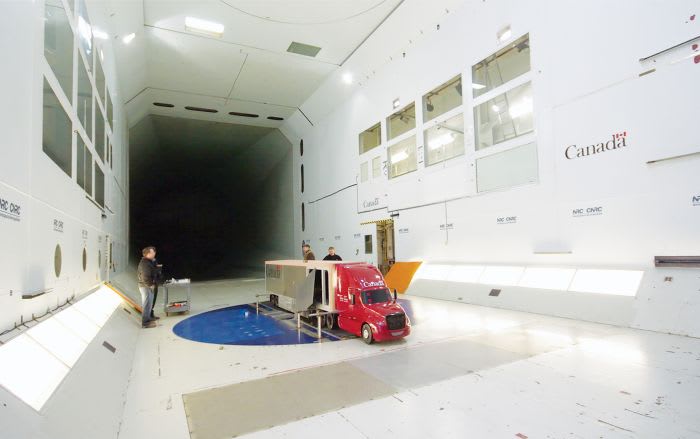
The National Research Council of Canada studied 30% scale models in its 29-foot wind tunnel. Photo: National Research Council of Canada
The National Research Council of Canada studied 30% scale models in its 29-foot wind tunnel.Photo: National Research Council of Canada
Everyone knows reducing aerodynamic drag saves fuel, but figuring out which aero devices make sense is a challenge. A multi-year Canadian study offers insight into which types of devices and combinations provide the greatest benefits.
The project was a collaboration between Transport Canada (the country’s governmental regulatory agency for transportation) and the National Research Council of Canada. The study used 30% scale model trucks in NRC’s 29-foot wind tunnel, which has a turntable to simulate crosswinds, including the type of gusts seen in real life.
The devices tested did not represent specific products. Instead, they were designed to treat the air around the vehicle in a manner similar to some commercially available products.
Wind tunnel testing cannot produce an actual fuel-used number, only a number that reflects the change in the drag coefficient of the model from one test run to another. The team, led by senior research officer Brian McAuliffe with NRC, translated that into estimated fuel savings using baseline data gathered on test tracks.
The results assume a truck traveling 77,500 miles at highway speed a year out of a 100,000 mile annual mileage. McAuliffe says manufacturers’ published fuel-savings estimates are usually based on full-time exposure to highway speed, but in real life, no truck spends 100% of its time at that speed.
“When you mix in start and stop driving, urban driving, the results will differ,” he says. “This explains why fleets hardly ever see what the manufacturers of such devices claim.”
1. Tractor-trailer gap. Up to 50 gallons of fuel per year could be saved by reducing the gap from 36 to 24 inches, the study found. Models were tested with gap widths at 24, 30, 36, 42 and 48 inches for the sleeper cab, and 24, 36 and 48 inches for the day cab. The drag coefficient increases by about 2.7% per foot of gap width for both sleeper and day-cab models.
2. Gap devices. Three devices were tested: a trailer-mounted fairing to round out the front of the trailer, and full and partial plate seals, which mount vertically at right angles to the front of the trailer. The nose fairings performed well for the sleeper-cab but were most effective with the day cab, saving up to 425 gallons of fuel annually compared to an estimated 150 gallons with the sleeper cabs. The full plate seal was effective only for the sleeper-cab. Trailer-mounted refrigeration and heater units also provide effective drag reduction, especially for day-cabs.
3. Side skirts and underbody devices. Five devices were tested, including standard, split and extended side skirts, bogie fairing, diffuser fairing and a belly box (like a drop-frame trailer). Side skirts offered the largest drag reduction, with standard and split skirts performing nearly equally, yielding fuel savings of about 750 gallons per year. Extended skirts that run the full length of the trailer outperformed standard skirts, saving about 950 gallons of fuel.
4. Trailer base treatments, boat-tail configurations. Five variations of the “boat tail” device were tested; long (48-inch) 3- and 4-panel configurations, short (24-inch 3- and 4-panel, tapered 3-panel and a covered 4-panel (similar to an inflatable device). All devices performed nearly equally, producing an estimated 500 gallons per year in fuel savings. Overall results were lower than previous research has shown; McAuliffe believes the discrepancy may result from a 3-inch vertical offset built into the NRC models to allow for visibility of the rear-header-mounted required trailer lighting. Many models commercially available instead carve out gaps for the lights.
5. Flatdecks with side skirts. Three 53-foot three-axle flatdeck variations were tested: one with no cargo, one with irregular-shaped cargo stacked to full height, and one with tube-shaped cargo representing steel wire coils or concrete pipe. Side skirts were very effective on deck-type trailers, although not as effective as on dry vans. The greatest improvement was on loads of irregularly-shaped cargo. Side skirts on flatdecks could save 425 to 750 gallons of fuel a year, depending on cargo configuration.
6. Tractor-trailer height matching. Several configurations were tested, including day-cab and sleeper tractors with and without roof treatments. Trailers were either full-height vans or half-height vans intended to approximate low flatdeck loads. Fuel use listed from worst to best:
Day cab with add-on roof deflector and half-height van: 2,650 gallons used
Day cab with no roof fairing and full height van: 1,425 gallons used
Day cab with integral roof fairing and half-height van: 1,425 gallons used
Mid-roof sleeper cab with full-height trailer: 1,475 gallons used
Mid-roof sleeper cab with half-height trailer: 250 - 952 gallons saved
7. Combinations of aero devices. Combinations tested consisted of standard and extended side-skirts, 48-inch boat-tail, trailer gap fairing and a profiled roof (the rear 10 feet was tapered downward by 6 inches, rounded top and front edges). The combination of various technologies performed better than the sums of the individual results. This suggests that there may be even more benefit to combining technologies than the individual numbers would indicate.
Extended side skirts, trailer gap fairings and boat tails used in combination provided the next best results, followed by standard side skirts on the same configuration.
More Fuel Smarts

How Volvo Updated Its D13 for EPA 2027 [Watch]
Volvo’s updated D13 promises lower emissions without sacrificing performance or fuel economy. Take a closer look at what changed inside the engine in this HDT Spotlight video.
Read More →
Diesel Price Spike Shortens Payback for Natural Gas Trucks, Report Says
Energy Vision estimates fleets could recover the higher purchase price of an RNG-fueled Class 8 tractor in 1.3 to 2.8 years under current fuel-price scenarios.
Read More →
Calstart Becomes Catalyst Mobility, Reflecting Broader Focus
Calstart is now Catalyst Mobility, reflecting the nonprofit’s growing national role in clean transportation, including zero-emission trucks, infrastructure and incentive programs.
Read More →

Record Diesel Prices Squeeze Trucking Fleets
Average U.S. diesel prices have climbed to nearly $6 a gallon, surpassing the 2022 record as tight refinery capacity and Middle East disruptions keep fuel costs elevated.
Read More →
How Fuel Delivery Shapes Engine Performance
Fuel delivery depends on more than what happens at the injector. For fleet, maintenance and technical professionals, looking at the full path from pump to injector can provide useful context for understanding engine performance.
Read More →
East Coast Port Launches $45M Electric Truck Push
The Port Authority of New York and New Jersey announced millions in incentives for zero-emission drayage trucks, yard tractors, and new charging hubs near the port.
Read More →
California Bill Could Shed Light on Electric Truck Prices
Why do battery-electric Class 8 trucks remain so expensive? A California bill headed to Gov. Gavin Newsom would give fleets and state agencies more visibility into what manufacturers charge.
Read More →
Detroit Opens Orders for EPA 2027 Engines
Detroit isn’t starting from scratch to meet EPA 2027 diesel emissions standards. Its Gen 6 DD13 and DD15 engines keep much of today’s platform while updating the fuel and aftertreatment systems.
Read More →
Zero-Emission Truck Corridor Planned for West Coast
California, Oregon, Washington, British Columbia and Baja California are coordinating plans for truck charging and hydrogen fueling from Canada to Mexico.
Read More →
A Closer Look at Kenworth’s Electric T880E Vocational Truck [Video]
Learn more about Kenworth's T880E battery-electric vocational truck at the Paccar Technical Center, including its range, applications, upfitting considerations, and PTO options, in this HDT Spotlight video.
Read More →