Customers are excited to have their freight transported via zero-emissions trucks, but at the moment they're not willing to pay more for it.
Photo: 4Gen Logistics
7 min to read
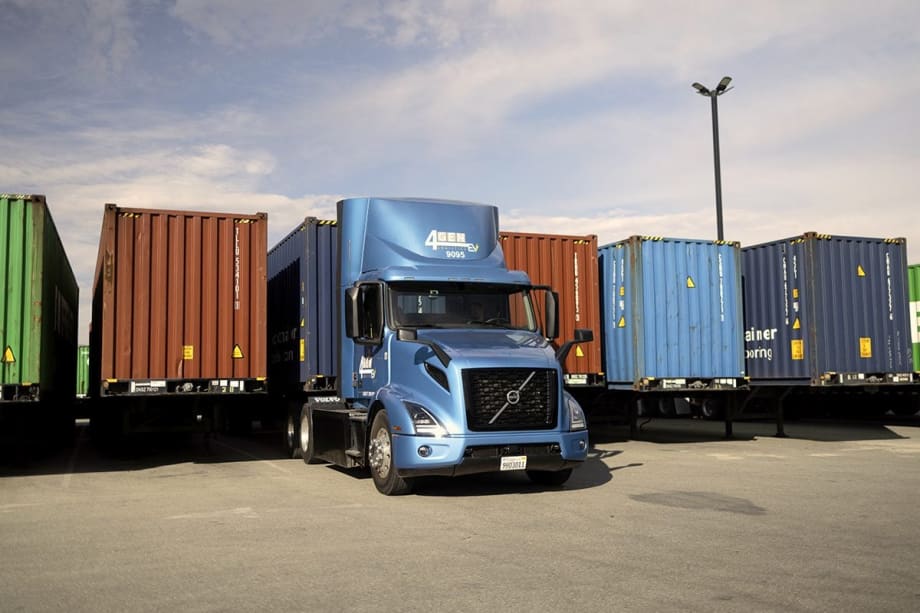
4Gen Logistics, a drayage fleet operating out of the southern California ports, had a goal of being totally zero emissions in 2025, and it looks like they are going to meet that goal.
Ad Loading...
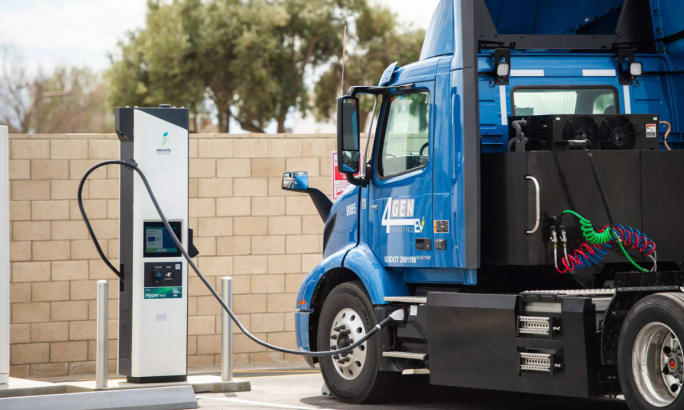
Today, it’s running 64 battery-electric trucks, and two charging infrastructure locations that have been live for nearly a year. One is at its home base in Rialto, one in its yard in the Port of Long Beach.
There were still two natural-gas-fueled trucks and two diesel trucks in the California operations at the time we talked, but the company plans to have them out of the state by the end of the year.
“It’s been probably one of the toughest, most challenging journeys that I've ever been a part of, but also the most rewarding, now that we've kind of made it through and we're up and running and adjusting to life with battery-electric versus diesels,” says Brad Bayne, VP of strategic initiatives.
Customer, he says, “are definitely very excited for us to deliver with zero-emission trucks. They're definitely not excited to pay us more to deliver with electric trucks.”
The company does have some customer specifically because they want their freight delivered with zero-emission trucks.
With freight rates down, that means 4Gen is focused on keeping costs down and operating as efficiently as possible. And that’s a new game running BEVs vs. diesels.
How Maintenance Costs on EVs Compared to Diesel Trucks?
Overall maintenance expenses are very good, without the need to maintain an internal combustion engine, Bayne says.
Ad Loading...
It’s important to maintain the coolant levels on the different systems needed for the electric trucks. And there’s the normal maintenance for brakes and other non-“engine” parts of the truck.
What is Regenerative Braking?
Regenerative braking captures the kinetic energy as the truck shows down or descends a hill. It converts that energy, which otherwise would be lost as heat using traditional brakes, into electricity to recharge the battery. The electric motor reverses its function, acting as a generator to produce power as the wheels turn it.
While it’s too soon for this to have proven out yet, Bayne is convinced that the battery-electric trucks will mean savings on brakes, thanks to the use of regenerative braking.
“We absolutely believe they will,” he says. “If you’re using the most aggressive regen braking, you ultimately hardly ever need to use the brake, unless you're coming to an absolute complete stop.”
One exception to lower maintenance costs? Tires.
Managing Tire Wear Cause by High-Torque BEVs
“We knew about this going in; [the wear on the tires] has just been a little bit more aggressive than we thought,” Bayne says.
Ad Loading...
4Gen has been able to work with Volvo to adjust the torque closer to that of diesels, which helps.
The company is rotating tires a little bit differently and “just getting as creative as we can” to try to extend the tire life.
“You know, we're never going to get 70,000 80,000 90,000 miles out of drive tires like we did on the diesels,” Bayne says. They’re focused on pushing the tire life to 30,000 or 40,000 miles.
“It’s still a big learning process because we're so early into it. But I think for the most part, we're seeing some success.”
“Just because a truck will go zero to 50 bobtailing or with a loaded trailer on the back at the same speed doesn't mean we need to do that,” he says the message is to drivers.
It’s about showing, not just telling, so drivers understand what happens when they aren’t driving correctly.
“It’s about getting them to buy in and invest in the fact that we need them to drive a certain way. And for the most part, I think our drivers are really bought into that. They kind of challenge themselves now to get the most regen energy in a day, or really focus on that one pedal driving to extend their range throughout the day.”
Electric-Truck Charging Insights
Because the price of diesel in California is high, 4Gen is saving money by using electricity. They do try to limit charging during peak time from 4-9 p.m., when it costs 51 cents a kilowatt. The fleet uses an app called Flipturn, which helps it manage its chargers and electricity costs.
Because you can’t charge an electric truck as fast as you can fill a diesel tank, running an EV fleet likely will mean making some adjustments in operations.
Ad Loading...
At 4Gen, traditionally slip-seating has been the norm. At the moment, because things are slow at the ports, that’s not a big issue, but when things get busier, it will be.
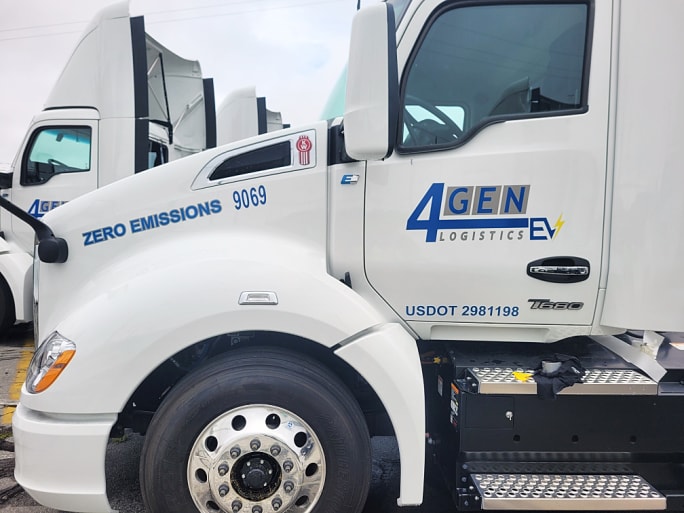
Bayne says its first-generation Kenworth trucks, which have less range and slower charging rates, are kept in the port, where they’re only doing 40 or 50 miles a day.
“They have a range, a legit range loaded of about 100 miles, but they only have a charging rate of 125 kilowatts an hour,” he explains. “The good news is that can still be done in two hours with our chargers because they're usually at 40 or 50% battery level. So that works out pretty well.”
4Gen Logistics has several Kenworth battery-electric trucks and is looking into replacing some with the new next-generation model.
Photo: 4Gen Logistics
The Volvo trucks are handling the longer drayage routes, and Bayne has had to get used to a little range anxiety.
“I get alerts all day long of guys getting to 10% or 8% battery level,” he says. “But the drivers aren’t getting range anxiety, because they’ve figured it out. They understand how far they can stretch that truck.”
Ad Loading...
In the year since 4Gen has really had the EV fleet running, Bayne says, there have been only two or three times where a driver “ran out of juice,” as he puts it. And that’s a lot better than what he had worried about going into this.
Charging Infrastructure Lessons
Bayne says 4Gen learned some valuable lessons in its first phase of installing charging infrastructure.
“You need to get your utilities involved very early on, even really before the OEM and the truck side of it,” he says.
Because this is all still so new, it’s even more important to do your due diligence when choosing the vendors and contractors you use.
For its second phase of charging, the company is going an entirely different route in how its choosing a vendor.
“There are a lot of people coming into the market,” he says, “from a construction side, from the actual charging equipment side, from the charger management software side.
“Make sure you find someone who's done big projects like you’re doing, has relationships with the utilities, and that you're able to see their work, see what they've done at other places.”
The Importance of Driver Buy-In for Fleet Electrification
When giving advice to other fleets about adopting zero-emission trucks, Bayne stresses getting the drivers involved from the beginning.
“Get them to the ride and drive events, let them understand the technology,” he says.
Ad Loading...
Over and over, he’s had longtime drivers who were very skeptical of the BEVs, but once they actually started driving the electric trucks, they don’t want to go back to driving a diesel.
Carefully research providers when setting up charging infrastructure for electric trucks.
Photo: 4Gen Logistics
Adapting Operations for EVs
When the company has to start slip-seating again, Bayne says, they’ll have to adjust first and second shift schedules to leave some charging time in between.
“The great news is the Volvos will charge up to 250, and I've actually seen rates as high as 230 going into the truck, so in theory, we need a couple of hours to get them back to where we need them to be.”
The good news, he says, is that each generation of electric trucks is improving in range and in charging time.
4Gen is building in some megawatt charging capabilities in its Phase 2 infrastructure, so that as charging capability on the trucks continues to increase, they’ll be able to take advantage of the advances.
Ad Loading...
“If we could charge a truck at a megawatt, we could slip seat all day long,” Bayne says, “Because we're probably looking at 45 minutes to get a full charge if you're all the way down to zero.
“We're making it work. We knew going in we'd have to kind of adjust the way we go about our daily business. Luckily for us, probably 80% of our loads can be delivered it on a single charge. So we're doing 150 to probably 300 miles a day”
On longer runs, he says, drivers will come back to the yard to take their 30-minute break and get in a little opportunity charging, enough to get them through the rest of the day.
In certain situations where there’s a really long run, 4Gen keeps a couple of extra trucks in Long Beach and drivers can swap out a truck where the battery’s getting low to one that’s fully charged.
“We're not as efficient as we need to be, but we'll continue to improve that every day.”
Ad Loading...
Watch Brad Bayne talk about fleet electrification on this episode of HDT Talks Trucking:
Volvo’s updated D13 promises lower emissions without sacrificing performance or fuel economy. Take a closer look at what changed inside the engine in this HDT Spotlight video.
Energy Vision estimates fleets could recover the higher purchase price of an RNG-fueled Class 8 tractor in 1.3 to 2.8 years under current fuel-price scenarios.
Calstart is now Catalyst Mobility, reflecting the nonprofit’s growing national role in clean transportation, including zero-emission trucks, infrastructure and incentive programs.
Average U.S. diesel prices have climbed to nearly $6 a gallon, surpassing the 2022 record as tight refinery capacity and Middle East disruptions keep fuel costs elevated.
Fuel delivery depends on more than what happens at the injector. For fleet, maintenance and technical professionals, looking at the full path from pump to injector can provide useful context for understanding engine performance.
The Port Authority of New York and New Jersey announced millions in incentives for zero-emission drayage trucks, yard tractors, and new charging hubs near the port.
Why do battery-electric Class 8 trucks remain so expensive? A California bill headed to Gov. Gavin Newsom would give fleets and state agencies more visibility into what manufacturers charge.
Detroit isn’t starting from scratch to meet EPA 2027 diesel emissions standards. Its Gen 6 DD13 and DD15 engines keep much of today’s platform while updating the fuel and aftertreatment systems.
California, Oregon, Washington, British Columbia and Baja California are coordinating plans for truck charging and hydrogen fueling from Canada to Mexico.
Learn more about Kenworth's T880E battery-electric vocational truck at the Paccar Technical Center, including its range, applications, upfitting considerations, and PTO options, in this HDT Spotlight video.