




Megawatt Charging System for Electric Trucks a Step Closer
The United States and the European Union agreed to “a shared vision on a standard for charging electric heavy-duty vehicles,” during the recent meeting of the Trade and Technology Council in Sweden.

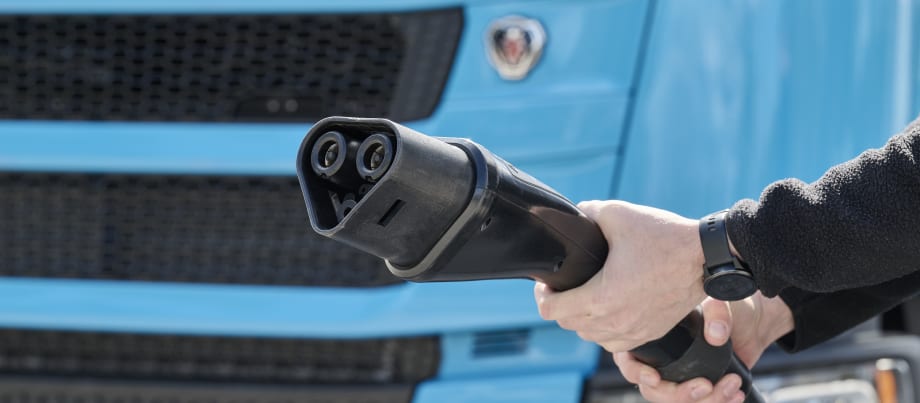
A next-generation electric Scania truck completed its first charging test with a pilot Megawatt Charging System (MCS) from ABB E-mobility.
Photo: Scania
An international high-speed charging standard for heavy-duty electric trucks is a step closer to reality.
The United States and the European Union agreed to “a shared vision on a standard for charging electric heavy-duty vehicles,” during the recent meeting of the Trade and Technology Council in Sweden.
In a White House statement outlining this and other accomplishments at the TTC meeting, the administration said the agreement includes recommendations from a longstanding collaboration between the EU’s Joint Research Centre and the U.S. Department of Energy’s Argonne National Laboratory.
“We recognize the Megawatt Charging System (MCS) adoption by IEC, SAE and ISO for the charging of electric heavy-duty vehicles, where the alignment of our approaches to standardization will be critical for the roll-out of dedicated recharging infrastructure,” said the White House statement.
Both sides applaud efforts toward compatibility of physical connectors (plugs) and a common vehicle-to-grid communication interface for all power levels, they said, “recognizing that additional solutions may be possible among private sector operators.”
The U.S. and EU said they will continue to work together to develop a transatlantic test procedure for high power-charging, up to MCS levels, assuring interoperability and system charge performance.
“During our meeting in Luleå, we displayed the MCS physical connector as well as a truck and recharging station — a visible proof of this success,” the White House statement said, nothing that this cooperation also paves the way for possible MCS applications in inland shipping, marine, mining, and aviation sectors, among others.
A few weeks ago, Scania announced it had successfully installed and tested a pilot MCS from ABB E-mobility, noting the technology will cut charging time for heavy-duty vehicles in half.
The initial testing, to prove the technical viability of high current charging, is a step toward the progressive deployment of high-power chargers. This is a charging standard that Scania and ABB E-mobility have been developing in collaboration with CharIN (Charging Interface Initiative), a German-based non-profit charging initiative.
More Fuel Smarts

How Volvo Updated Its D13 for EPA 2027 [Watch]
Volvo’s updated D13 promises lower emissions without sacrificing performance or fuel economy. Take a closer look at what changed inside the engine in this HDT Spotlight video.
Read More →
Diesel Price Spike Shortens Payback for Natural Gas Trucks, Report Says
Energy Vision estimates fleets could recover the higher purchase price of an RNG-fueled Class 8 tractor in 1.3 to 2.8 years under current fuel-price scenarios.
Read More →
Calstart Becomes Catalyst Mobility, Reflecting Broader Focus
Calstart is now Catalyst Mobility, reflecting the nonprofit’s growing national role in clean transportation, including zero-emission trucks, infrastructure and incentive programs.
Read More →

Record Diesel Prices Squeeze Trucking Fleets
Average U.S. diesel prices have climbed to nearly $6 a gallon, surpassing the 2022 record as tight refinery capacity and Middle East disruptions keep fuel costs elevated.
Read More →
How Fuel Delivery Shapes Engine Performance
Fuel delivery depends on more than what happens at the injector. For fleet, maintenance and technical professionals, looking at the full path from pump to injector can provide useful context for understanding engine performance.
Read More →
East Coast Port Launches $45M Electric Truck Push
The Port Authority of New York and New Jersey announced millions in incentives for zero-emission drayage trucks, yard tractors, and new charging hubs near the port.
Read More →
California Bill Could Shed Light on Electric Truck Prices
Why do battery-electric Class 8 trucks remain so expensive? A California bill headed to Gov. Gavin Newsom would give fleets and state agencies more visibility into what manufacturers charge.
Read More →
Detroit Opens Orders for EPA 2027 Engines
Detroit isn’t starting from scratch to meet EPA 2027 diesel emissions standards. Its Gen 6 DD13 and DD15 engines keep much of today’s platform while updating the fuel and aftertreatment systems.
Read More →
Zero-Emission Truck Corridor Planned for West Coast
California, Oregon, Washington, British Columbia and Baja California are coordinating plans for truck charging and hydrogen fueling from Canada to Mexico.
Read More →
A Closer Look at Kenworth’s Electric T880E Vocational Truck [Video]
Learn more about Kenworth's T880E battery-electric vocational truck at the Paccar Technical Center, including its range, applications, upfitting considerations, and PTO options, in this HDT Spotlight video.
Read More →