




Q&A: Forum Mobility’s Matt Schrap on Helping Drayage Fleets Transition to Electric Trucks
The former Harbor Trucking Association CEO explains why he joined Forum Mobility and how the drayage fleets he's advocated for can navigate California’s zero-emission future.

Matt Schrap said he'll continue to advocate for truckers and making ZEVs work in the real world in his new position at Forum Mobility.
Image: HDT Graphic
Matt Schrap, who has been working with drayage fleets in California as the CEO of the Harbor Trucking Association, is taking his knowledge of the challenges those trucking companies face into a new position at electric truck charging supplier Forum Mobility.
Schrap is Forum Mobility’s new chief commercial officer. He brings decades of experience in trucking, supply chain, and industry advocacy to the company, including a previous stint at the California Trucking Association.
Forum Mobility is developing a comprehensive network of dedicated electric-vehicle charging depots in key freight corridors and port-adjacent locations. These facilities are designed to provide seamless access to charging for carriers of all sizes.
In his new role, Schrap will oversee commercial strategy, customer partnerships, and fleet transition initiatives, helping operators cost-effectively deploy advanced technology.
“I’ve spent my career advocating for truckers and working to ensure they have the tools they need to succeed,” said Schrap in a news release.
We caught up with Schrap to talk about his new role and the challenges faced by drayage fleets in California, especially given the rapidly shifting regulatory landscape.
The following Q&A has been edited for length and clarity. Keep an eye out for the full interview on the HDT Talks Trucking video podcast.
Deborah Lockridge: Let's talk a little bit about what Forum Mobility does. I know it's electric truck charging infrastructure.
Matt Schrap: Well, I think that you probably used the most appropriate description. They build heavy-duty vehicle charging infrastructure.
And while the company also offers what's known as trucks as a service, where you have a low monthly lease payment for a truck that then charges at the facility, the main focus of Forum has and will remain to be building infrastructure and providing solutions for motor carriers who are looking to make the transition into battery-electric heavy duty Class 8.
Lockridge: You spent years at the Harbor Trucking Association advocating for drayage truckers, many of whom have been trying to adapt to electrification. What made you decide to join Forum Mobility?
Schrap: When I first met the team over at Forum, around four years ago while I was at the HTA, I was immediately impressed with their ability to understand the challenges that motor carriers are going through.
The regulatory policy was pushing [fleets] in a direction that, many at the time were kind of going kicking and screaming, for lack of a better way to put it.
The technology was still evolving. There wasn't a lot of infrastructure in the ground. There were cost concerns about the vehicle, there were other larger legal concerns of whether the reg was actually enforceable in the first place — and subsequently, with the waiver being pulled, it's not.
Suffice it to say, all that uncertainty gave fleets a lot of consternation about moving forward in this transition [to zero-emission trucks].
Forum Mobility, while they're not alone in this space, struck me as a group that was really focused on the needs of the fleet operator. It wasn't being couched in, “We're saving the planet,” or telling fleets that they're part of the problem so they need to be part of the solution.
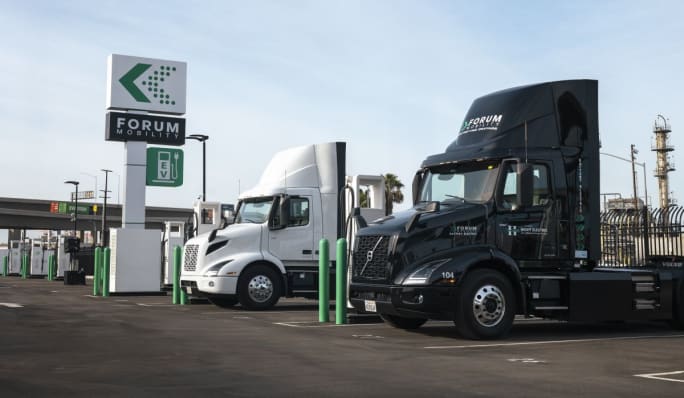
Earlier this year, Forum Mobility opened a port-based electric truck charging depot at the Port of Long Beach.
Photo: Kevin Krause for Forum Mobility
It was more, the transition needs to be sustainable. Fleets need to be able to make money to survive.
I thought [the Forum Mobility position] was a good opportunity, because fleets still need help out there. And I'm going to be able to help Forum understand even further and appreciate what trucking fleets are going through on a daily basis. And to continue to advocate for them, for sound, sustainable policies, on every level as much as I can.
I'll just be wearing a little bit of a different hat doing it.
Trucking's Unprecedented Emissions Regulatory Environment
Lockridge: It's an interesting time to be in this space, with all the back and forth about emissions regulations with the Trump administration's EPA and California. What are your thoughts there?
Schrap: It's exciting. On the one hand, I've been doing this in the air quality regulatory space for 20 years. Never would I have thought that there would be an environment like the one that we're existing in with so much pushback on [California Air Resources Board] rules.
And so it's interesting to watch this happen from a public policy standpoint. It's unprecedented on many levels.
But I think it's clear that California has been, and will remain, committed to the [ZEV] transition. They have a lot of their own money they're able to use for incentives.
Right now, we’re in a place where the market is truly going to have to drive this transition. If the truck has a positive TCO [total cost of ownership], if it works better for the fleet operator, if they're able to operate more efficiently, they're going to naturally adopt it.
You don't need a regulation to get people to get into technology that's going to save them money at the end of the day.
[Even with the revoked EPA waivers for Advanced Clean Trucks and the NOX regulations], there are other things that [California] can do that are still at their disposal. So those local levers combined with the incentive money that's out there, I still think that there's a good opportunity.
Regardless of what happens on the federal level in DC, it is not going to change California's mind about the overall direction they want to go. And sometimes what happens in federal, emboldens California to even go further. That they're going to work even harder to try to drive this transition by all means necessary.
Lockridge: It definitely seems like California’s attitude is, “We're going to do this one way or another.” So on that TCO, that affordability for fleets, are we getting any better with that?
Schrap: Technology is evolving.
Before, it was, “There's not enough [charging] infrastructure.” Now that the infrastructure is coming online, we have an opportunity to say, now we need to address the challenges with the truck, which is cost, weight, and range.
There are more models coming in, and you know, the Tesla Semi is a real thing.
I think back in 2017, there were a lot of high expectations. People put deposits down [on the Semi], and they were waiting on this vehicle to show up. It's taken a little bit of time to get to this point, but they are on the verge of being able to deliver this equipment.
And from what we've seen so far, it has a much greater range than some of the existing traditional OEMs that are in this space, and a cost that is significantly less than some of the other OEMs that are in the marketplace.
I was skeptical, but you're going to see maintenance savings because there are just less moving parts. And depending on when you're charging and how you're managing your fuel usage, you can see a cheaper fuel usage rate when compared to diesel, especially as fuel taxes are continually increasing.
There's a lot of things going on right now. But the technology has evolved to point of when you have major OEMs investing hundreds of millions of dollars and assembly lines, you know they’re serious.
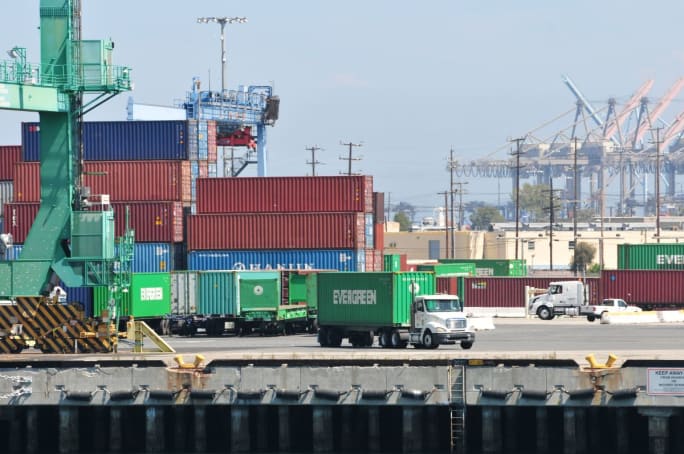
Schrap suggests that California and its container ports may shift to some non-regulatory strategies to achieve its ZEV goals, such as giving ZEV operators some benefits to help deal with congestion at the ports.
Photo: Port of Long Beach
I will say Tesla is very serious. They aren't just hauling potato chips and empty soda cans like folks have been trying to allege for the past eight years. They've been doing a lot of R&D. So when that truck enters the marketplace. I really think that it's going to be a game-changer. It is going to provide an opportunity to bring down that overall TCO that's going to get much closer to, if not beat diesel.
So the technological evolution is true. It's real. And I think we're going to start seeing the fruits of that here very soon.
Drayage And Electric Trucks
Lockridge: Drayage is one of the more practical use cases for electric trucks, right?
Schrap: It is. Not every single lane of drayage; it’s not going to work blanket across every part. But for those where it does work, It works very well. We've heard that from our members at HTA who have been some of the biggest proponents for this.
When you sprinkle all the incentive money from the state of California's incentive programs, when you start putting that in, you're seeing a pretty positive TCO curve.
But incentives aren't going to last forever. We need to get those overall truck prices to come down.
We've seen a lot of people make that first step into this equipment and are finding that it's better than they had anticipated.
You know, I've been complaining about the lack of infrastructure for so long; now finally I'm in an opportunity where I get to help do something about it.
Lockridge: So when a small drayage carrier tells you, “I can't afford it. I can't do this.” What do you tell them?
Schrap: We start asking questions about their operations. Some people don't even know what their cost per mile is. They're just out there hustling, load to load, moving the American economy.
So we start asking questions about, what are your operational costs? What are your inputs that are going into keeping that truck on the road every single day? And as we start drilling down, we can show them that, especially when you include incentives, you’re seeing a more positive return than you would if you were to stay in that diesel.
The initial cost of entry seems a little bit higher, but once you start getting into it, running the truck and becoming used to it, people are experiencing positive TCO, better than they would if they were burning diesel.
It takes somebody with a little bit of intestinal fortitude to take that first step. No one wants to be that very first person in the small fleet world. But the more and more people start operating it, they're going to see that battery-electric heavy-duty vehicles, they can work.
I’ve never said the technology doesn't work. It can do the job. It's got the torque. It has the towing capacity. There's some need for better range, and we need some faster charging times, but those things are right on the horizon, with MCS Megawatt charging standard and battery chemistry technology evolving.
We’ll continue to see these costs go down. Maybe not as fast as the California Air Resources Board would have liked it, but they are headed in the right direction.
So, we have those conversations with small fleets, really trying to show them the pathway to understanding their own costs and how a battery-electric vehicle can help offset the increased costs of operating internal combustion engines, and why it potentially is a better pathway for them in their business.
Still Advocating For Trucking
Lockridge: You're obviously very passionate about the trucking drayage business, and you know all these ins and outs. Is it going to be hard to step away from that?
Schrap: Well, having this insider info, I think, is going to just serve us all better on the Forum team for having our team members really understand these challenges.
And how is an electric truck going to help with any of that?
Maybe there's green lanes into the terminals. We've got one in LA/Long Beach in the APM terminal here, Pier 400. They do a pretty good clip of zero emission vehicles, and the folks who use the ZEV lanes, obviously, they love the ZEV lanes.
There's also been talk about appointment exemptions. Now that means you still have to make an appointment, but if you got a ZEV, maybe you get an allocation of X amount of free appointments for that truck each month or each week.
So if I have an electric vehicle, when I get my container availability and they're like, you can't get an appointment for another four days, I'm going to use my ZEV card and play that so that I can get an appointment perhaps the next day.
Lockridge: So those are some examples of how the ports can incentivize zero emissions without the regulations. The carrot rather than the stick.
Schrap: Exactly.
So yeah, I'll miss this stuff a little bit, but we'll remain involved. The more we know, the better positioned we'll be to have those conversations, to talk fleets through why the transition [to electric] can make sense for their operations.
If it doesn't make sense, there's no reason to try to convince a fleet if it doesn't work for their job, for their vocation. But if it works, understanding their challenges, I think, is going to go a long way.
More Fuel Smarts

How Volvo Updated Its D13 for EPA 2027 [Watch]
Volvo’s updated D13 promises lower emissions without sacrificing performance or fuel economy. Take a closer look at what changed inside the engine in this HDT Spotlight video.
Read More →
Diesel Price Spike Shortens Payback for Natural Gas Trucks, Report Says
Energy Vision estimates fleets could recover the higher purchase price of an RNG-fueled Class 8 tractor in 1.3 to 2.8 years under current fuel-price scenarios.
Read More →
Calstart Becomes Catalyst Mobility, Reflecting Broader Focus
Calstart is now Catalyst Mobility, reflecting the nonprofit’s growing national role in clean transportation, including zero-emission trucks, infrastructure and incentive programs.
Read More →

Record Diesel Prices Squeeze Trucking Fleets
Average U.S. diesel prices have climbed to nearly $6 a gallon, surpassing the 2022 record as tight refinery capacity and Middle East disruptions keep fuel costs elevated.
Read More →
How Fuel Delivery Shapes Engine Performance
Fuel delivery depends on more than what happens at the injector. For fleet, maintenance and technical professionals, looking at the full path from pump to injector can provide useful context for understanding engine performance.
Read More →
East Coast Port Launches $45M Electric Truck Push
The Port Authority of New York and New Jersey announced millions in incentives for zero-emission drayage trucks, yard tractors, and new charging hubs near the port.
Read More →
California Bill Could Shed Light on Electric Truck Prices
Why do battery-electric Class 8 trucks remain so expensive? A California bill headed to Gov. Gavin Newsom would give fleets and state agencies more visibility into what manufacturers charge.
Read More →
Detroit Opens Orders for EPA 2027 Engines
Detroit isn’t starting from scratch to meet EPA 2027 diesel emissions standards. Its Gen 6 DD13 and DD15 engines keep much of today’s platform while updating the fuel and aftertreatment systems.
Read More →
Zero-Emission Truck Corridor Planned for West Coast
California, Oregon, Washington, British Columbia and Baja California are coordinating plans for truck charging and hydrogen fueling from Canada to Mexico.
Read More →
A Closer Look at Kenworth’s Electric T880E Vocational Truck [Video]
Learn more about Kenworth's T880E battery-electric vocational truck at the Paccar Technical Center, including its range, applications, upfitting considerations, and PTO options, in this HDT Spotlight video.
Read More →