




Newsom Vetoes California Autonomous Truck Bill
California Gov. Gavin Newsome vetoed Assembly Bill 316, which would have banned driverless autonomous trucks over 10,000 pounds from California roads.

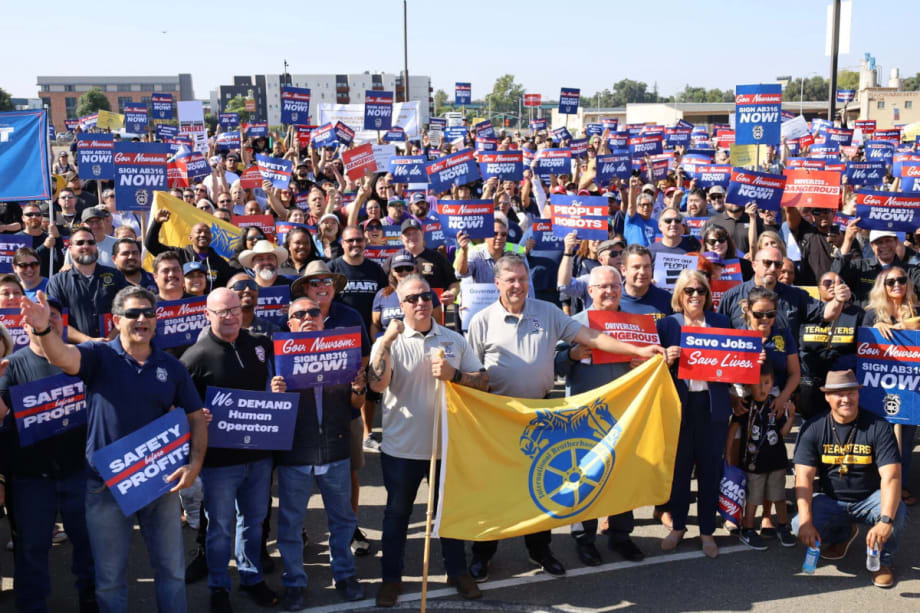
Teamsters and others last week marched on the California Capitol urging the governor to sign AB 316, which he later vetoed.
Photo: Teamsters
California Gov. Gavin Newsome vetoed Assembly Bill 316, which would have banned driverless autonomous trucks over 10,000 pounds from California roads. He said the regulation was unnecessary and existing laws provide sufficient authority for oversight and regulatory framework.
Shortly before Newsom vetoed the bill, the Teamsters released a statement demanding he sign the bill into law. Just days earlier, a large group of Teamsters and others marched on the California Capitol to voice support for the bill that would have prevented further driverless trucking in the state.
“I’m here today because Gavin Newsom has signaled his intent to turn his back on the safety of 39 million Californians and veto AB 316, not only putting every California driver in danger, but opening big tech to eliminating hundreds of thousands of jobs,” said Mike Di Bene, a member of Teamsters Local 70 in Oakland. “AB 316 is the least we must do.”
“He is sending a message to California and every state in this country that technology should overrule middle-class jobs,” said Teamsters General President Sean M. O’Brien.
Autonomous Trucking Regulation
A statement from Newsom explained that in 2012, the California Legislature gave the Department of Motor Vehicles the authority to regulate the testing and deployment of autonomous vehicles on public roads in California.
As part of its oversight and regulatory responsibilities, the DMV consults with the California Highway Patrol, the National Highway Traffic Safety Administration, and others with relevant expertise to determine the regulations necessary for the safe operation of autonomous vehicles on public roads, he said.
The department monitors the testing and operations of autonomous vehicles on California roads and has the authority to suspend or revoke permits to protect public safety.
Evolving Technology
The governor’s statement added that autonomous vehicle technology is evolving and the DMV remains committed to keeping the state's autonomous vehicle rules up to date to reflect continued development in California. According to the governor, the DMV held public workshops with interested stakeholders earlier this year to gather information to help in in the development of future rulemakings for both light-duty and heavy-duty autonomous vehicles.
“This rulemaking will be a transparent, public process where subject matter experts and other stakeholders will have the opportunities to shape the regulations related to the safe operations of autonomous vehicles in California. The draft regulations are expected to be released for public comment in the coming months,” said Newsom in the statement.
Employment Impact
Newsome said his administration is not just focused on safety, but also on jobs and how they may be impacted by technology. In 2019 his administration started a Future of Work Task Force, which includes labor leaders from the Teamsters, United Food and Commercial Workers International Union, and the Service Employees International Union. As a result of that group’s efforts, the state prepared a report on emerging technology and how it impacts on California's workforce.
“I am committed to incentivizing career pathways and training for the necessary workforce specifically associated with this technology,” said Newsom. “As such, I am directing the Labor and Workforce Development Agency to lead a stakeholder process next year to review and develop recommendations to mitigate the potential employment impact of testing and deployment of autonomous heavy-duty vehicles.”
Lorena Gonzalez, California Labor Federation executive secretary-treasurer, voiced support for the bill’s passage prior to Newsom’s veto.
“This is about the future of work, and I am tired of people talking about the future of work without talking about the future of workers,” said Gonzalez. “Big tech continues to say, ‘We’re going to make life more efficient.’ No. You’re going to make your life more profitable.”
More Fleet Management

Color Match Smarter: Tools That Restore & Perform
For fleet managers and collision repair professionals keeping heavy-duty trucks on the road, getting the color right the first time isn't just about appearance — it's about efficiency, turnaround time, and bottom-line results. Discover how today's digital color tools are transforming the repair process from guesswork to precision.
Read More →
FMCSA Pauses Biennial-Update Enforcement Amid Motus Transition
Carriers whose updates were due on or after June 1 have more time, while FMCSA works to stabilize its new registration system and warns of phishing sites impersonating its new carrier registration system, Motus.
Read More →
2026 Blueprint for Countering Smarter Supply Chain Theft
Cargo theft is no longer just the cost of doing business. It's a multi-billion-dollar criminal enterprise exploiting vulnerabilities across your fleet, drivers, and supply chain.
Read More →


How Telematics Improves Visibility, Control, and Performance in Refrigerated Fleets
Explore how telematics help refrigerated fleets improve visibility, uptime, efficiency, compliance, and cargo protection across connected cold chain operations.
Read More →
What the U.S.-Canada Trade War Means for Trucking
Escalating U.S.-Canada tariffs could disrupt cross-border freight, reduce truck volumes, raise costs, and create new uncertainty for carriers on both sides of the border.
Read More →
What Are Trucking’s Top Concerns for 2026?
The American Transportation Research Institute wants to know what's worrying trucking fleet managers, drivers, and other stakeholders in its annual Industry Issues survey.
Read More →
American Trucking Associations Looks for a New Leader
ATA President and CEO Chris Spear abruptly left his job at the association on August 21, at a pivotal time for the trucking industry.
Read More →
Public Wi-Fi Cybersecurity Risks: How Truck Drivers and Fleets Can Protect Their Data
Public Wi-Fi can expose truck drivers and fleets to credential theft, malware, and other cyber threats. Here’s how to reduce the risk on the road.
Read More →
For Nicky Cupp, Fleet Innovation Starts With Frustration
HDT Truck Fleet Innovator Nicky Cupp turns everyday pain points at Fraley & Schilling into opportunities for better technology and smarter processes.
Read More →
Adam Buttgenbach’s Approach to Electric Trucks: Start With Where They Fit
HDT Truck Fleet Innovator Adam Buttgenbach helped PepsiCo build one of North America’s largest EV fleets by focusing on where electric trucks make operational sense.
Read More →