





Why Volvo Thinks the U.S. Truck Market is at a 'Tipping Point.'
Volvo’s Quiet Confidence Turns into a Full-Throated Bet on the Future
After years of steady, methodical progress, Peter Voorhoeve says the OEM’s latest lineup isn’t just evolutionary. It’s delivering real, measurable gains for fleets right now.
April 6, 2026

Peter Voorhoeve, president, Volvo Trucks North America, says the OEM's long-term commitment to build safe, fuel-efficient and connected trucks is paying fleets big dividends just when they need them the most.
Credit:
Jack Roberts
6 min to read
For a company long known for its understated demeanor, Volvo Trucks North America is starting to sound a little different these days.
The executive conference room at the Volvo Customer Center in Dublin, Virginia overlooks the extensive test track looping around the back of the facility. The room is gleaming white-on-white and exudes a quiet confidence very much in line with Volvo’s North American posturing these days.
I was there to talk Peter Voorhoeve, president of Volvo Trucks North America. And I was barely settled in before he made it clear that Volvo believes it has timed the development of its product and technology portfolio just right on multiple fronts.
For decades now, Volvo has worked continuously to stake out leadership positions in safety,connectivity, fuel economy and driver comfort.
And now, it seems times have finally caught up with its efforts.
Fuel Economy That Actually Moves the Needle
Voorhoeve doesn’t waste much time getting to what matters most to fleets right now: money.
Thanks to the war with Iran, fuel prices are surging. At the same time, North American carriers are increasingly realizing they simply must replace older trucks that are becoming increasingly expensive to maintain.
And for Voorhoeve, that means, specifically, how quickly can a new truck start putting more money back into a carrier’s pocket?
“With the new VNL, we’re seeing about 10% improvement in fuel efficiency,” he noted. “If you’re running 120,000 miles a year at around $3.50 diesel, that’s roughly $3,500 to $4,000 annually. That’s $300 to $400 a month.”
And with diesel prices climbing again, the math gets even more compelling.
“At $5.50 diesel, you can almost double that,” he added. “That’s not just nice to have. It’s essential for your business.
Fuel represents roughly a quarter of a fleet’s operating cost, Voorhoeve noted. Improve that by 10%, and suddenly you’re talking about a 2.5% to 3% swing in profitability. That’s a move that can double margins for many carriers operating in today’s razor-thin environment.
“That’s what customers are telling us,” Voorhoeve said. “We have about 16,000 of the new VNLs already on the road. And across that sample, the 10% fuel economy average is holding steady.”
A Brand Finding Its Swagger
For longtime observers, the shift at Volvo feels noticeable.
There’s a bit more energy. A bit more willingness to lean into what the company believes it does well.
“Yes, we feel that,” he said. “But change is always difficult. Some customers told us, ‘We never asked for a new VNL. The old one was great.’ And we say, ‘We understand. But we also made it better.’”
That “better” goes beyond fuel economy.
It’s about rethinking the truck as a platform for what’s coming next. And that’s particularly true for the truck’s safety systems and electrical architecture.
The move from 12-volt to 24-volt electrical systems, for example, raised some eyebrows.
“People ask, ‘Why would you do that?’” Voorhoeve said. “But if you want more safety -- more cameras, more sensors, more communication -- you need more power. And that requires a different architecture.”
In other words, Voorhoeve said Volvo isn’t just developing technology and vehicle systems for today’s trucks. It’s setting the stage for what trucks will need to become in the future.
Safety: From Philosophy to Financial Imperative
If there’s one area where Volvo has never wavered, it’s safety.
Safety is central to Volvo’s origin story.
And for decades, the company has pushed advanced safety systems -- sometimes ahead of what North American fleets were ready to embrace.
Now, the market has caught up.
Or more accurately, the courtroom has forced it to.
“With nuclear verdicts, safety has become a serious business case for our customers,” Voorhoeve acknowledged. “But that was never our starting point.”
Instead, he pointed to a principle deeply embedded in Volvo’s culture:
“Everybody has the right to go home the same way they came to work,” he said. “We at Volvo have always believed that. That is not just a slogan for us.”
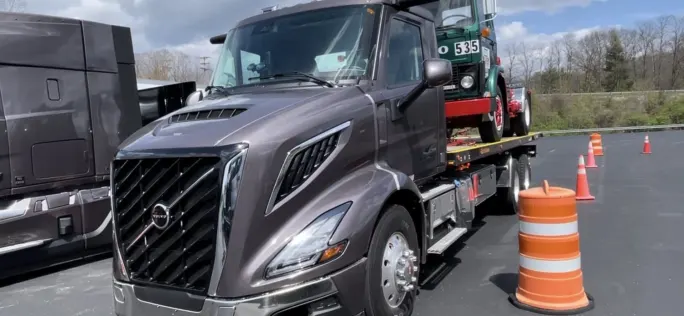
A new Volvo VNR carries the first-ever Volvo truck built at the New River Valley manufacturing plant around Customer Center test track.
Credit:
Jack Roberts
That philosophy applies to drivers, technicians, and increasingly, everyone sharing the road with a commercial vehicle.
But today, there’s a second layer.
Fail to spec available safety systems such as blind-spot monitoring, pedestrian detection, advanced driver assistance, and fleets risk more than accidents. They risk catastrophic legal exposure.
“Now you see CFOs becoming interested in trucks,” Voorhoeve said with a slight smile. “It’s a telling shift. Safety is no longer just an operational or ethical decision. It’s a financial one.”
And Volvo, having invested heavily in proprietary safety systems for years, finds itself well-positioned to provide carriers with advanced solutions to meet this problem head-on.
A Bigger Play in Vocational
In North America, Volvo is primarily known for its long- and regional-haul trucks.
Which, Voorhoeve admits, is a little frustrating for the OEM.
Because in Europe, the Middle East and South America, Volvo is acknowledged as a long-time leader in tough, capable vocational trucks.
But that’s about to change, Voorhoeve said.
“In Europe, we have about 30% of the construction segment,” he noted. “We’re very strong there.”
At TMC in March, Volvo teased the launch of a new VNX vocational truck later this year. And Voorhoeve has high hopes for the new heavy haul/vocational model.
“With the new platform coming, we will significantly increase our vocational position,” he said. “The VHD had a niche. Our vocational presence will soon become much wider. We’ll be offering both tractors and straight trucks for tough vocational applications.”
And Volvo has another advantage most OEMs can’t match, Voorhoeve noted: Vertical integration within the global Volvo Group. And that includes Volvo Construction Equipment’s line of yellow iron.
“We already work closely with Volvo Construction Equipment,” Voorhoeve said. “You’ll see more integration there, soon.”
That could mean tighter coordination between trucks and jobsite equipment, shared technology platforms, and potentially more efficient workflows in construction environments, he added.
A Market That Can’t Catch a Break
Of course, all of this is unfolding against a frustrating backdrop for the industry.
Freight demand has been inconsistent. Rates have been under pressure. And just as the market shows signs of life, something else seems to knock it back down.
In many ways, I told Voorhoeve, it feels like this industry is trying to shake off the freight recession. And it just can’t catch a break.
Voorhoeve didn’t disagree.
“This cycle has been different,” he said. “Normally, when demand drops, capacity follows. Trucks exit the market, restoring balance. But that didn’t happen this time.
In Voorhoeve’s view, two key factors disrupted the usual truck replacement cycle:
First, fleets that bought trucks at peak prices in 2022 and 2023 often financed them. When the market softened, lenders were reluctant to repossess assets with large valuation gaps. Instead, they restructured loans.
Second, those same operators kept running -- sometimes at rates that undercut the market.
“They drive on a price that kills the price for others,” Voorhoeve said. “And that leads to very low profitability across the board.”
Recently, though, he said there are signs of correction coming.
Regulatory changes affecting non-domiciled CDL drivers have reduced capacity. Rates are beginning to firm back up.
“We don’t see volumes going up that much,” he said. “But at least rates are becoming healthier.”
And there’s another inevitable force at play: Aging truck fleets.
“Most first owners run a truck for five years,” Voorhoeve said. “Maybe six or seven. But at some point, maintenance costs go up, uptime goes down, and it’s time to replace it.”
The desire to buy is there, now, he noted.
“The question is, can they?” he asked.
As rates improve, Voorhoeve believes that the answer is increasingly becoming yes.
And he feels Volvo is well-positioned to meet carriers with new trucks, fuel economy, safety, driver comfort and connectivity when they are ready to invest in the future.
More Fleet Management

How MFA Helps Protect Trucking Fleets
Multi-factor authentication adds protection when passwords are stolen. Here’s how it works and where fleets should start.
Read More →
How Better Freight Data Helps Trucking Teams Get Ahead of Disruption
Trucking and logistics teams have plenty of data. The problem is getting the right information in front of the right people soon enough to act. Better-connected data can help teams spot trouble earlier and make smarter decisions before small problems become big ones.
Read More →
Trimble: Taking Artificial Intelligence in Trucking Beyond Faster Tasks
At Insight 2026, Trimble executives argued that fleets may need to redesign workflows to get more from AI as it introduced new products and enhancements. AI’s value will depend on how fleets combine automation with their people's knowledge.
Read More →


Nominations Open for HDT Emerging Leaders
Heavy Duty Trucking is looking for accomplished trucking fleet professionals under 40 who are making an impact and helping lead the industry forward.
Read More →
Why Private Fleets Are Taking More Freight
Private fleets are putting their own trucks on demanding customers and high-cost lanes as companies seek greater control over service, costs, and capacity.
Read More →
Sponsored•September 16, 2026
Color Match Smarter: Tools That Restore & Perform
For fleet managers and collision repair professionals keeping heavy-duty trucks on the road, getting the color right the first time isn't just about appearance — it's about efficiency, turnaround time, and bottom-line results. Discover how today's digital color tools are transforming the repair process from guesswork to precision.
Read More →
FMCSA Pauses Biennial-Update Enforcement Amid Motus Transition
Carriers whose updates were due on or after June 1 have more time, while FMCSA works to stabilize its new registration system and warns of phishing sites impersonating its new carrier registration system, Motus.
Read More →
Sponsored•September 14, 2026
2026 Blueprint for Countering Smarter Supply Chain Theft
Cargo theft is no longer just the cost of doing business. It's a multi-billion-dollar criminal enterprise exploiting vulnerabilities across your fleet, drivers, and supply chain.
Read More →
Sponsored•September 1, 2026
How Telematics Improves Visibility, Control, and Performance in Refrigerated Fleets
Explore how telematics help refrigerated fleets improve visibility, uptime, efficiency, compliance, and cargo protection across connected cold chain operations.
Read More →
What the U.S.-Canada Trade War Means for Trucking
Escalating U.S.-Canada tariffs could disrupt cross-border freight, reduce truck volumes, raise costs, and create new uncertainty for carriers on both sides of the border.
Read More →