





Why Volvo Sees Autonomous Trucks as an All-New Transportation Mode
Volvo Teases Next-Gen VNX as Platform Expansion Continues at TMC
Volvo Trucks North America highlighted new connectivity, safety tech and production investments at TMC. The OEM also signaled that a new heavy-haul flagship tractor is coming soon.
March 18, 2026

Magnus Koeck, vice president, Volvo Trucks North America, announced a new VNX model truck coming later this year.
Credit:
Jack Roberts
4 min to read
Volvo Trucks North America used its Technology & Maintenance Council (TMC) press conference to recap a sweeping, two-year product and investment cycle.
But tucked into the updates was a clear signal of what’s coming next: a new VNX model aimed at the heavy-haul segment, expected to debut later this year.
While much of the presentation revisited the rollout of Volvo’s new platform underpinning the recently launched VNL and VNR models, executives pointed to the upcoming VNX as the next major step in extending that architecture across the lineup.
“We’re in the midst of more than $2 billion in product investments,” said Magnus Koeck, vice president of strategy, marketing and brand management. “And we’re not done.”
VNX Tease Signals Expansion into Heavy-Haul
Volvo stopped short of providing specifications or timing details. However, the confirmation of a next-generation VNX suggests the OEM is preparing to bring its new vehicle platform -- first introduced with the long-haul VNL-- into vocational and heavy-haul applications.
That move would align with Volvo’s broader strategy of standardizing architecture across segments to deliver gains in fuel efficiency, safety, and uptime.
The current VNX, designed for severe-duty and heavy-haul operations, has not yet been updated alongside the VNL and VNR.
A redesigned version would round out the platform transition and position Volvo more aggressively in specialized, high-demand applications.
Platform Strategy Driving Efficiency Gains
The foundation of Volvo’s recent launches is a clean-sheet redesign of its truck architecture, first seen in the all-new VNL introduced in 2024 and followed by the VNR regional haul model, which recently entered production.
The OEM reports strong early performance metrics. The VNL is delivering fuel economy improvements of 10% or more in real-world operation, while the new VNR is targeting up to 7.5% fuel savings.
With diesel prices continuing to pressure carrier margins, Koeck said those gains translate directly to the bottom line.
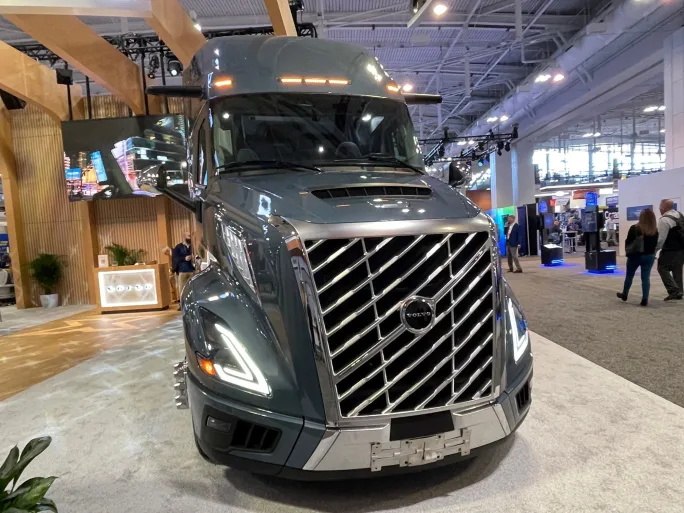
A Volvo VNL stands guard at the OEM's booth at the TMC Annual Meeting in Nashville.
Credit:
Jack Roberts
“In today’s environment, that can mean a 3% improvement in operating margin,” he said. “That’s the difference between profit and loss for many fleets.”
To support its product expansion, Volvo highlighted significant investments in North American manufacturing.
That includes more than $400 million invested in its New River Valley plant in Virginia, as well as a new $700 million facility in Monterrey, Mexico. The Mexico plant is expected to begin low-volume production later this summer.
Executives emphasized the new facility will add capacity—not replace U.S. production—as Volvo looks to grow market share.
Connectivity and OTA Updates Gain Traction
Beyond hardware, Volvo is continuing to push deeper into software-defined vehicle capabilities.
More than 220,000 Volvo trucks in North America are now connected, enabling over-the-air (OTA) updates that can be installed without taking trucks out of service.
Since expanding OTA deployment roughly six months ago, Volvo said the percentage of trucks running the latest software has jumped from about 25% to more than 80%.
That has had a measurable impact: trucks with current software are seeing 24% fewer unplanned stops, according to the company.
“Trucks today are essentially smartphones on wheels,” said product expert Maddie Sullivan. “They’re constantly improving.”
New Trailer Connector Aims to Boost Data Flow
In another forward-looking announcement, Volvo revealed it has developed a new patented tractor-trailer connector designed to handle significantly higher data throughput.
Current connectors, developed decades ago, are limited to basic lighting and braking functions. The new design is intended to support modern demands such as advanced safety systems, cameras, and telematics.
Volvo said it is working with industry partners to establish the connector as a new North American standard.
Safety Innovations Continue to Expand
Safety remains a central theme, with Volvo highlighting several features now standard on its new platform trucks.
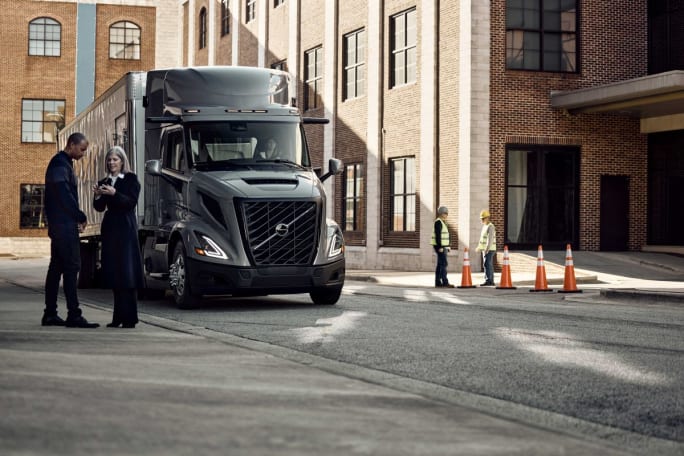
An industry-first side-curtain air bag for heavy trucks is the latest addition to Volvo's long line of vehicle safety enhancements.
Credit:
Volvo Trucks North America
Among them is an industry-first side-curtain airbag for heavy-duty trucks, along with an automatic emergency call system that contacts first responders in the event of a crash.
Optional technologies gaining traction include passenger-side blind-spot detection covering the length of a 53-foot trailer, adaptive corner lighting, and Volvo Dynamic Steering.
The OEM also emphasized the financial impact of safety systems, noting that while most crashes do not result in injuries, they can average nearly $50,000 in damage per incident.
More Equipment

Kodiak Targets Dallas–Houston for Driverless Trucks
The company says its autonomous trucks are completing the I-45 run without a safety observer taking control. It plans to remove the observer by the end of 2026.
Read More →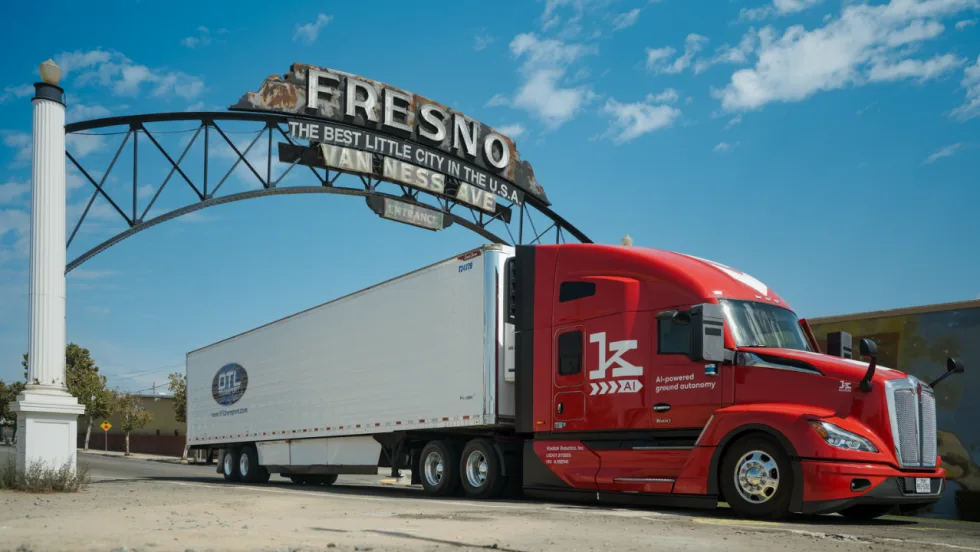
Kodiak Hauls Produce in California Autonomous Truck Pilot
Kodiak AI and DTL Transport have begun hauling produce between Fresno and Los Angeles under California’s new rules for testing heavy-duty autonomous trucks. A safety driver remains behind the wheel.
Read More →
Used-Truck Remarketing Math Is Changing
Used-truck value is no longer just a concern at trade-in. Decisions made throughout a truck’s first life can influence what it’s worth years later.
Read More →
How Volvo Updated Its D13 for EPA 2027 [Watch]
Volvo’s updated D13 promises lower emissions without sacrificing performance or fuel economy. Take a closer look at what changed inside the engine in this HDT Spotlight video.
Read More →
Michelin Tire Improves Efficiency and Durability for Regional Fleets
The Michelin X Multi Energy D2 is a regional haul drive tire engineered to help fleets improve fuel efficiency, durability and traction in demanding stop-and-go operations.
Read More →
ZF Expands Commercial Vehicle Push in North America
ZF is expanding its North American commercial-vehicle presence with new transmission applications, electrification, trailer technology and autonomous-driving systems.
Read More →
Tesla Wants a Self-Driving Semi. Are Cameras Enough?
Could Tesla’s camera-only autonomous driving technology work on an 80,000-pound Semi? In this commentary, HDT's Deborah Lockridge takes a look at Tesla, Cybercab, and how autonomous trucks see the road.
Read More →Kodiak: Driverless Long-Haul Truck Launch on Track for 2026
Kodiak AI says its driverless long-haul safety case is 93% complete and it remains on track to begin commercial operations by year-end 2026.
Read More →
What DOT’s Automated Vehicle Strategy Means for Trucking
The U.S. Department of Transportation issued a new automated-vehicle strategy that outlines plans for driverless-truck regulations, cross-state freight corridors, and federal safety standards.
Read More →
East Coast Port Launches $45M Electric Truck Push
The Port Authority of New York and New Jersey announced millions in incentives for zero-emission drayage trucks, yard tractors, and new charging hubs near the port.
Read More →